
TL;DR:
- Many purpose-built social platforms in 2026 focus on specific features like privacy or community control rather than replicating Facebook.
- Choosing multiple specialized platforms and migrating communities together helps maintain engagement and reduces the risk of abandonment.
The best facebook.com alternatives in 2026 are not clones of Facebook. They are purpose-built platforms that do one or two things better than Facebook ever did. Here is the short version of what you need to know before diving deeper:
- Minds — Open-source, crypto-enabled, community-moderated. Best for privacy-conscious creators who want to earn Ethereum tokens for their content.
- Vero — Granular audience controls (close friends, acquaintances, followers). Best for selective sharing without an algorithmic feed.
- Instagram — Photo and video with a massive influencer and commerce ecosystem. Best for visual creators who need reach.
- Diaspora — Federated, open-source, no ads, no tracking. Best for privacy-first users who want to choose their own hosting pod.
- Telegram — Cloud-based messaging with large group and channel support. Best for communities needing secure, feature-rich communication.
- Reddit — Thousands of niche subreddits with community-driven curation. Best for topic-specific engagement and anonymity.
- LinkedIn — Professional networking, job listings, and B2B content. Best for career-focused connections.
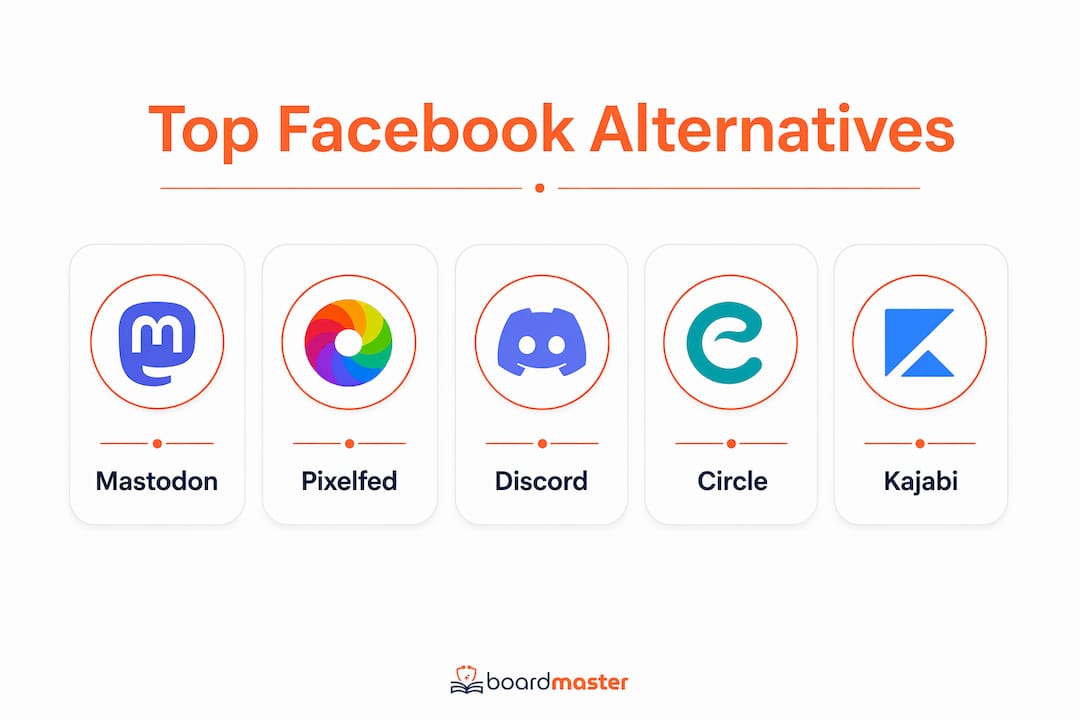
- Mastodon — Federated microblogging with chronological timelines and no ads. Best for users who want decentralized, community-governed spaces.
- Pixelfed — Ad-free, open-source, federated photo sharing with chronological feeds. Best for privacy-first photo sharing.
- Nextdoor — Neighborhood-based social networking. Best for local community engagement and hyperlocal alerts.
- Discord — Voice, video, and text chat for communities and hobbyist groups. Best for real-time group communication.
- Circle — Branded community platform with membership, courses, and events. Best for creators monetizing engaged communities.
- Mighty Networks — Community building with courses, events, and membership. Best for creators who want a branded space beyond Facebook Groups.
- Podia — Courses, digital products, and memberships. Best for educators and content creators monetizing their audience.
- Kajabi — All-in-one platform for creating and selling digital products. Best for entrepreneurs building premium communities.
- Slack — Team communication with deep productivity integrations. Best for professional and project-based collaboration.
- Signal — End-to-end encrypted private messaging. Best for users who prioritize privacy in one-on-one and group chats.
- GroupApp — Simple group tools and monetization for community leaders. Best for organizers who want a manageable platform.
- Trust Cafe (formerly WT.Social) — Ad-free, community-moderated social feed. Best for meaningful conversations without data mining.
- Snapchat — Ephemeral photo and video sharing with AR features. Best for younger audiences engaging through media-rich messages.
- Forums — Traditional niche discussion boards with long-established communities. Best for persistent, topic-specific discussions.
- X (formerly Twitter) — Real-time microblogging and public discourse. Best for fast communication and trending conversations.
- YouTube — Video sharing with comments, channels, and monetization. Best for video creators who need global reach.
- Group.app — Community hosting with membership and engagement tools. Best for organizers building paid or free communities.
- Skool — Courses plus discussion forums with gamification. Best for creators delivering structured learning with community engagement.
- Disciple — Private, branded community platform with app customization. Best for niche community builders who want full control and monetization.
No single platform replaces everything Facebook does. The right move is picking the one that fits your actual use case, not the one that looks most familiar.
How do these Facebook alternatives actually compare?
Every platform on this list solves a different problem. The table below maps each one against the dimensions that matter most when switching: what it is best for, its privacy stance, pricing, platform type, and user base scale.
| Platform | Best For | Privacy Focus | Pricing | Platform Type | User Base |
|---|---|---|---|---|---|
| Minds | Privacy-focused creators | High | Free + token economy | Decentralized | Millions |
| Vero | Selective sharing | Medium | Free (paid features planned) | Centralized | Millions |
| Visual creators | Low | Free | Centralized | Very large monthly user base | |
| Diaspora | Federated privacy | Very High | Free (self-host option) | Decentralized | Hundreds of thousands |
| Telegram | Secure group messaging | High | Free + Premium tier | Centralized | — |
| Niche communities | Medium | Free + Reddit Premium | Centralized | — | |
| Professional networking | Low-Medium | Free + Premium plans | Centralized | — | |
| Mastodon | Decentralized microblogging | Very High | Free (instance-based) | Decentralized | Millions |
| Pixelfed | Ad-free photo sharing | Very High | Free | Decentralized | Growing |
| Nextdoor | Local communities | Medium | Free | Centralized | Tens of millions |
| Discord | Real-time group chat | Medium | Free + Nitro | Centralized | — |
| Circle | Monetized communities | Medium | Paid plans | Centralized | Growing |
| Mighty Networks | Branded creator communities | Medium | Paid plans | Centralized | Growing |
| Podia | Course and product sales | Medium | Paid plans | Centralized | Growing |
| Kajabi | Premium digital products | Medium | Paid plans | Centralized | Growing |
| Slack | Professional collaboration | Medium | Free + paid tiers | Centralized | Millions |
| Signal | Private messaging | Very High | Free | Centralized | Tens of millions |
| GroupApp | Community management | Medium | Free + paid | Centralized | Growing |
| Trust Cafe | Ad-free social feed | High | Free | Centralized | Small |
| Snapchat | Ephemeral media sharing | Low-Medium | Free | Centralized | — |
| Forums | Persistent niche discussion | Varies | Varies | Centralized/Decentralized | Varies |
| X | Real-time public discourse | Low | Free + Premium | Centralized | — |
| YouTube | Video content and channels | Low-Medium | Free + Premium | Centralized | — |
| Group.app | Paid and free communities | Medium | Free + paid | Centralized | Growing |
| Skool | Structured learning + community | Medium | Paid plans | Centralized | Growing |
| Disciple | Private branded communities | High | Paid plans | Centralized | Growing |
A few platforms deserve more than a table row.
Mastodon operates on a fundamentally different model than anything else on this list. Each server is an independent entity with its own rules, enforced locally rather than by a corporate policy team. Choosing the right instance matters because each one has its own community culture, governance, and local moderation. You can follow anyone across any Mastodon server from a single account and receive posts in chronological order, with no ads and no algorithmic sorting.
Pixelfed is the closest thing to early Instagram that exists today. It is ad-free, open-source, and decentralized, defaulting to chronological feeds and running on ActivityPub, the same open protocol that powers Mastodon. It launched official iOS and Android apps in January 2025, which significantly lowered the barrier to entry.

Discord has quietly become one of the most active community platforms on the internet. Its voice channels set it apart from text-only alternatives, and its server structure maps well onto the kind of group-based social life that Facebook Groups used to serve. The free tier is genuinely usable; Nitro adds cosmetic and file-size upgrades.
Circle, Mighty Networks, Skool, and Disciple all occupy a similar space: paid community platforms that give creators control over membership, content, and monetization. The differences come down to depth. Circle and Mighty Networks lean toward course hosting alongside community. Skool adds gamification to keep members engaged. Disciple goes furthest on app customization, letting niche builders white-label the entire experience.
Kajabi and Podia are primarily course and product platforms that happen to include community features. If your primary goal is selling digital products and you want community as a secondary layer, either works well. If community is the core, Circle or Mighty Networks fit better.
Trust Cafe (formerly WT.Social) was created by Wikipedia co-founder Jimmy Wales specifically as a non-toxic, ad-free alternative. It does not collect or sell user data, and advertisers do not control the feed. The user base remains small, but the moderation philosophy is genuinely different from most platforms.
Minds uses an Ethereum-based token system to reward content creators, which is unusual enough to be worth noting. It also employs a decentralized governance model where randomly selected users vote on content moderation decisions. The infrastructure is not fully decentralized in the way Mastodon or Diaspora are, but the governance model is closer to community control than most centralized platforms.
On integration and device compatibility: Discord, Slack, Telegram, and Reddit all offer strong mobile apps across iOS and Android, plus desktop clients. Mastodon and Pixelfed have multiple third-party client apps on both platforms. LinkedIn, Instagram, X, YouTube, and Snapchat are mobile-first with full-featured apps. Circle, Mighty Networks, Kajabi, and Podia are primarily web-based with mobile access through apps or responsive browsers.
How do you choose the right platform for your needs?
The single most useful reframe here: stop searching for a Facebook clone. No platform replicates Facebook's full feature set, and the ones that try tend to do everything adequately and nothing well. Start with what you actually use Facebook for, then find the platform built specifically for that.
Here are the decision criteria worth working through:
- Privacy level. If data tracking and ad targeting bother you, the decentralized options (Mastodon, Pixelfed, Diaspora) and encrypted messengers (Signal, Telegram) are the only ones that structurally prevent it. Centralized platforms, even ad-free ones, still collect usage data.
- Content format. Photo-heavy? Instagram or Pixelfed. Video? YouTube. Text and links? Reddit, X, or Mastodon. Real-time chat? Discord, Telegram, or Slack. Long-form courses? Kajabi, Podia, or Skool.
- Community size vs. niche depth. Reddit has scale but also noise. A well-run Discord server or a Mighty Networks community can feel tighter and more purposeful, even with fewer members.
- Moderation style. Centralized platforms enforce top-down rules. Decentralized ones let each instance or server set its own standards. Neither is universally better; it depends on whether you trust the platform or prefer local governance.
- Monetization. If you create content and want to earn from it, Minds (tokens), YouTube (ad revenue), Circle, Kajabi, Podia, Skool, and Disciple all offer direct monetization paths. Instagram and X have creator programs, but the terms change frequently.
- Professional vs. personal. LinkedIn is the only platform on this list built specifically for professional networking. Slack works well for professional communities but is not a social network in the traditional sense.
Decentralized vs. centralized: what it actually means for you
Decentralized platforms like Mastodon, Pixelfed, and Diaspora store your data on independent servers rather than a single corporate database. You choose which server to trust, or you run your own. The tradeoff is complexity: setup takes more effort, and the user experience varies by instance. Centralized platforms are easier to join and often have larger user bases, but a single company controls your data, your feed, and your account status.
For most casual users, a centralized alternative like Discord, Reddit, or Nextdoor is the practical starting point. For users with genuine privacy concerns or a preference for community governance, Mastodon or Diaspora are worth the extra setup time.
Pro Tip: When moving a community to a new platform, bring the group together rather than migrating alone. A community-based transition dramatically reduces the "ghost town" feeling that kills most platform migrations before they gain traction.
Testing multiple platforms simultaneously is a reasonable strategy, especially for creators. Run your primary community on one platform, maintain a presence on one or two others, and see where engagement actually happens before committing fully. The cost of maintaining a presence on Mastodon and Reddit at the same time is low; the cost of betting everything on a platform that loses momentum is high.
Why are people leaving Facebook for other platforms?
The reasons are specific and documented, not vague dissatisfaction. Facebook data belonging to 533 million users was leaked, a figure that landed in headlines and stuck in public memory. The Cambridge Analytica scandal before it showed that user data could be harvested at scale without meaningful consent. These are not abstract privacy concerns; they are concrete events that changed how people think about what they share and where.
Beyond the data issues, several other factors are pushing users toward alternatives:
- Ad saturation. Facebook's feed is heavily monetized, and the ratio of ads to organic content has shifted noticeably over the years.
- Algorithmic manipulation. The feed prioritizes content that drives engagement, which tends to mean emotionally charged or controversial posts rather than posts from people you actually care about.
- Chronological feed removal. Many users want to see posts in the order they were published. Facebook's algorithm makes that nearly impossible without workarounds.
- Mental health concerns. Research has linked heavy use of algorithmically curated social feeds to increased anxiety and comparison-driven thinking. Platforms with chronological feeds and no engagement optimization remove a significant source of that pressure.
- Data tracking across the web. Facebook's tracking pixels follow users across third-party websites, building behavioral profiles that extend far beyond the platform itself.
- Power concentration. A single company controlling the social infrastructure for billions of people creates risks that go beyond privacy: content moderation decisions, political advertising policies, and platform access all sit with one organization.
- Demand for niche spaces. General-purpose social networks serve everyone, which means they serve no one particularly well. Specialized platforms like Reddit's subreddits, Discord servers, or Nextdoor's neighborhood focus deliver more relevant, focused interactions.
The mental health angle is worth taking seriously. Platforms like Mastodon and Pixelfed, which show posts chronologically and do not optimize for engagement, remove the feedback loop that makes social media compulsive for many users. That is a structural difference, not a feature toggle.
What trends are shaping social networking in 2026?
The clearest shift in social networking right now is the move from all-in-one centralized platforms toward federated and specialized ecosystems. Digital media experts describe this as a break from attention-economy algorithms, giving communities direct control over content and moderation rather than delegating that power to a corporate feed.
The technical foundation making this possible is ActivityPub, an open protocol that lets different apps communicate across federated networks. Mastodon, Pixelfed, and PeerTube all use it, as does Meta's Threads. Users on ActivityPub-based networks can interact across different apps the way email users can send messages between Gmail and Outlook. Bluesky uses a different open protocol called AT Protocol, which powers apps like Flashes and Pinksky, both of which are building photo-first experiences on top of Bluesky's existing social graph.
The practical implication: you do not need to rebuild your network from scratch when you move to a federated platform. Your connections can follow you across compatible apps.
Creators are also responding to platform instability by diversifying across multiple specialized platforms rather than concentrating on one. A creator might publish long-form video on YouTube, run a paid community on Circle or Skool, maintain a newsletter on Substack, and keep a presence on Mastodon for public conversation. Each platform serves a different function, and no single algorithm change can wipe out the whole operation.
The "critical mass" problem remains the biggest obstacle to decentralized platform adoption. Smaller platforms feel empty compared to Facebook because they are, at least initially. The most effective mitigation strategy is community-based migration: moving an existing group together rather than joining alone. When a Discord server, a subreddit, or a Mastodon instance already has the people you want to talk to, the network effect starts working in your favor instead of against you.
BoardMaster gives medical students a sharper study network
Social platforms help you stay connected. BoardMaster helps you stay ahead of your class.
If you are a medical student who has been using Facebook Groups or Discord servers to share notes and quiz each other before exams, BoardMaster offers something those platforms cannot: questions generated directly from your own lecture notes, calibrated to what your professors actually emphasize. Upload your slides, and BoardMaster produces USMLE-style practice questions targeting the high-yield content in your specific course. One student, Sarah, moved from the 73rd to the 92nd percentile while cutting her study hours in half by focusing on BoardMaster's targeted questions instead of generic question banks. That kind of efficiency is not something a group chat can replicate. See how it works with the AI question generator demo, or explore the full USMLE prep platform to get started.
FAQ
What do millennials use instead of Facebook?
Millennials have largely shifted toward Instagram for visual content, Reddit for community discussion, and Discord for group communication. LinkedIn serves professional networking, while Mastodon and Signal attract those with stronger privacy preferences.
What is the best open-source alternative to Facebook?
Mastodon and Diaspora are the leading open-source alternatives. Mastodon focuses on microblogging with federated servers and no ads, while Diaspora offers a more Facebook-like feed structure with user-controlled data pods and no advertising or tracking.
Are decentralized social networks harder to use than Facebook?
They require more setup, particularly choosing a server or pod, but platforms like Mastodon have improved significantly with better onboarding and official apps. Once you are on an instance that fits your interests, the day-to-day experience is straightforward.
Which platform is best for building a paid community?
Circle, Mighty Networks, Skool, and Kajabi all support paid memberships with varying depths of course and event tools. Skool adds gamification; Kajabi includes marketing automation; Circle and Mighty Networks focus on community engagement with course hosting as a secondary feature.
Can you really replace Facebook with one platform?
No. Experts consistently recommend choosing by function rather than looking for a single replacement. Pick Pixelfed for photos, Mastodon for public conversation, Discord for group chat, and LinkedIn for professional networking. The combination covers most of what Facebook does, often better.
Key Takeaways
No single platform replaces Facebook completely; the most effective approach is choosing two or three platforms matched to your specific use cases, whether that is privacy, community building, content creation, or professional networking.
| Point | Details |
|---|---|
| Function over familiarity | Choose platforms built for your actual use case (photos, chat, professional networking) rather than the one that looks most like Facebook. |
| Decentralized options offer the strongest privacy | Mastodon, Pixelfed, and Diaspora store no centralized user data and serve no ads, making them the top picks for privacy-conscious users. |
| Community migration beats solo switching | Moving an existing group together to a new platform solves the critical mass problem that makes smaller alternatives feel empty at first. |
| Creators should diversify across platforms | Spreading presence across YouTube, Circle or Skool, and a federated network reduces risk from any single platform's algorithm or policy changes. |
| BoardMaster for medical students | BoardMaster generates USMLE-style questions from your own lecture notes, targeting the content your professors emphasize rather than generic board material. |