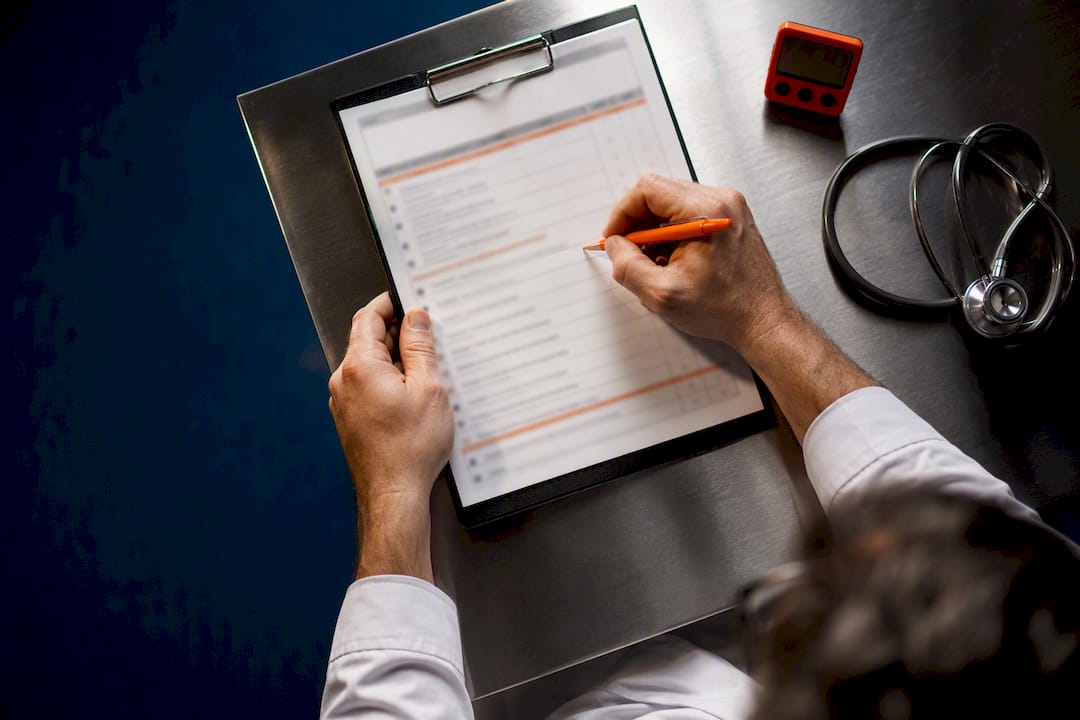
The most effective way to run clinical skills exam practice online is a blend of rubric-scored simulated patient encounters and targeted procedural drills, not passive video review. Pair timed OSCE-style stations with focused checklists for exam skills like auscultation or ECG reading, then review feedback against a rubric. BoardMaster is a practical starting point for this exact mix. Begin with one short, timed station today.
TL;DR:
- Focus on timed, rubric-aligned simulated patient encounters and procedural drills for effective online clinical skills practice; passive videos are insufficient.
- Different virtual formats train distinct skills: live standardized patients for communication, AI simulations for history-taking, and procedural simulators for technical recognition.
- Prioritize practice that enforces timing and verbalization, and regularly review transcripts against rubrics to identify specific areas for improvement.
- Use platforms like BoardMaster for targeted, exam-aligned practice, ensuring feedback is detailed and case variety is comprehensive.
- Incorporate daily short drills, focused midweek stations, and full timed runs into your schedule, while supplementing with official resources for calibration.
Table of Contents
- What Does Online Clinical Skills Practice Actually Include?
- Which Practice Format Trains Which Skill?
- How Do You Choose the Right Clinical Skills Practice Platform?
- What Does a Realistic Weekly Study Schedule Look Like?
- How BoardMaster Fits Into Exam-Focused Practice
- Do These Platforms Work on Any Device?
- Simulation vs. Supervised Practice: Where Each One Wins
- Get Started With BoardMaster
- Trusted Resources to Pair With Online Practice
- Sources
- FAQ
What Does Online Clinical Skills Practice Actually Include?
"Clinical skills exam practice online" covers more ground than most students realize before they start looking. It spans four distinct categories, and each one trains a different muscle. Confusing them, or leaning on only one, is why some students ace communication but freeze on procedural interpretation, or vice versa.
- Virtual standardized patient encounters: Text or video-based conversations with a simulated patient, used to practice history-taking, rapport, and information-gathering under time pressure.
- AI or voice-based simulations: Spoken conversations scored against a rubric, generating a transcript you can review line by line.
- Procedural simulations: ECG interpretation, auscultation libraries, and ultrasound walkthroughs that build recognition speed for technical findings.
- Quizzes and self-assessment: Quick knowledge checks that catch content gaps before they surface mid-station.
The best virtual exams mirror in-person OSCEs closely: a countdown timer, a card with station instructions, and an expectation that you verbalize physical exam maneuvers rather than skip them. If your practice tool doesn't enforce timing or require verbalized exam steps, it's teaching you a different skill than the one you'll be tested on.
Which Practice Format Trains Which Skill?
Not every format earns equal time. Matching the format to your weak spot is the fastest way to close a gap instead of just logging hours.
- Live standardized patient sessions. Nothing beats a real person reacting to your tone and follow-up questions in real time, with an examiner watching how you handle the unexpected. These sessions are the gold standard for communication nuance, but they're harder to schedule repeatedly.
- AI or voice simulations. These let you run the same case type ten times in a week, and platforms like ClinicalSim score the conversation against a competency framework and hand back a transcript tied to that rubric. That transcript evidence is what turns a vague "you did fine" into an actual study plan.
- Procedural sims and audio libraries. Recognizing an S3 gallop or a rhythm strip takes repetition, not reading. Platforms such as SIMTICS offer over 200 procedural simulations built for exactly this kind of pattern drilling.
- Full timed station runs with note-writing. This is the integration test: can you take a history, examine verbally, and write a clean patient note before the buzzer, all in one continuous run?
Skip step 4 and you'll find out on exam day that your note-writing speed is the bottleneck, not your clinical reasoning.
How Do You Choose the Right Clinical Skills Practice Platform?
Most platforms look similar from a marketing page. The differences show up the moment you actually run a case.
- Realism and timing. Does it enforce a countdown and station transitions, or let you pause indefinitely?
- Rubric alignment. Is feedback tied to a recognizable framework, or just a generic "good job" score? Tools that map cases to AAMC or ACGME-style competencies make it easier to see exactly where you lost points.
- Feedback detail. Look for transcript highlights, not just a number. A score without evidence tells you nothing about what to fix.
- Case variety. One or two case types won't prepare you for exam-day breadth.
- Note-writing practice. If the platform skips this, you're only training half the encounter.
- Scheduling and cost. Some full simulated exam packages, like Kaplan's 6- or 12-station format, run at a premium price point, which matters if you need frequent repetition rather than one big rehearsal.
Red flags are easy to spot once you know to look: passive video walkthroughs with no interaction, no visible timer, or feedback that's just a pass/fail stamp.
Pro Tip: Before you commit to any subscription, run exactly one timed station on the free tier or demo. If the feedback names specific phrases you used or missed, it's worth your money. If it just gives you a percentage, keep looking.
What Does a Realistic Weekly Study Schedule Look Like?
Cramming stations the night before an OSCE almost never works, because the skill being tested is fluency under time pressure, and fluency needs spacing.
- Daily micro-drills (20 to 30 minutes). Rotate through auscultation clips, ECG strips, or a single short history-taking prompt. Small and frequent beats long and rare.
- Two focused stations midweek. Pick your weakest category, run it twice, and compare your transcript to the rubric line by line.
- One full timed run weekly. Complete the whole sequence, exam, note, and rubric review, treating it as a dress rehearsal.
- Handbook cross-reference. Read the relevant section of your institution's clinical handbook or a resource like the Oxford Handbook alongside your simulation results, since pairing short simulation bursts with focused handbook study helps you pick up both the correct procedural steps and the phrasing examiners expect to hear.
- Build a remediation checklist. Every time a rubric flags a missed step, write it down. Rubric-linked transcript evidence is only useful if you turn it into a short, specific to-do list you check off week over week.
This is where the comprehensive guide to structuring OSCE-style practice can help you map out station order and pacing before you build your own calendar.
How BoardMaster Fits Into Exam-Focused Practice
BoardMaster was built around one specific problem: students burn hours studying material that isn't actually tested the way their course or board exam expects. That same logic applies to clinical skills prep.
- AI OSCE practice sessions available around the clock, so you're not limited by scheduling a standardized patient.
- Rubric-aligned feedback that flags missed steps instead of handing back a bare score.
- AI role-play scenarios for history-taking and communication, built to mirror real station formats.
- Checklist generation pulled from your own weak spots after each run.
- Tailored question sets generated from your uploaded lecture notes, so board-style prep and class exam prep reinforce each other instead of pulling in two directions.
One student used BoardMaster's targeted question sets to significantly improve her percentile ranking while substantially reducing her study time. That's a single illustrative case, not a guarantee, but it shows what happens when practice targets the right material instead of everything at once. The AI OSCE practice feature is where that same targeting applies to clinical skills specifically.
Do These Platforms Work on Any Device?
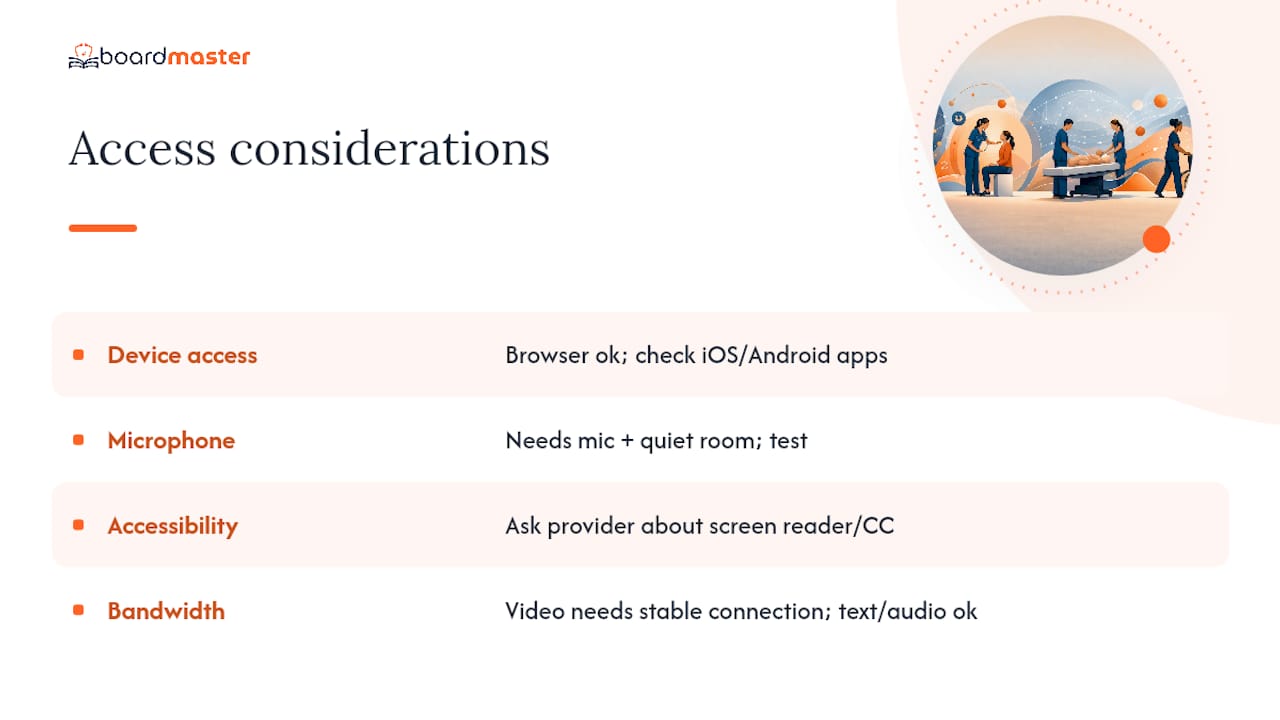
Access matters more than most students plan for, especially when you're squeezing in a 20-minute drill between rotations. Most modern clinical skills platforms run in a browser, which means no installation and no compatibility headache across Windows, macOS, or Chromebook. Several also offer dedicated mobile apps, and checking for iOS and Android availability before you subscribe is a quick way to confirm you won't be stuck at a desktop for every session.
Voice-based simulations need a working microphone and a quiet room, which sounds obvious until you're trying to practice a history-taking station in a shared apartment or a busy library. Some platforms include a headset-friendly mode or noise filtering, but not all do, so test the audio setup during any free trial before you commit.
Screen readers and closed captioning are less standard across this category than they should be. If you rely on either, ask the provider directly rather than assuming support exists, since accessibility features vary widely between platforms built for casual review and ones built for exam simulation.
Bandwidth is the last quiet dealbreaker. Video-based standardized patient sessions need a stable connection, while text and audio-transcript formats tend to run fine on slower Wi-Fi. If your connection is inconsistent, lean toward voice or text simulations over live video streaming, and save the bandwidth-heavy formats for when you're on a reliable network. Practicing on your phone during a commute is realistic for quiz-style review; it's a poor substitute for a full timed station run that deserves your full attention and a quiet room.
Simulation vs. Supervised Practice: Where Each One Wins
Simulations are unmatched for repeatable, low-stakes drilling. You can run the same history-taking case five times in an evening and get consistent, rubric-based feedback every time. What they can't fully replace is a live examiner calibrating your performance against real candidates, or a standardized patient reacting to subtle nonverbal cues. Use simulations to build fluency between rotations, and prioritize supervised sessions in the weeks right before a high-stakes exam.
— Dr. Ahmed Abuzoor
Get Started With BoardMaster
BoardMaster gives you a faster path to exam-ready clinical skills than piecing together disconnected videos and generic question banks. It maps AI OSCE practice, rubric-based feedback, and tailored question generation directly to what your course and boards actually test, instead of covering everything at equal weight.
Signing up starts with the free tier, so you can run a real timed station before deciding whether to upgrade. A first session typically means picking a case type, whether history-taking, communication, or a procedural walkthrough, and getting rubric-scored feedback with specific highlights instead of a bare score. If you've read scenario ideas on the OSCE role-play scenarios guide, you can put that same structure to work inside your own practice session. Pair it with a resource like AmmarAI's guide to studying smarter with AI if you want a broader look at responsible AI-assisted study habits alongside exam-specific drilling. Head to BoardMaster and run your first timed station today.
Trusted Resources to Pair With Online Practice
Simulations work best alongside a few outside anchors that keep your terminology and station expectations accurate.
- Institutional LibGuides. Georgetown University's Test Preparation Guide curates eBooks, videos, and structured resources specifically for OSCE and clinical skills prep.
- Procedural simulation libraries. Tools that combine ECG, auscultation, and step-by-step procedural walkthroughs with rubric scoring reinforce the technical side of station performance.
- Free official sample cases. The Medical Council of Canada publishes free sample cases and videos that show real station structure and examiner expectations, useful for calibrating what "normal" pacing looks like before you build your own routine.
Cross-checking your simulation results against these references keeps your practice grounded in what examiners are actually trained to look for, rather than what feels comfortable to rehearse.
Sources
- SIMTICS online healthcare simulation training | Wolters Kluwer
- AI clinical simulation for medical communication | ClinicalSim
- CliniSim | OSCE History Taking Practice
- USMLE Clinical Skills Practice - Full Simulated Exam | Kaplan Test Prep
FAQ
What Is the Best Way to Practice Clinical Skills Exams Online?
A blend of timed, rubric-scored simulated patient encounters and focused procedural drills works better than passive video review, since it forces you to perform under the same time pressure and format as the real exam.
Are AI Clinical Skills Simulations Accurate Enough to Rely On?
AI voice-based tools like ClinicalSim score conversations against competency frameworks and provide transcript evidence, which makes them reliable for communication and history-taking practice, though supervised sessions still matter for hands-on physical exam assessment.
How Many Practice Stations Should I Run Before an Exam?
There's no fixed number, but a realistic pattern is daily short drills, two focused stations midweek, and one full timed run weekly, building toward a full simulated exam of 6 or 12 stations closer to your test date.
Can BoardMaster Help With Clinical Skills Exam Prep Specifically?
Yes. BoardMaster's AI OSCE practice sessions offer rubric-aligned feedback and role-play scenarios generated from your own course material, alongside tailored question sets for class and board exams.
Do I Still Need In-Person Standardized Patient Sessions?
Yes. Simulations are excellent for repeatable drilling, but live sessions with an examiner and a real standardized patient remain important for calibrating your performance against actual exam conditions before high-stakes assessments.