
A single, generic study plan fails because it ignores individual knowledge gaps, pacing, and professor-specific learning objectives. Medical students who use AI-generated, objective-aligned practice questions instead of generic question banks saw daily self-study time rose substantially and satisfaction improved notably. A separate pilot using ChatGPT-generated questions tied to faculty objectives produced significant score gains on some exams.
The fix isn't more content. It's aligned content.
- Map your lecture objectives before choosing any resource.
- Generate or find practice questions tied to what your professor actually tested last time.
- Layer in spaced repetition, then track weak spots with analytics instead of guessing.
Key Takeaways
Personalized, professor-aligned study consistently outperforms generic, one-size-fits-all resources because it targets the exact material students are tested on.
| Point | Details |
|---|---|
| Uniform plans ignore fit | Prior knowledge, pace, and course-specific objectives vary too much for one resource to serve everyone. |
| Alignment drives results | ChatGPT-generated questions tied to faculty objectives produced significant score gains on two of five exams. |
| Generic overload has costs | Using three or more commercial resources was weakly linked to lower exam scores in one study. |
| Feedback must be continuous | Weekly self-assessment against analytics prevents drift back into unfocused, generic study habits. |
| BoardMaster implements the workflow | It converts lecture slides into professor-aligned questions and flashcards with built-in analytics. |
Table of Contents
- Why Uniform Study Plans Fail for Medical Students
- The Real Cost of Generic Study Plans
- What Personalized, Professor-Aligned Study Actually Looks Like
- Build a Professor-Aligned Study Workflow This Week
- What the Evidence Says About Personalized and AI-Driven Study
- Your Dedicated Preparation Period Checklist
- How to Evaluate Any Study Tool Before You Commit
- Cognitive Biases That Undermine Standardized Study Methods
- Building Self-Assessment Into Your Study Cycle
- A Field Note on Testing This Workflow
- Try the Professor-Aligned Workflow With BoardMaster
- Sources
- FAQ
Why Uniform Study Plans Fail for Medical Students
Every student walks into second-year pharmacology with a different foundation. One classmate aced biochemistry; another is still shaky on enzyme kinetics. A single downloaded study plan can't account for that spread, and it definitely can't account for the fact that your cardiology professor tests differently than the board exam does.
Three mechanisms explain the failure pattern:
- Prior knowledge gaps compound. A generic resource assumes a flat starting line that doesn't exist.
- Curriculum misalignment splits attention. When a commercial question bank emphasizes different content than your syllabus, you end up studying two curricula instead of one.
- Cognitive load isn't evenly distributed. Retrieval practice and spaced repetition help most when the material matches what you'll actually be tested on; generic resources dilute that match.
The data backs this up. Voluntary use of a targeted practice-question tool, ScholarRx's Qmax, was significantly associated with higher CBSE scores and with taking and passing Step 1 on schedule, in both traditional and integrated curricula. That's not a coincidence of motivated students self-selecting into good habits. It's what happens when practice content tracks the actual exam.
The Real Cost of Generic Study Plans
The damage from one-size-fits-all study isn't abstract. It shows up in your calendar, your bank account, and your exam performance.
Consider what happens when students lean almost entirely on lecture slides as their primary study material. One study found this pattern in 94.7% of respondents, and the authors flagged a real risk: "death by PowerPoint" pushes students toward shallow recall instead of the kind of understanding that survives a board exam. Layer onto that the tendency to buy three or more commercial review resources, which 54.5% of students do and which correlates weakly with lower exam scores when overused.
Here's the harm list in plain terms:
- Persistent knowledge gaps that surface right before the exam, not during study time when you could still fix them.
- Wasted hours during your Dedicated Preparation Period spent re-learning content your lectures already covered well.
- Financial strain: median DPP spending runs $650, and a quarter of students report that spending strained their finances, which correlates with worse wellbeing during prep.
Pro Tip: This week, pull up one lecture's stated objectives and compare them line by line against whatever resource you're currently using for that topic. If less than half the objectives are covered, you've found your gap.
What Personalized, Professor-Aligned Study Actually Looks Like
Personalized study isn't a vague ideal. It's a specific set of components working together: learning objectives mapped from your actual lectures, practice questions generated from that mapping, spaced-repetition flashcards reinforcing the same material, analytics that flag your weak spots, and a faculty-review step that catches anything an algorithm gets wrong.
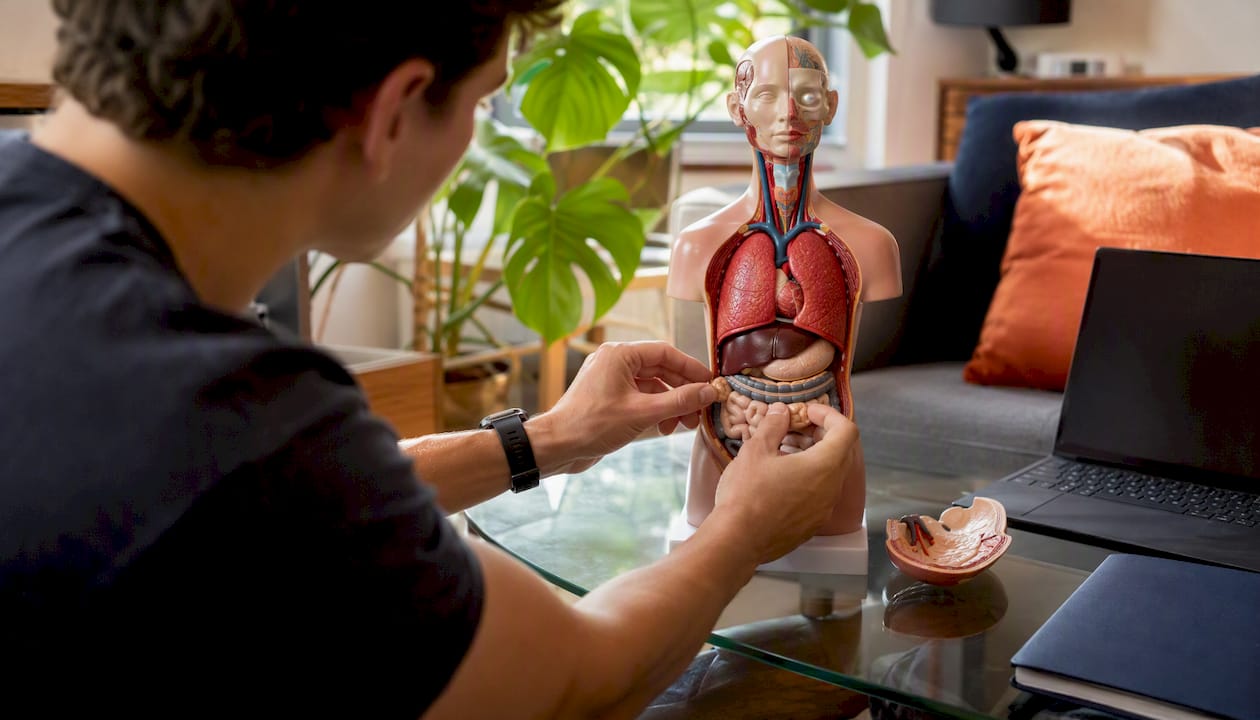
AI makes the first two steps fast. Upload lecture slides, and a well-designed system extracts what your professor actually emphasized, then converts that into USMLE-style questions reflecting the same weighting. This isn't the same as buying a static question bank written for a national average student. It's questions written for your class, your professor, your exam.
A typical workflow: you upload a 40-slide renal physiology lecture. Within minutes, you get a 20-question practice set weighted toward the concepts your professor spent the most time on, a matching flashcard deck for spaced review, and a short practice schedule spanning the next five days. Anki-style spaced repetition correlates with better standardized exam performance, though the effect varies by subject and tends to be smaller for application-heavy content, which is exactly why the practice-question layer matters as much as the flashcards.
Build a Professor-Aligned Study Workflow This Week
You don't need a semester-long overhaul. You need five repeatable steps.
- Extract learning objectives. Pull the actual objectives from your syllabus or lecture slides rather than assuming a review book covers the same ground.
- Generate and validate practice questions. Convert those objectives into questions, then spot-check a handful against your lecture content for accuracy.
- Schedule spaced-repetition cycles. Set flashcard reviews at increasing intervals, tied to the same material the questions cover.
- Use analytics to reprioritize. Whatever tool you use, track which topics you're missing repeatedly, and shift time there instead of re-reviewing what you already know.
- Run rapid faculty checks. Where possible, verify AI-generated content against what your professor emphasized in lecture or office hours.
For a 4 to 8 week Dedicated Preparation Period, this scales into weekly blocks: one system-based topic per week, question sets front-loaded early, spaced-repetition review compounding through the following weeks. For ongoing term-time study, the same five steps just run on a smaller, weekly cycle tied to whatever lecture just happened.
Pro Tip: Standardize your prompts if you're generating your own questions with a general AI tool. One pilot found that after standardizing ChatGPT prompts, question quality improved and revision time dropped, because vague prompts produce inconsistent, low-yield questions.
What the Evidence Says About Personalized and AI-Driven Study
The strongest signal isn't a single study. It's a pattern across several independent ones. A separate cohort using ChatGPT-generated practice questions aligned to faculty objectives scored significantly higher on two of five exams after usage climbed from 12.1% to 36.4% of the class.
That gain didn't happen automatically. It required safeguards:
- Faculty review of AI-generated questions before students saw them, catching inaccuracies early.
- Standardized prompting, which measurably improved question quality and cut revision time.
- Longitudinal tracking, so students and instructors could see whether gains held up on later exams, not just the next quiz.
Faculty guidance on Competency-Based Medical Education points the same direction: individualized pathways, not fixed timelines, produce mastery. The consistent thread across pilot data and CBME frameworks is that alignment and personalization together, not either alone, drive the improvement.
Your Dedicated Preparation Period Checklist
Before your DPP starts, run through this list once. During the DPP, revisit it weekly.
- Map every system's learning objectives against your board exam's content outline before picking resources.
- Choose practice-question sets weighted toward your weak areas, not just whatever is most popular.
- Set spaced-repetition targets per week rather than cramming flashcards at the end.
- Schedule at least one faculty or mentor spot-check per system to catch misaligned content early.
- Track your own analytics weekly, and treat a stalled score as a signal to re-map, not push harder blindly.
For a 4 to 8 week DPP, that's roughly one system per week for content mapping, with spaced review compounding underneath. For weekly term-time study, compress the same checklist into a Sunday planning session.
On cost: prioritize one well-aligned tool over three overlapping ones. Given that median DPP spending already runs $650, consolidating around a single, curated system tends to protect both your wallet and your schedule better than stacking subscriptions.
How to Evaluate Any Study Tool Before You Commit
Run every study tool, including BoardMaster, through the same six-point rubric before you pay for it:
- Does it align directly with your lecture objectives, or just a generic national curriculum?
- Can it generate professor-weighted practice questions, not just a static test bank?
- Does it support spaced repetition with minimal manual setup?
- Does it give you analytics that flag specific weak topics, not just an overall percentage?
- Is there any faculty-review or expert-validation layer behind the content?
- Is the cost reasonable relative to what you're already spending on other resources?
Faculty researchers reviewing external resource integration in medical curricula recommend exactly this kind of curated approach: student autonomy within a framework aligned to institutional objectives, rather than uncoordinated resource-hopping.
One BoardMaster user, Sarah, moved from the 73rd to the 92nd percentile on practice exams while cutting her weekly study hours roughly in half, after switching from a generic question bank to questions generated directly from her own lecture material.
Pro Tip: Test any new tool on a single lecture before committing to a full course. Upload one set of slides, review the generated questions against what you remember your professor emphasizing, and judge the fit before you scale up.
Cognitive Biases That Undermine Standardized Study Methods
Fixed mindsets do a lot of quiet damage during medical school. The most common one: assuming a resource that worked for a friend, or that ranks highly online, will work the same way for you. That's the sunk-cost trap of buying yet another commercial review book because everyone else seems to swear by it, rather than checking whether it actually covers what your professor tests.
Confirmation bias shows up too. Students tend to keep using a familiar resource even after noticing gaps, because switching feels like starting over. That's a costly assumption when the resource was never built to reflect your specific curriculum.
There's also the illusion of competence that comes from passive review. Rereading slides feels productive because it's easy, but recognition isn't recall. Retrieval practice, actually generating an answer without looking, is uncomfortable by comparison, which is exactly why students avoid it and why generic slide-based study persists longer than it should.
Anchoring bias plays a role in how students choose board-prep tools, too. Once a student picks a resource in first year, they often stick with it through boards regardless of fit, simply because switching costs feel higher than they actually are. Breaking that pattern requires treating your study tools the same way you'd treat a differential diagnosis: reassess when the evidence changes, not out of habit. A fixed mindset treats "the way I've always studied" as identity. A growth-oriented approach treats it as a hypothesis to test against your actual exam results.
Building Self-Assessment Into Your Study Cycle
Personalization isn't a one-time setup. It requires continuous feedback, or it drifts back into guesswork within a few weeks.
The simplest self-assessment loop: after every practice question set, tag each miss by why you missed it, not just what topic it covered. Was it a knowledge gap, a misread question stem, or a reasoning error under time pressure? Those three categories require completely different fixes, and lumping them together as "I got it wrong" wastes the diagnostic value of the question.
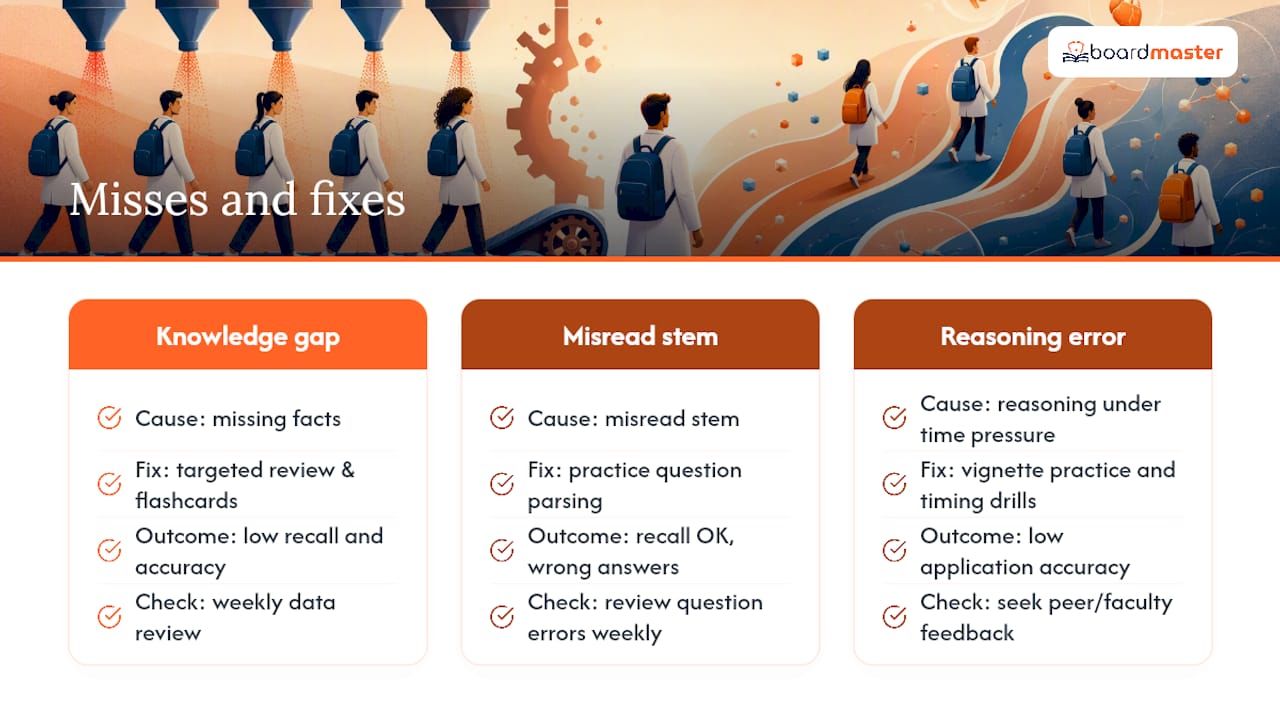
Weekly, compare your practice-question accuracy against your flashcard retention rate for the same topics. A mismatch, high flashcard recall but low question accuracy, usually signals that you know facts but haven't practiced applying them, which matters enormously once boards shift toward vignette-style clinical reasoning.
Analytics dashboards help here, but they're only useful if you actually act on what they show. Set a fixed check-in, say every Sunday, to review which topics your data flags as weak and reallocate the coming week's practice accordingly. This is the same principle behind CBME's individualized pathways: mastery gets reassessed continuously, not assumed once and left alone.
Don't skip peer or faculty feedback either. A classmate or TA can catch reasoning errors an algorithm might miss, especially on complex clinical-integration questions where the "right" answer depends on nuance a question bank can't always capture.
A Field Note on Testing This Workflow
Running the lecture-to-question workflow against a single cardiology unit made the gap obvious fast: half the practice questions students were using came from content their professor never emphasized. Once the mapped, faculty-aligned questions replaced the generic set, review time dropped and the practice-quiz accuracy on that unit climbed within a week. The micro-advice that stuck: always check the first ten generated questions against your actual slides before trusting the rest of the set.
Try the Professor-Aligned Workflow With BoardMaster
BoardMaster is built specifically to run the workflow this article just walked through. Upload your lecture slides, and it generates USMLE-style practice questions weighted toward what your professor actually emphasized, then pairs them with spaced-repetition flashcards and analytics that flag your weakest topics automatically.
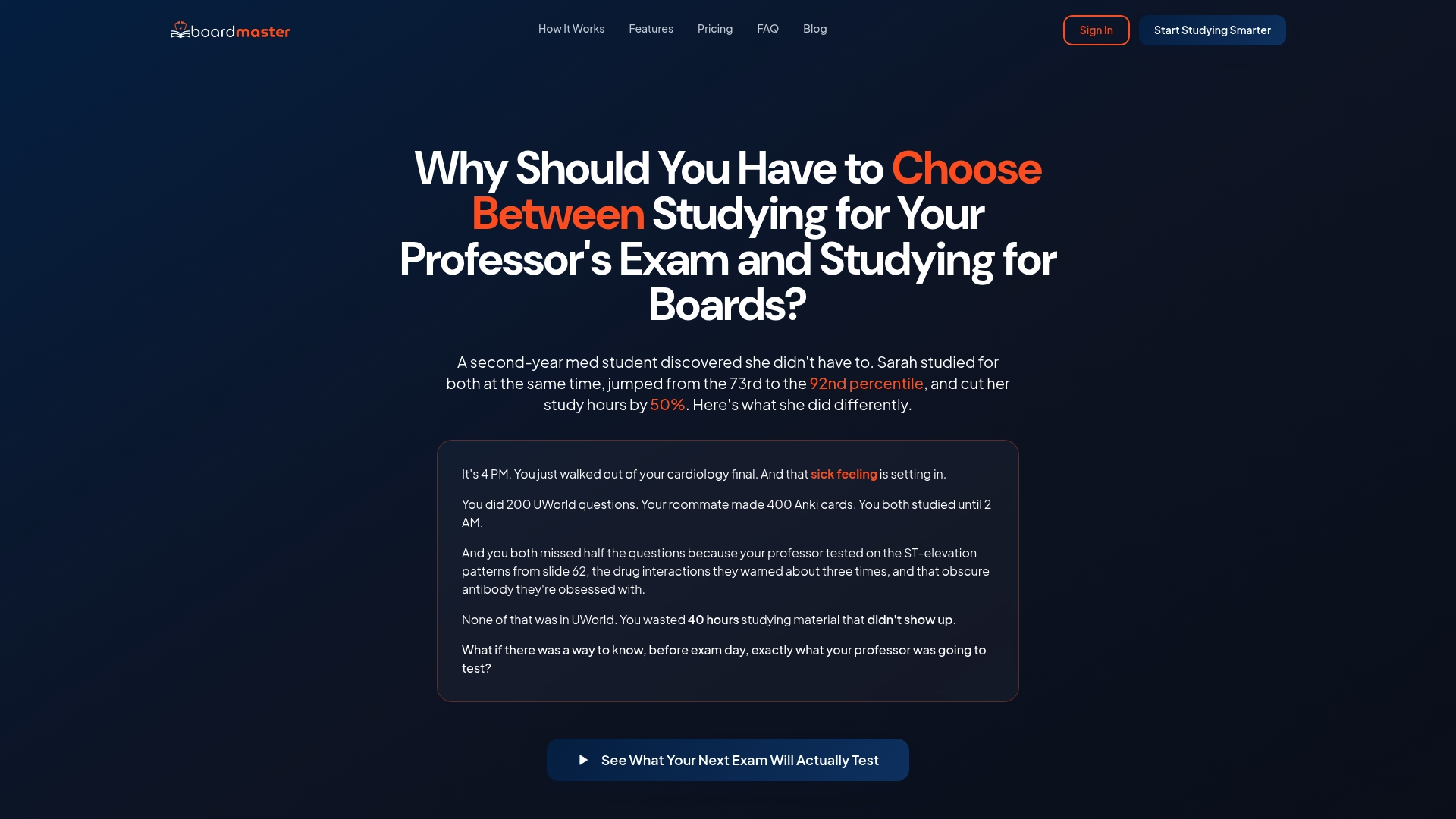
A simple way to test it: upload one recent lecture and ask it to generate a practice set focused specifically on the professor's stated learning objectives, then compare the output against your own notes. If you're heading into board prep specifically, the USMLE prep tools extend the same lecture-aligned approach across your full DPP. You can also see the lecture-to-question conversion in action before committing to a plan.
Sources
- Evaluation of the impact of AI-driven personalized learning platform on medical students’ learning performance - PMC
- Using ChatGPT-Generated Practice Exam Questions in Medical Education (digitalcommons_unmc)
- Association between ScholarRx Qmax question bank engagement and NBME CBSE and USMLE Step 1 performance - Springer (BMC)
- Exploring the usage of learning resources by medical students in the basic science stage and their effect on academic performance - BMC Medical Education
FAQ
Why does a one-size-fits-all study plan fail medical students?
It ignores individual knowledge gaps and professor-specific emphasis, forcing students to split attention between generic content and what's actually tested in class.
What is the alternative to generic question banks?
AI-personalized, lecture-aligned practice questions paired with spaced repetition and analytics, an approach platforms like BoardMaster are built to deliver.
How much does a Dedicated Preparation Period typically cost?
Median spending is $650, and a quarter of students report that amount strained their finances.
Does spaced repetition alone fix generic study problems?
Not entirely; Anki-based spaced repetition helps but shows smaller effects on application-heavy, clinical-reasoning content without aligned practice questions.
How can I tell if my current study resource is misaligned?
Compare its content against your lecture's stated learning objectives directly; a large mismatch signals wasted study time on the wrong material.