
Study-tool mismatch is the gap between the resources you spend study hours on and the high-yield course or board content you actually need to know. The fix is straightforward: map one primary content source to your lecture blueprint and pair it with one primary question bank for active practice.
Start here:
- Consolidate. Drop to one core content backbone and one Qbank.
- Map. Match each lecture topic to the corresponding Qbank block.
- Test. Convert lecture notes into board-style questions before your next mock.
Key Takeaways
Study-tool mismatch, the gap between what you study and what your course or board actually tests, is best resolved by consolidating to one aligned Qbank, one content backbone, and one spaced-repetition system.
| Point | Details |
|---|---|
| Define the problem | Mismatch is studying the wrong material, not studying too little. |
| Financial cost is real | Students using six to eight resources average roughly $7,500 in study materials and fees. |
| Preparedness predicts performance | Perceived preparedness linked to outcomes at p = .017; aligned tools drive that preparedness. |
| Consolidate immediately | Two diagnostic signals present means drop to one Qbank and one content backbone now. |
| Lecture-to-question workflow | Converting lectures into board-style questions closes the gap between class exams and USMLE prep. |
Table of Contents
- What is study-tool mismatch, and why does it happen?
- How mismatch hurts your scores, wallet, and study time
- How to tell if your tools are mismatched right now
- What to do this week, this month, and before your next mock
- Sustainable alignment: systems for students and schools
- How BoardMaster resolves mismatch end-to-end
- A note on getting this right
- Sources
- FAQ
What is study-tool mismatch, and why does it happen?
Medical school gives you no official resource list, so students build their own. That self-navigation is where mismatch begins. A systematic review of 19 studies covering 22 unique third-party resources found that First Aid, UWorld, and Pathoma dominate student adoption, yet faculty rarely validate which tools align with their own course emphasis. The result: students study the same concepts from multiple angles while entire lecture-specific topics go untouched.
Perceived usefulness drives adoption more than curriculum fit. Students gravitate toward video resources first, then self-assessment tools, because those formats feel productive, not because they map to what a professor will test. A PMC survey on self-directed technology use confirmed that perceived usefulness is the dominant adoption driver, often overriding whether a resource actually covers the tested material.
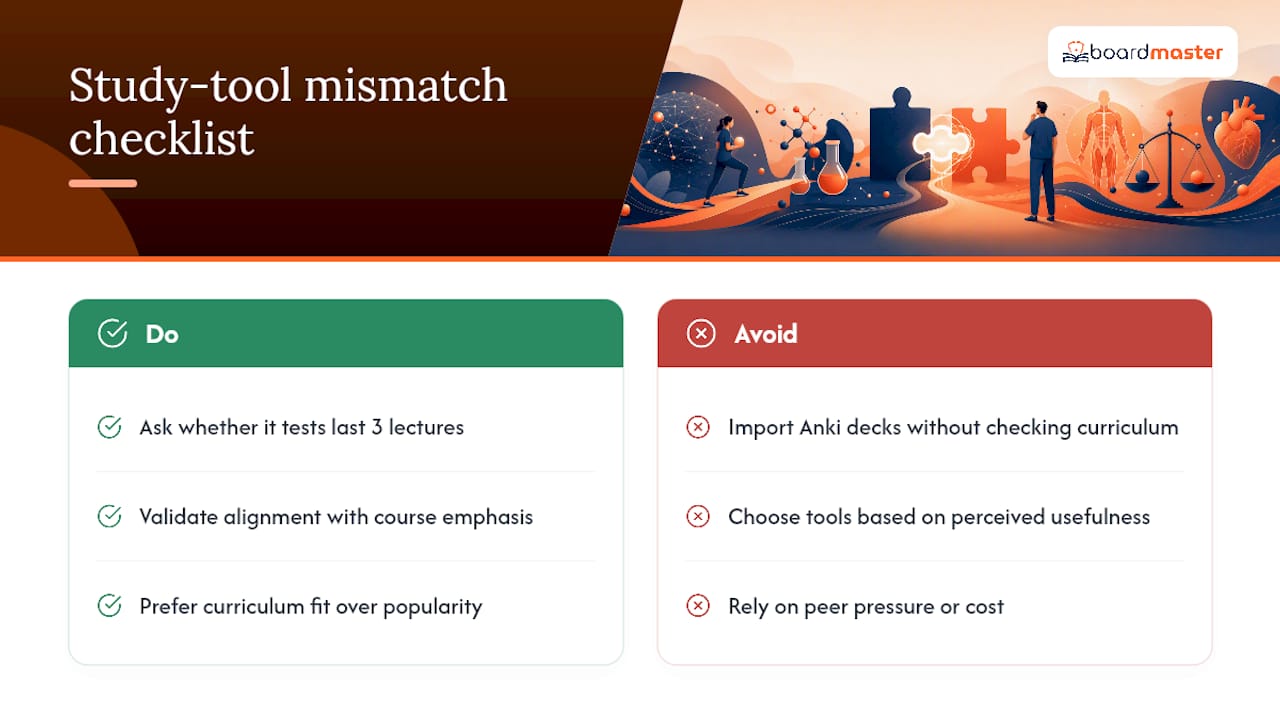
Cost and peer pressure compound the problem. When classmates share Anki decks built from a popular resource, you import them without checking whether the card set reflects your school's curriculum. That is tool mismatch in learning at its most invisible: you are studying, the cards look right, and yet the content emphasis is wrong.
Learning-style variation adds another layer. A PMC study using Honey and Mumford categories found that theorists scored higher under moderate teaching-mode mismatch while pragmatists scored lower, meaning the same resource can simultaneously help one student and hurt another in the same cohort.
Pro Tip: Before adding any new resource, ask one question: "Does this tool test the concepts my professor emphasized in the last three lectures?" If the answer is unclear, the tool is probably misaligned.
How mismatch hurts your scores, wallet, and study time
The impact of study-tool mismatch shows up in three places: performance, cost, and cognitive load.
Key stat: A cross-institutional survey found a modest negative association between the number of different resources students used and their exam scores, with perceived preparedness linked to better outcomes at a statistically significant level. Source: PMC — Educational Resources and Perceived Preparedness
That p = .017 finding matters because it connects perceived alignment, not just raw effort, to measurable results. Students who felt prepared with validated, aligned tools outperformed peers who studied more but with scattered resources.
The financial picture is equally stark. A multi-school PMC survey reported that students commonly use six to eight resources for exam prep, with combined study materials and exam fees averaging roughly $7,500 across training. Paying for six resources that partially overlap is not a study strategy; it is an expensive redundancy.
Cognitive cost is harder to measure but just as real. Switching between platforms fragments attention, and redundant coverage of the same topic across three resources crowds out review time for untested lecture material. The net effect:
- Attention fragmentation: each platform switch resets your working memory load.
- Redundant coverage: you review renal physiology four times and miss your professor's hepatology emphasis entirely.
- Wasted review cycles: time spent on low-weight blueprint topics comes directly out of high-yield practice.
How to tell if your tools are mismatched right now
Run this self-check during your next study session. Two or more of the following signals mean you should consolidate immediately.
Direct signals:
- Practice questions regularly include topics you have never seen in lecture.
- Your mock exam percentile sits well below your practice-question percentile.
Time signals:
- Three or more resources are competing for your core study hours on the same subject.
- You cannot finish a full Qbank pass because you keep switching to a second bank.
Coverage signals:
- You spend more time on low-weight blueprint topics than on the high-yield clusters your professor returns to repeatedly.
- Your Anki deck has thousands of cards but fewer than 20% come from your own lecture notes.
Decision rule: two signals present means consolidate now. Three signals means you likely have a significant mismatch that is already affecting your scores. Expert synthesis on board prep consistently recommends a core stack of one primary Qbank, one content backbone, and one spaced-repetition system, with everything else as a targeted add-on.
What to do this week, this month, and before your next mock
Week 1: triage
- Pull the official USMLE or COMLEX blueprint and highlight the highest-weighted topic clusters.
- Choose one primary Qbank and one content backbone that explicitly map to those clusters.
- Suspend all other primary resources. Not delete, just suspend, so the decision feels reversible.
- Check your current Anki deck: tag cards by source and pause any deck not tied to your lectures or your chosen backbone.
Weeks 2–4: build the system
- Create a one-page mapping matrix: lecture topic in column one, corresponding Qbank block in column two, Anki tag in column three.
- Schedule two mixed timed blocks per week using NBME-style questions, not topic-isolated practice.
- After each block, flag weak questions and convert the underlying concept into a new Anki card or a targeted re-read of one lecture section.
Before your next mock
- Take ten recent lectures and generate board-style questions from each one. A lecture-to-question tool like BoardMaster's AI question generator does this automatically from uploaded notes.
- Run a timed block on those questions before the mock to calibrate where lecture emphasis and board format intersect.
Pro Tip: To prune an imported Anki deck without losing high-yield cards, sort by "Ease" ascending. Suspend them first and monitor your retention before deleting anything permanently.
For a deeper week-by-week schedule, the BoardMaster Step 1 study guide walks through a full timeline with built-in mock checkpoints.
Sustainable alignment: systems for students and schools
Student-level system (one sentence): one primary content backbone, one primary Qbank, one spaced-repetition system, scheduled mocks every three to four weeks, and a brief reflection note after each mock identifying which lecture topics you missed.
School-level solutions require more coordination but produce the largest efficiency gains across a cohort:
- Validated resource bundles: course directors identify two or three tools that map directly to their syllabus and share that list explicitly, removing the hidden-curriculum guesswork.
- Partial course licensing: schools negotiate group access to one aligned Qbank, reducing the financial burden and standardizing the question format students practice with.
- Near-peer curated decks: upper-year students build lecture-specific Anki decks under faculty review, so incoming students start with aligned cards rather than generic imports.
- Syllabus-to-board alignment audit: a course director or student representative maps each lecture objective to the official blueprint in three steps: list lecture learning objectives, cross-reference each with the blueprint's topic weighting, and flag any objective that appears in neither the blueprint nor the Qbank. That gap list becomes the course's revision priority.
For objective criteria to evaluate any new tool before adding it, the BoardMaster study-tool comparison guide provides a structured framework.
How BoardMaster resolves mismatch end-to-end
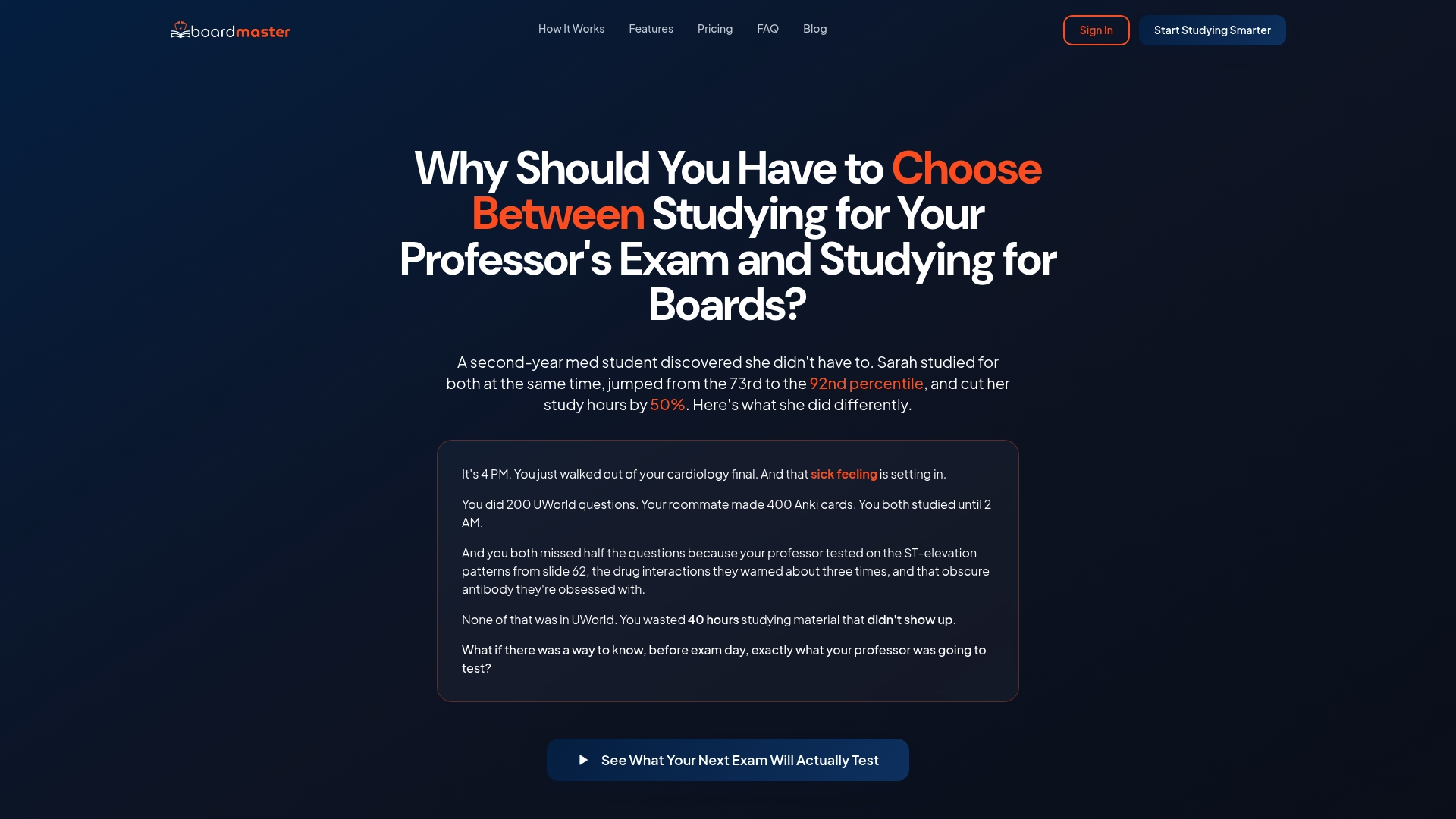
That result reflects a specific workflow, not just motivation. Here is how it works in practice:
- Upload your lecture notes to BoardMaster. The platform reads the content and identifies the concepts your professor emphasized.
- Generate targeted USMLE-style questions automatically. Questions reflect your lecture's emphasis, not a generic blueprint average.
- Practice in mixed timed sets alongside BoardMaster's 5,000+ physician-written board questions, so class-exam prep and board prep happen in the same session.
- Convert weak-question learnings into AI-generated flashcards with spaced repetition and medical images, keeping your Anki equivalent pruned and lecture-relevant.
This workflow collapses the gap between what your professor teaches and what the board tests. It also eliminates the need for three separate tools covering the same ground. See the full feature in action at the BoardMaster demo or explore the complete USMLE prep platform.
A note on getting this right
Study-tool mismatch is not a willpower problem. It is a structural one, and recognizing that is the first productive step. The evidence is consistent: more tools do not produce better scores; better-aligned tools do. If you are feeling overwhelmed by your current stack, that feeling is diagnostic. Pick your one Qbank, map it to your lectures, and run one timed block today. Adjustment takes a week, not a semester.
Sources
- Unlocking Medical Student Success: A Systematic Review and Meta-Analysis of Third-Party Resources Used for Medical Education and USMLE Board Preparation
- Medical Students’ Technology Use for Self-Directed Learning: Contributing and Constraining Factors
FAQ
What exactly is study-tool mismatch?
Study-tool mismatch is the gap between the resources you study with and the high-yield content your course or board exam actually tests. It causes wasted study time, redundant coverage, and lower scores despite high effort.
How many study resources is too many?
Using six to eight resources, as surveys show many students do, is associated with a modest negative effect on exam scores. Experts recommend one primary Qbank, one content backbone, and one spaced-repetition system as the core stack.
Can mismatch affect my USMLE score even if I study hard?
Yes. Perceived preparedness, which depends on studying the right material, is statistically linked to performance. Effort applied to misaligned resources does not produce the same score gains as the same effort applied to aligned ones.
How do I fix mismatch quickly?
Read the official USMLE or COMLEX blueprint, pick one Qbank and one content source that map to your lecture topics, and suspend all other primary resources this week. Then convert recent lectures into board-style practice questions before your next mock.
How does BoardMaster address study-tool mismatch?
BoardMaster generates USMLE-style practice questions directly from your uploaded lecture notes, aligning class-exam prep and board prep in one workflow and removing the need for multiple misaligned resources.