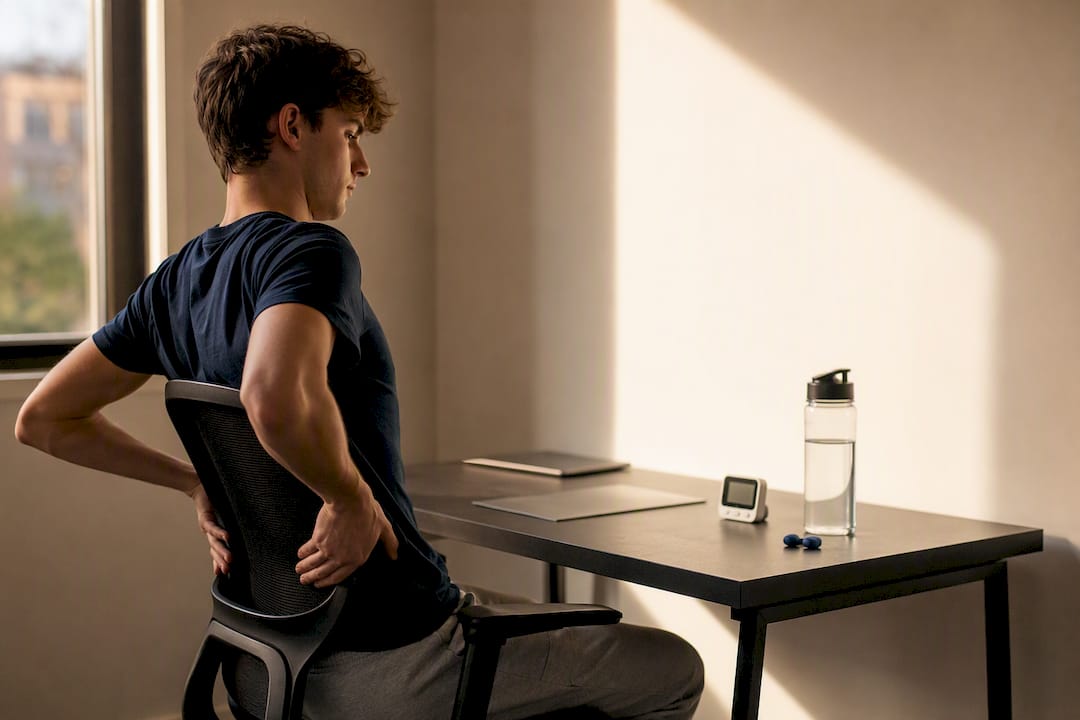
If you want practice that actually predicts test-day performance, run full-length timed sessions on official-format questions, in a hard chair at a bare desk, with a zero-drift full-screen timer, only the exact materials your exam allows, and the same break structure and scoring rules as the real thing. Everything else is study time, not simulation. Here's a checklist to run today:
- Full-length session, single sitting, no pausing mid-section
- Zero-drift, full-screen timer with per-question pacing visible
- Only permitted items on the desk (calculator, formula sheet, or nothing)
- Same break schedule and re-entry rules as the actual exam
- Hard desk, upright chair, overhead lighting, no phone in reach
- Score it against the real rubric, not a generic answer key
- Log timing per question and flag patterns, not just the raw score
Run your first full mock as an honest baseline, three to four weeks out, before you've over-corrected anything. Save the highest-fidelity dress rehearsal for one to two weeks before the actual exam.
Key Takeaways
Simulating board exam conditions works because it trains pacing, stamina, and scoring discipline together, none of which content review alone can teach.
| Point | Details |
|---|---|
| Match test-day fidelity | Replicate the room, materials, timer, and break rules exactly, not approximately. |
| Run full-length sessions | A single uninterrupted mock trains knowledge, pacing, and stamina simultaneously. |
| Log every mock | Track score, per-question timing, and error patterns to target remediation. |
| Validate your simulation | Compare mock results against real outcomes and test sensitivity to small changes. |
| Use syllabus-aligned practice | Tools like BoardMaster generate mock questions from your own lecture material for higher relevance. |
Table of Contents
- Why You Need to Simulate Board Exam Testing Conditions
- How Do You Build a Practice Environment That Matches Test Day?
- How Do You Run a Full-Length Timed Mock Exam?
- How Should You Analyze Mock Results and Fix Weak Spots?
- Is Your Practice Mock Actually a Valid Predictor?
- Build Exam-Like Practice From Your Own Lecture Material
- Sources
- FAQ
Why You Need to Simulate Board Exam Testing Conditions
Realistic simulation trains three things content review never touches: pacing under a visible clock, the mental stamina to hold focus for three or four hours straight, and the triage instinct to skip a hard question and come back. Content knowledge gets you the right answer. Simulation gets you the right answer in time.
- Time management: you learn your real pace per question type, not your guessed pace
- Fewer careless errors: fatigue-induced mistakes show up in practice instead of on exam day
- Better final-pass strategy: you develop a repeatable system for flagged questions instead of improvising
A full-length mock, written in one uninterrupted sitting that mirrors the real paper's structure, trains subject knowledge, time management, answer discipline, and physical stamina together. Shorter practice blocks, according to board exam practice research, simply can't train all four at once. That's the gap between someone who knows the material and someone who performs under a clock.
How Do You Build a Practice Environment That Matches Test Day?
Fidelity lives in the details most students skip. Here's what to control:
Room and seating. Match the physical setup of your actual test center as closely as you can: a hard desk, an upright chair, overhead lighting rather than a desk lamp, and a wall or blank surface in your sightline instead of a window. Testing centers are deliberately unglamorous. Your kitchen table with a scented candle is not preparing you for that.
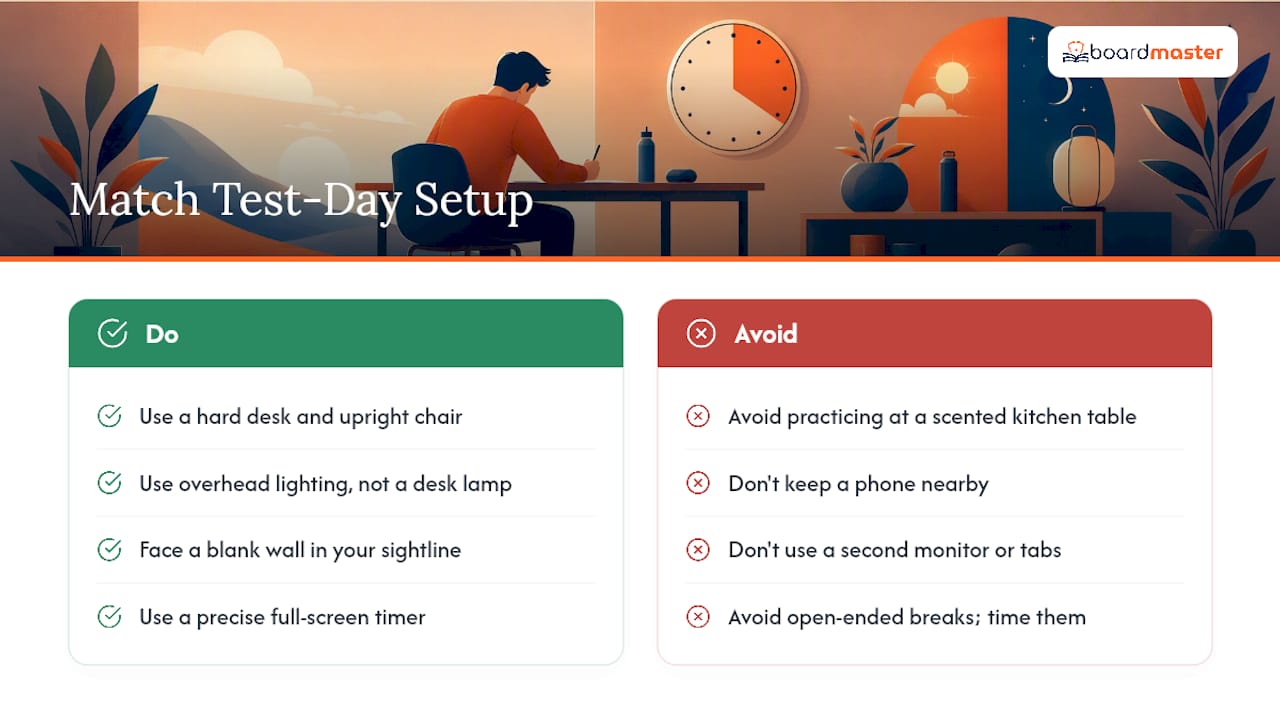
Materials and device rules. If your exam allows a basic calculator and nothing else, practice with exactly that; no phone nearby, no second monitor, no reference tabs open. Recreate whatever restriction the proctor enforces, down to whether scratch paper is provided or you bring your own.
Timing. Use a precise, full-screen timer rather than your phone's stopwatch. A zero-drift timer with visible per-question pacing, the kind Exam Timer Online provides, builds what's essentially temporal muscle memory: your brain starts to feel when it's behind pace without needing to check the clock constantly.
Breaks. Practice the actual break length and re-entry, not an open-ended pause. If your exam gives a 10-minute break between blocks, time it and force yourself back to the desk at the buzzer.
Distractions. Script mild interruptions, a door closing, someone walking past, a chair scraping, at random intervals so your focus isn't only ever tested in silence.
Pro Tip: Print your practice questions and use an actual answer booklet if your exam is paper-based, or lock yourself into a browser's full-screen kiosk mode if it's computer-based. Matching the input method matters more than most students assume.
How Do You Run a Full-Length Timed Mock Exam?
A mock only counts as a rehearsal if it enforces every rule the real exam enforces. Here's the protocol:
- Select your source material. Prioritize official practice forms, high-fidelity past papers, or question sets built to mirror your exam's actual content mix and difficulty curve. Generic banks that don't match your syllabus waste rehearsal time.
- Run the pre-test checklist. ID check if applicable, reading time if your exam includes it, materials laid out exactly as allowed.
- Apply the pacing method. First pass answers everything you know cold. Second pass tackles anything that took too long. Final triage clears remaining flags in the last few minutes.
- Calculate target pace per question. Divide total section time by question count, then subtract a small buffer for review, so you know your per-question ceiling before you start.
- Handle breaks on the clock, not on convenience.
A few extra rules matter depending on your exam format:
- If your board exam is computer-adaptive, don't allow backtracking during practice; simulate the lockout.
- If it's fixed-form, practice skipping and returning freely, since that's the actual rule.
- Simulators like ProfExam, which enforce time limits, navigation restrictions, and randomized question order, can approximate these constraints reasonably well when your source material lacks its own interface.
Pro Tip: Once a month, stack two full-length mocks back-to-back with only the official break between them. This is deliberate fatigue training, and it's the closest most people get to feeling the ninth hour of an actual multi-day board exam before it happens for real.
How Should You Analyze Mock Results and Fix Weak Spots?
A mock without an error log is just a stressful afternoon. Capture four things every time: raw score, time spent per question, which question types you missed, and where your flagging pattern breaks down (too many flags, too few, or flags you never revisit).
Prioritize fixes using impact times frequency times time-to-fix.
- Set a SMART target for the next mock (a specific accuracy or timing gain, not "do better")
- Schedule corrective practice blocks on the weakest topic within 48 hours
- Move from content review back into full simulation once you can explain the error out loud
- Space repeated review of the same weak topics rather than cramming them once
Is Your Practice Mock Actually a Valid Predictor?
A mock that feels hard isn't automatically a good mock. Run two checks. First, external validation: compare your mock outcomes against real operational data, official sample scoring, or your own past exam results where you have them, since research on modeling and testing shows this comparison is what catches systemic bias in a practice set. Second, sensitivity analysis: change one variable at a time (a shorter timer, added noise, a harder section) and see if your score swings wildly or stays stable.
Iterating between small simulation runs and full mocks catches timing or navigation problems cheaply before you burn a full session finding them the hard way.
- Choose scenarios that cover both typical days and worst-case ones (low sleep, noisy environment, a brutally hard section)
- After two or three mocks, ask: did my score, pacing, and stress response stay consistent, or wildly swing?
- If your mock scores don't move in the same direction as your actual knowledge growth, the mock itself may be miscalibrated
Instructor Perspective: What Most Students Get Wrong About Simulation
The single most common mistake I see is students who simulate the questions but skip the room, the clock discipline, and the break rules, then wonder why real exam day feels foreign. Fix that first, before you add more difficulty. Once your pacing and error rate stabilize across two mocks in a row, stop escalating difficulty and shift into consolidation instead of chasing harder and harder material.
Build Exam-Like Practice From Your Own Lecture Material
Generic question banks force you to simulate an exam that doesn't match what your professors actually test. BoardMaster generates USMLE and COMLEX-style questions directly from your uploaded lecture notes, so your mock content mirrors your actual coursework instead of a stranger's syllabus guess, cutting the hours you'd otherwise spend hunting for relevant practice.
The platform includes features built specifically for the fidelity rules above:
- Timed QBank sessions with over 5,000 physician-written questions for full-length mocks
- Section structure presets that mirror board exam block timing and breaks
- Scoring reports that flag weak topics by frequency and difficulty, not just raw percentage
- AI-generated OSCE practice for timed clinical-skills rehearsal
- Targeted remediation questions generated from your own missed topics
Try the AI question generator on a set of your own lecture notes, run one mock using the checklist above, and log your baseline before your next content review cycle. You can start with the physician-written QBank or explore the full platform at BoardMaster.
Sources
- Using Modeling and Simulation to Test Designs and Requirements (National Academies)
- Using modeling and simulation to test designs and requirements (MathWorks)
- Free Board Exam Practice Papers — Daily Questions (ReadyForBoards)
- Exam Timer Online — Free Test Simulation & Pacer
- ProfExam Simulator - Open VCEX Files on Any Platform
Prefer official practice forms when your board offers them; use curated or third-party sets to fill content gaps.
FAQ
Is Two Weeks Enough to Prepare With Mock Exams?
Two weeks works for a final dress rehearsal and light remediation, but not as your only mock cycle. Instructors generally recommend one baseline mock, two to three remediation cycles, and a final mock a week or two before the exam, per practical test-prep guidance.
Are Mock Exams Harder Than the Real Board Exam?
Mocks are often calibrated slightly harder on purpose to build a buffer, but a poorly validated mock can just be miscalibrated rather than genuinely tougher. Compare your mock accuracy against official sample questions to check.
What Does a Good Mock Test Actually Look Like?
A good mock is full-length, timed in a single sitting, uses questions matching your exam's real content mix, and gets scored against the actual rubric rather than a rough estimate.
What Is a Simulation Test, Exactly?
A simulation test recreates the structure, timing, materials, and environment of the real exam so your practice performance predicts your actual test-day performance, not just your subject knowledge.
How Often Should I Schedule Full Mocks?
Space full-length mocks two to three weeks apart to allow time for remediation between sessions, with a final one close to test day. Running them more frequently than that usually leaves no time to fix what you found wrong. Question sets built from your own coursework, like those BoardMaster generates from uploaded lectures, can help you fill remediation gaps between full mocks without hunting for relevant material.