
If you're rereading the same explanation for the third time, guessing more than you're reasoning through, or your percent-correct has flatlined for a week, stop increasing your question volume. That's Qbank burnout, and pushing through it with more questions makes it worse, not better. The fix is a structured pullback, not a study strategy overhaul: cut volume for a few days, protect sleep, and follow a four-week recovery protocol built around stabilization, controlled rebuilding, simulation, and taper.
TL;DR:
- Pushing through question volume during burnout can worsen fatigue; a structured four-week recovery plan with volume reduction and sleep protection is essential.
- Signs of burnout include micro-avoidance behaviors, plateaued accuracy, disrupted sleep, irritability, and physical symptoms, which should trigger volume and activity adjustments.
- Using question banks for assessment rather than mastery or reassurance risks reinforcing shallow knowledge and increasing anxiety, especially with high-volume, low-review sessions.
- Aim for 80 questions daily with thorough review in weeks 2 and 3, and incorporate targeted practice from your weak systems, while avoiding frequent resource hopping.
- External stressors and improper use of study tools, like timers or difficulty filters, can compound burnout; setting strict daily limits and honest progress assessment help maintain sustainable study habits.
Table of Contents
- Recognizing Qbank Burnout USMLE Style: Warning Signs That Matter
- Why QBanks Make Burnout Worse If You Use Them Wrong
- Diagnose Your Deficit Before You Panic
- The 4-Week Recovery Protocol for Qbank Burnout
- Daily Hard Limits That Actually Prevent Relapse
- Preventing Qbank Fatigue Solutions for the Long Haul
- Nutrition and Movement That Support Cognitive Recovery
- Tailoring Qbank Intensity to Your Learning Style and Background
- External Stressors That Make Qbank Burnout Worse
- Using Timers and Difficulty Settings to Control Workload
- Author Perspective: Adjusting Your Plan Is the Strategic Move
- Focus Your Recovery With Targeted Practice, Not More Volume
- Sources
- FAQ
Recognizing Qbank Burnout USMLE Style: Warning Signs That Matter
Qbank burnout doesn't announce itself as exhaustion. It shows up as small, specific behaviors that are easy to write off as a bad day, until they stack into a pattern.
The deep knowledge on this is blunt: burnout often looks like micro-avoidance, not laziness. You might spend 15 minutes staring at a question you'd normally answer in 90 seconds, or reread the same explanation paragraph three times without absorbing it. Students frequently mistake this for a focus problem when it's actually a capacity problem.
Watch for these clusters:
- Behavioral signs: stalling between questions, switching Qbanks or resources every 3 to 5 days looking for a fix, opening a block and closing it within minutes.
- Cognitive signs: your percent-correct plateaus or dips despite more hours, you're guessing on questions you'd normally reason through, you reread stems or explanations repeatedly without retention.
- Physical and emotional signs: disrupted sleep (falling asleep late, waking at 3 a.m. running through practice questions), unusual irritability with classmates or family, tension headaches, or stomach issues that show up specifically during study blocks.
Run a quick weekly data check to catch this before it snowballs. Track three numbers: your rolling percent-correct trend over the last 200 to 300 questions, your NBME score trajectory if you've taken more than one, and your average sleep hours for the week. A percent-correct that's dropped for two consecutive weeks, an NBME score that's flat or falling, and sleep under 6 hours most nights together are a stop signal, not a "push harder" signal.
The mistake most students make is treating these signs as motivation problems. They're not. They're signs your brain has stopped consolidating new information efficiently, and no amount of willpower reverses that. Only rest and a change in review approach do.
Why QBanks Make Burnout Worse If You Use Them Wrong
Question banks are designed to simulate exam pressure, which is exactly why they can accelerate burnout instead of just reflecting it. Every question triggers a small evaluation response: right or wrong, pass or fail. String together 100 of those in a row, day after day, and you've built what amounts to a continuous testing loop with no recovery window. That wiring keeps your anxiety system engaged long after the block ends, and chronic anxiety activation interferes with the memory consolidation that actually makes questions "stick."
There's also a volume trap. Answering questions fast without deep review builds shallow pattern recognition. You start recognizing a stem's shape and guessing the answer type, but you can't explain the mechanism when someone asks you directly. That's fragile knowledge, and it collapses under exam pressure. One insight worth taking seriously is that QBanks are learning and assessment tools, not emotional reassurance. Using them to "prove" you're ready, rather than to actually learn, turns every block into a gamble on your mood for the rest of the day.
Perfectionism compounds this. Students chasing a specific percent-correct number start adding late-night blocks, stacking caffeine to push through fatigue, and treating rest days as wasted time. During dedicated prep, 2 to 4 hours of focused Qbank work a day, roughly 80 to 120 questions with thorough review, is a realistic and effective target. Pushing well past that without rest produces diminishing returns fast.
Diagnose Your Deficit Before You Panic
Before you decide whether to cut back, postpone, or push forward, spend 30 to 45 minutes running an honest audit. Vague anxiety about "being behind" is the enemy here. Numbers fix that.
- Count your remaining questions. Total questions in your bank, minus completed questions, equals what's left.
- Count your remaining days. Days until your exam date, being realistic about days you'll actually study (classes, rotations, and life still happen).
- Divide remaining questions by remaining days. That's your required daily average. Compare it to a sustainable range: 2,200 to 3,500 total questions is a common target range for Step 1 success, and finishing every single question in a bank is not a requirement for a strong score.
- Set your 7-day baseline. If you're still attending classes, a baseline of 40 to 60 questions a day with full review is realistic. Fully dedicated students can sustain 80 to 120 a day, per the guidance above, as long as review quality holds.
- Apply the burnout adjustment. If you're showing two or more warning signs from the previous section, cut your daily target by 20 to 30 percent for 3 to 4 days before reassessing.
- Check your NBME trend against your test date. If your practice scores are consistently below your target 4 to 8 weeks out from the exam, that's the point to seriously discuss postponement with an advisor, not push harder.
Cap your review time per question too: average 2 to 4 minutes, with a hard ceiling of 5 to 6 minutes even for dense pathology questions, based on recovery protocol guidance built for exactly this situation. Then do one thing today: a timed 40-question mixed block, followed by full review using that time cap.
The 4-Week Recovery Protocol for Qbank Burnout
A structured pullback works better than either quitting entirely or grinding through. The 4-week recovery protocol below moves you from stabilization to full simulation readiness without repeating the mistake that got you burned out in the first place.
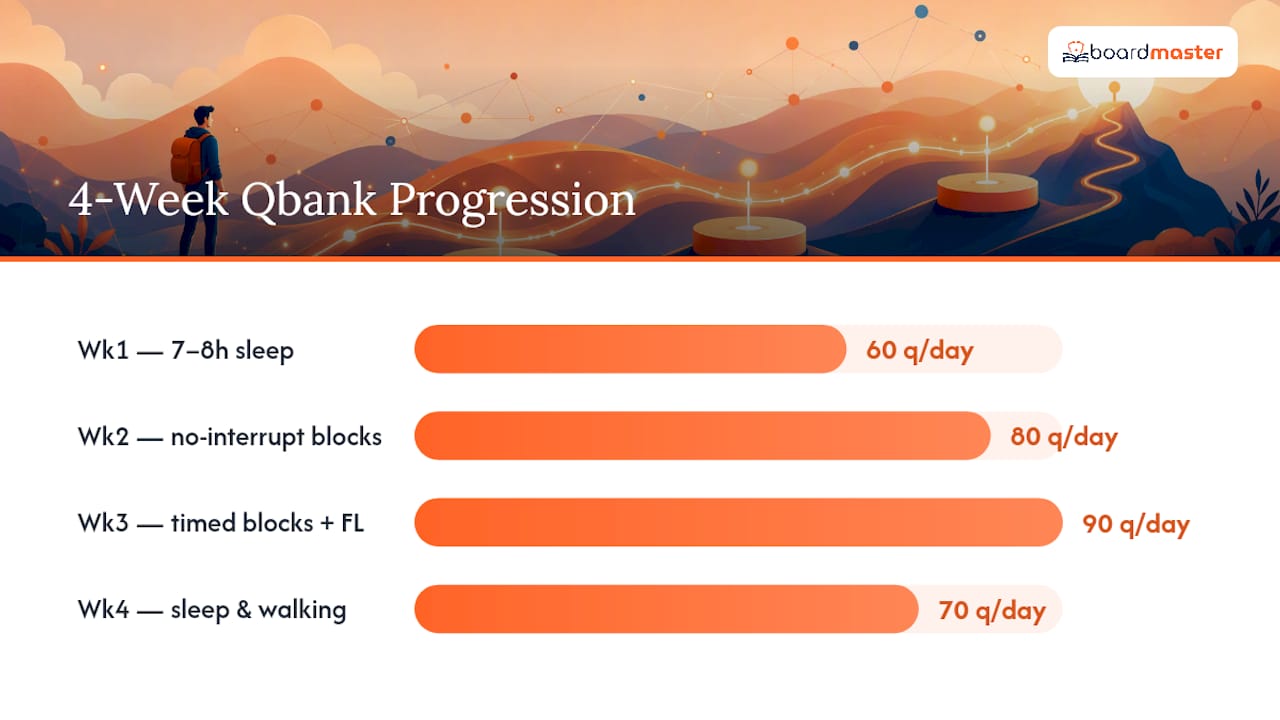
Week 1: Stabilization. Cut your daily volume by 20 to 30 percent from your previous baseline, targeting roughly 60 questions a day. Protect 7 to 8 hours of sleep as a non-negotiable. Pick your top 3 to 4 weakest systems (use your percent-correct breakdown by subject) and dedicate review time exclusively to those, rather than scattering effort across everything.
Week 2: Controlled increase. Return toward a sustainable volume, around 80 questions a day, but keep strict review discipline: full explanation review on every wrong answer and every correct guess. Protect two or three no-interruption study blocks daily.
Week 3: Simulation and pattern training. Push volume to roughly 90 questions a day, now organized into timed, back-to-back blocks that mimic exam pacing. Take one full-length practice exam under real exam-day conditions this week, including timing, breaks, and no notes.
Week 4: Sharpen and taper. Drop volume back to around 70 questions a day. Shift focus to pattern lists and high-yield weak areas rather than new content. Preserve sleep and add light daily exercise, walking counts, to keep cognitive load manageable heading into exam week.
A sample week 2 schedule: mornings, one 40-question timed block with immediate review; afternoons, a second 40-question block reviewing only missed and guessed questions from both sets; evenings, flashcard review of that day's weak topics, then screens off by 10 p.m. Adjust the numbers to your own baseline from the diagnostic audit, but keep the week-by-week shape intact.
Daily Hard Limits That Actually Prevent Relapse
Recovery only holds if you build limits that don't depend on willpower. Here's what actually works, drawn from the routine-over-heroics principle that shows up across burnout-prevention calendars built for exam season.
- Daily question cap: 80 questions on dedicated days, 40 to 60 on class days, with a hard ceiling of 100 to 120 even on your best days.
- One rest day per week, no exceptions, no "just checking a few questions."
- No studying past midnight. Sleep debt shows up in your percent-correct within 48 hours.
- Maximum 4 high-effort days in a row before a lighter day or full rest day.
- Disaster-day minimum: if you're sick, exhausted, or emotionally wrecked, the floor is 10 questions plus full review. Something beats nothing, and it keeps the routine alive.
Run a 10-minute weekly burnout check every Sunday: How many nights this week did you sleep under 6 hours? Has your mood toward studying shifted from neutral to resentful? Did you catch yourself rereading the same explanation more than twice? Answering yes to two or more means it's adjustment time, not push-through time.
Pro Tip: Block out two or three no-interruption study windows every day, phone in another room, notifications off, door closed. A single uninterrupted 90-minute block with full review beats three fragmented hours of half-attention every time.
Preventing Qbank Fatigue Solutions for the Long Haul
Recovery only sticks if you build habits that keep you from ending up back here in three weeks. The single biggest lever: stop resource-hopping. Pick one primary Qbank, one primary reference text, and one spaced-repetition system, and stay with that combination through your exam. Guidance on question bank use is consistent on this point: splitting attention across multiple Qbanks fragments learning and makes it harder to trust your own progress data.
Build a lighter week into your schedule every 3 to 4 weeks, a planned 30 percent drop in volume, before burnout forces one on you. Treat it as a pressure valve, not a setback. Alongside that, protect sleep and daily movement as fixed appointments, not optional extras, and keep one small non-screen activity in your day, even 20 minutes of something enjoyable that has nothing to do with medicine.
Reassess your test date honestly after every NBME in your final 6 to 8 weeks. A single low score isn't a crisis. A trend of scores flat or falling across your last two or three NBMEs, especially alongside burnout signs, is the point to have a real conversation with an advisor about a date change. For structuring the weeks between now and exam day, a weekly schedule that balances classes and Qbank blocks helps keep this sustainable rather than reactive.
Nutrition and Movement That Support Cognitive Recovery
What you eat and how much you move directly affects how well your brain consolidates the material you're grinding through. This isn't about optimizing your diet for exam performance with some elaborate plan. It's about avoiding the specific patterns that make burnout worse.
Skip the caffeine escalation. A morning coffee is fine; stacking three or four doses through the day to push past fatigue disrupts sleep architecture that night, which then makes the next day's questions harder to retain. If you're relying on caffeine to get through afternoon blocks, that's a volume problem, not a caffeine problem.
Steady blood sugar beats sugar spikes for sustained focus. Protein and complex carbs at meals, rather than skipping meals and grabbing something sweet between blocks, keep attention more stable across a 3 to 4 hour study session. Dehydration also shows up as fatigue and headache that gets misread as "burnout" when it's actually just water.

Movement matters more than most students expect. A 20 to 30 minute walk between study blocks isn't wasted time, it's part of how your brain processes what you just reviewed. Even light daily exercise during recovery weeks supports the sleep quality that makes the whole recovery protocol work. None of this replaces rest or volume adjustment, but skipping it makes recovery slower and harder to sustain.
Tailoring Qbank Intensity to Your Learning Style and Background
The daily question ranges in this article are starting points, not universal prescriptions. Your ideal volume depends heavily on how you learn and what you're walking in with.
If you retain concepts well from first exposure, lectures, textbooks, whatever your primary source is, you can likely run at the higher end of the daily ranges because your review time per question is shorter. If you need multiple exposures before something sticks, you'll get more value from fewer questions with deeper review, even if that means falling short of a volume target that works for a classmate.
Prior knowledge matters just as much. Students coming off a strong basic science foundation often move faster through Qbank content and can afford more questions per day with lighter review. Students who are shoring up foundational gaps alongside board prep need to slow down and spend more time per question, because each wrong answer is doing double duty: it's teaching new content and testing retention simultaneously. Trying to hit someone else's daily question count when you're in that position is one of the fastest routes to burnout, because you're rushing review that needs to be slow.
The practical move is to test your own ratio during week 1 of recovery. Track how long full review actually takes per question over a 40-question block. If it's under 2 minutes on average, you likely have room to increase volume. If it's consistently over 4 minutes, cut volume before adding more.
External Stressors That Make Qbank Burnout Worse
Qbank burnout rarely happens in isolation. Financial pressure, relationship strain, family obligations, and even unrelated coursework deadlines all compete for the same limited cognitive bandwidth your Qbank review depends on.
The stressors worth naming specifically: unpredictable clinical rotation schedules that eat into planned study blocks, financial stress tied to loan burden or living costs, and comparison with classmates who post their scores or study hours. That last one deserves particular attention. Comparing your percent-correct or question count to someone else's is one of the fastest ways to turn a sustainable plan into an anxious escalation, because you're optimizing for someone else's baseline instead of your own diagnostic numbers.
Mitigation starts with naming the stressor out loud, to a mentor, an advisor, or even just in your own weekly planning. A stressor you've identified and planned around is far less disruptive than one you're pretending doesn't exist. If rotations are unpredictable, build slack into your weekly targets rather than assuming a perfect week. If financial stress is present, that's worth a direct conversation with your school's advising office rather than trying to out study it.
Support networks matter here too. A short call with a friend, a study partner check-in, or even a structured peer group focused on accountability rather than competition can reduce the isolation that makes burnout feel heavier than it is. None of this replaces the volume and sleep adjustments already covered, but ignoring external stressors while fixing your Qbank routine only gets you halfway there.
Using Timers and Difficulty Settings to Control Workload
Most Qbank platforms and study tools include features specifically built to modulate workload, and most students never touch the settings. That's a missed lever.
Timed mode versus tutor mode changes the anxiety profile of a session significantly. Practicing in timed, exam-simulation mode is essential in weeks 3 and 4 of the recovery protocol, but it's the wrong setting during week 1 stabilization, when the goal is deep review, not pressure testing. Switching to a slower, review-focused mode during recovery removes the ticking-clock stress that keeps your nervous system on edge.
Difficulty and topic filtering let you build the exact targeted blocks the diagnostic audit calls for, focusing on your specific weak systems rather than a random mix that includes content you've already mastered. This is where a tool like BoardMaster becomes genuinely useful during recovery: generating focused practice questions from your own lecture material means every question in a block is addressing a real gap, not padding a session with content you don't need more repetition on.
Session length caps, some platforms let you set a hard stop after a set number of questions, act as a built-in guardrail against the "just one more block" pattern that drives burnout in the first place. Set that limit before you start, not while you're already fatigued and rationalizing one more set.
Author Perspective: Adjusting Your Plan Is the Strategic Move
Cutting volume when you're burned out isn't giving up. It's the same clinical judgment you'll apply to patients: recognizing when a treatment plan needs adjustment based on the data in front of you, not abandoning the goal. Exam day depends on how well your brain functions under pressure, not on how many total questions you logged getting there. Protecting that capacity is the actual strategy. For more on the reasoning behind this approach, see my full bio and background.
— Dr. Ahmed Abuzoor
Focus Your Recovery With Targeted Practice, Not More Volume
The hardest part of recovering from Qbank burnout is knowing which questions are actually worth your limited energy. BoardMaster solves that by generating practice questions directly from your own lecture notes, so every block during recovery targets the specific gaps your professors actually test, not generic content you've already mastered twice over.

During week 1 of the recovery protocol, upload notes from your weakest 3 or 4 systems and build short, focused blocks around exactly those topics using the AI Question Generator. Pair that with AI Flashcards for spaced-repetition consolidation once you've moved into week 2's controlled increase, when retention matters as much as exposure. The platform's QBank adds over 5,000 physician-written board-style questions when you're ready for broader board practice in weeks 3 and 4. Plans start with a free tier, and the monthly plan runs $39.99 if you want full access while you rebuild. Start by uploading your weakest lecture set today and building your first focused recovery block.
FAQ
How Many Qbank Questions Per Day Is Too Many?
Most students do well with 80 to 120 questions daily during dedicated prep, provided full review accompanies each block. Going well beyond that consistently, especially without adequate sleep, is a strong burnout signal rather than a sign of extra progress.
When Should I Consider Postponing My Exam Date?
Consider postponement if your NBME scores stay consistently below your target across your final 4 to 8 weeks, especially alongside two or more burnout warning signs like sleep disruption or plateauing percent-correct. Talk to an advisor before deciding, since a single low practice score alone isn't a reason to move your date.
Do I Need to Finish an Entire Qbank Before My Exam?
No. Successful students often complete roughly 2,200 to 3,500 total practice questions for Step 1, and thoughtful mixed-block practice with deep review matters more than finishing every question in a bank.
What Should I Do This Week If I Think I'm Burned Out?
Run the 30 to 45 minute diagnostic audit to calculate your sustainable daily target, then start week 1 of the 4-week recovery protocol: cut volume by 20 to 30 percent, protect sleep, and triage your top 3 to 4 weakest systems for review.
Can Software Features Like Timers Help Prevent Burnout?
Yes. Switching between timed exam-simulation mode and slower review-focused mode lets you match your practice style to where you are in recovery, and topic filters let you build targeted blocks instead of random mixed sets. Tools like BoardMaster's AI Question Generator take this further by generating questions from your actual lecture content, so difficulty and topic focus align with your real gaps.