
TL;DR:
- BoardMaster offers USMLE-style question generation directly from lecture notes, providing a targeted and integrated study method for US medical students. It combines lecture-based content conversion with spaced repetition, dashboards, and analytics, outperforming Neuroflip's content alignment for US exams. Using a structured one-week trial helps determine if it improves retention and study efficiency before committing.
For US medical students who need lecture-aligned, USMLE-style practice, the strongest Neuroflip alternative is BoardMaster, which converts your actual lecture notes and audio into targeted USMLE-style questions with built-in spaced repetition (SRS) and mastery dashboards. Neuroflip was built for NEET-PG and FMGE aspirants in South Asia, so its content alignment and question style don't map cleanly to USMLE Step exams or US medical school class exams. The good news: the US market has better-fit options across every study style.
Quick shortlist by category:
- Lecture-to-question pipeline: BoardMaster
- SRS flashcard tools: Anki, Brainscape, Voovo, Retain Cards
- High-volume USMLE Q-banks: UWorld, Amboss, Firecracker
- Hybrid multimedia + question platforms: Osmosis
Neuroflip markets active recall and spaced repetition as its core retention mechanism, but its flashcard library targets Indian licensing exams, not USMLE. The medical exam-prep space is highly fragmented, with hundreds of competitors, and the platforms that win for US students are those that let you customize study paths to your actual syllabus.
Table of Contents
- How do these alternatives compare on features that matter?
- What each platform actually does and who it fits
- How we evaluated these alternatives
- How do you pick the right alternative for your study stage?
- A 7-day test plan to compare any alternative to Neuroflip
- Key Takeaways
- The switching cost nobody talks about
- BoardMaster turns your lectures into USMLE-style practice
- Useful sources
- FAQ
How do these alternatives compare on features that matter?
| Platform | Best for | USMLE question fidelity | Upload lecture notes / custom questions | AI features | SRS algorithm | Mobile / offline | Pricing / free trial | Analytics |
|---|---|---|---|---|---|---|---|---|
| BoardMaster | Class exams + USMLE board prep | High (USMLE-style from your lectures) | Yes — upload notes or audio | AI question generation, SRS pacing, mastery analytics | Yes | Yes / Yes | Free demo available | Mastery dashboards |
| Anki | SRS-first retention | Low (user-created) | Manual card creation | Limited (plugins) | Best-in-class SRS | Yes / Yes | Free (desktop); — iOS | Basic stats |
| UWorld | USMLE Step prep | Very high | No | Performance analytics | No | Yes / Limited | Subscription; free trial | Strong |
| Amboss | Combined Q-bank + reference | High | No | Contextual library links | No | Yes / Limited | Subscription; free trial | Strong |
| Osmosis | Multimedia learners | Moderate | No | Study scheduling | No | Yes / Yes | Subscription; free trial | Moderate |
| Firecracker | Long-term adaptive review | High | No | Adaptive daily review | Yes | Yes / Limited | Subscription; free trial | Strong |
| Voovo | Mobile flashcard study | Low–Moderate | Limited | AI flashcard features | Yes | Yes / Yes | Free tier; premium available | Basic |
| Retain Cards | AI-assisted SRS mobile | Low–Moderate | Limited | ML card prioritization | Yes | Yes / Yes | Free tier; premium available | Basic |
| Brainscape | Instructor-shared decks | Low–Moderate | Instructor-created decks | Adaptive repetition | Yes | Yes / Yes | Free tier; premium available | Moderate |
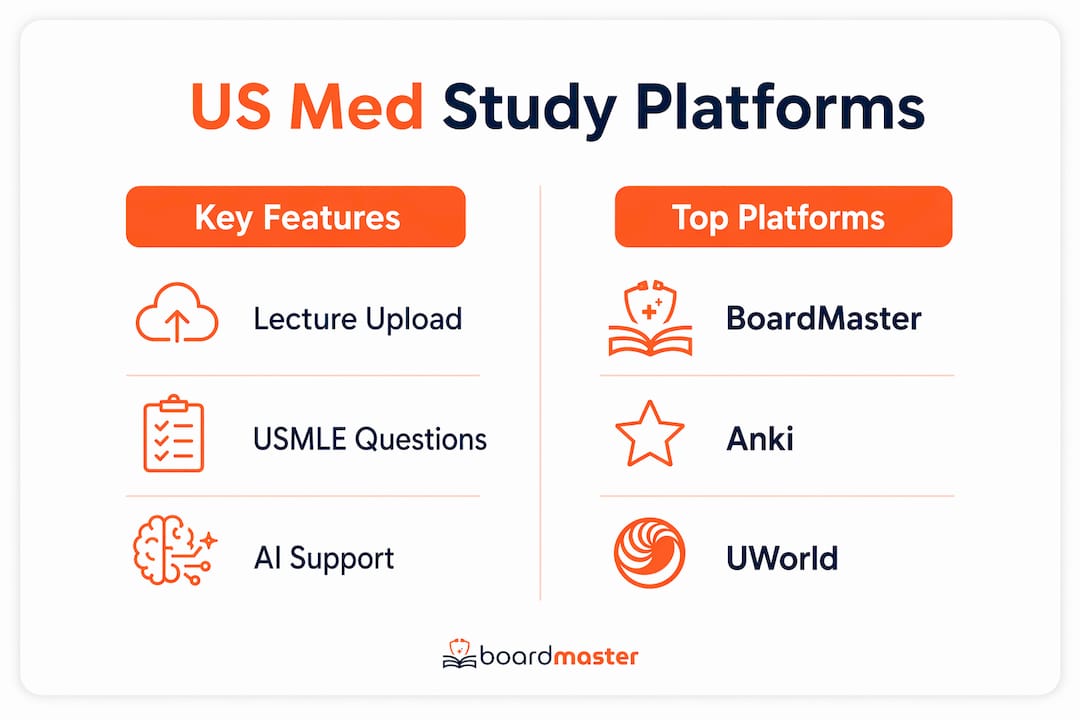
Two trade-offs worth flagging immediately: BoardMaster is the only platform here that takes your professor's lecture and generates USMLE-style questions from it, which is the closest workflow to what Neuroflip promises but with US exam alignment. UWorld and Amboss deliver the highest raw question fidelity for Step prep, but neither lets you upload a lecture and auto-generate questions around it.
What each platform actually does and who it fits
BoardMaster
BoardMaster's core workflow is the one most students switching from Neuroflip actually want: upload lecture notes or audio, and the AI question generator produces USMLE-style multiple-choice questions mapped to what your professor emphasized. SRS flashcards and mastery dashboards are built in. One student, Sarah, jumped from the 73rd to the 92nd percentile while cutting her study hours in half. A free demo is available at boardmaster.ai.

Anki
Anki is the gold standard for SRS efficiency. The algorithm is genuinely powerful, the desktop app is free, and the community has pre-built decks for almost every preclinical topic (Zanki, Anking). The catch: you build or import everything yourself. There's no question-generation pipeline, and managing a large deck takes real time. The hidden cost of Anki is often the hours spent curating cards rather than actually learning.
UWorld
UWorld is the benchmark for USMLE Step question quality. Explanations are detailed, difficulty is calibrated to the real exam, and performance tracking is strong. It's the right tool for dedicated Step prep blocks, not for daily class-exam study tied to a specific professor's slides.
Amboss
Amboss pairs a Q-bank with a clinical knowledge library, so when you miss a question you can jump directly to a concise explanation without leaving the platform. That integration is genuinely useful during preclinical years. Pricing is subscription-based with a free trial.
Osmosis
Osmosis leans on video-driven explanations paired with practice questions and built-in study schedules. If you absorb material better by watching than reading, it fits well. Question fidelity is moderate compared to UWorld, but the multimedia depth is hard to match.
Firecracker
Firecracker assigns daily adaptive review sessions that adjust based on your performance history across subjects. It's built for students who want a long-term retention system running in the background throughout preclinical years, not just a cramming tool.
Voovo and Retain Cards
Both are AI-enabled flashcard apps with SRS and mobile-first design. Voovo layers AI study features on a flashcard interface; Retain Cards uses machine learning to prioritize which cards you see next. Neither generates USMLE-style questions from your lecture content, but both work for bite-sized daily review on mobile.
Brainscape
Brainscape's strength is shareable decks. If your school or a classmate has built a well-structured deck, you can inherit it and study immediately. The adaptive repetition scheduling is solid. It's a good fit when you want instructor-curated content without building from scratch.
Pro Tip: Match the tool to your study phase. Use a lecture-to-question platform like BoardMaster during the week you cover a topic in class. Switch to a high-volume Q-bank like UWorld for dedicated Step prep blocks six to twelve months out.
How we evaluated these alternatives
The criteria here identify platforms that balance lecture-alignment with USMLE-style question fidelity, the two things Neuroflip-style tools promise but rarely deliver for US students.
Evaluation criteria:
- USMLE-style question fidelity (format, difficulty, explanation quality)
- Ability to upload lecture notes or audio and generate questions from them
- AI personalization: question pacing, Bloom's-level analytics, adaptive scheduling
- SRS algorithm quality and configurability
- Question volume and subject coverage for USMLE Steps
- Mobile app quality and offline access (critical for on-rotation study)
- Pricing transparency and institutional access options
- Analytics depth: mastery levels, weak-area dashboards
- Community and peer support features
Active recall and spaced repetition are among the most evidence-backed study methods for long-term retention, which is why every platform on this list uses at least one of them. The real differentiator is whether the platform can connect those methods to your specific lecture content.
The medical exam-prep market is crowded precisely because customization and syllabus alignment are hard to get right. Most apps offer generic content; the ones worth paying for let you shape the study path to your course.
How do you pick the right alternative for your study stage?
Pick by your primary study priority: lecture alignment for class exams, high-volume question practice for Step prep, or pure SRS retention for facts.
Ask yourself before subscribing:
- Do I need to upload lecture audio or notes and get questions back?
- Do I want AI to generate USMLE-style questions automatically, or will I create cards manually?
- Am I prioritizing SRS efficiency or a large, pre-built Q-bank?
- Do I need institutional pricing, or will an individual subscription work?
- Does the platform work offline for on-rotation study?
Red flags to avoid:
- Vague "AI-powered" claims with no explanation of how questions are generated
- Opaque pricing with no free trial or demo
- No export or import options (you'll want your data if you switch again)
- Poor mobile or offline support
- No analytics beyond a basic percent-correct score
Pro Tip: Combining tools works well when the roles don't overlap. Pair an SRS deck (Anki or Brainscape) for pure fact retention with a lecture-to-question platform (BoardMaster) for applied USMLE-style practice. Running both for the same content just doubles your workload.
A 7-day test plan to compare any alternative to Neuroflip
Run a side-by-side trial on one course topic to compare retention, time-on-task, and usability before committing to a subscription.
- Day 1: Import or recreate equivalent content in both platforms (one lecture's worth of material).
- Day 2: Complete the platform's default study session for that topic. Note time spent.
- Day 3: Repeat the session. Track which items the SRS resurfaces.
- Day 4: Add any weak items flagged by analytics to a review queue.
- Day 5: Run a timed USMLE-style mini-block (10–15 questions) on the topic in each platform.
- Day 6: Review weak items using the SRS or adaptive review feature.
- Day 7: Compare analytics side by side and rate subjective usability.
What to record each day:
- Time spent per session
- Percent-correct on the Day 5 timed block
- Whether questions mapped back to your lecture content
- Ease of exporting or saving your progress
Key Takeaways
BoardMaster is the strongest neuroflip.com alternative for US med students who need lecture-aligned USMLE-style practice, while UWorld and Anki lead for pure Step prep and SRS retention respectively.
| Point | Details |
|---|---|
| Lecture-aligned daily study | BoardMaster converts lecture notes into USMLE-style questions, the closest match to Neuroflip's workflow for US exams. |
| Intensive Step prep | UWorld delivers the highest USMLE question fidelity and detailed explanations for dedicated board prep blocks. |
| SRS-first retention | Anki's spaced-repetition algorithm and community decks make it the top choice when you want full control over card content. |
| 7-day trial method | Test any platform on one lecture topic before subscribing: track time, percent-correct, and lecture-to-question mapping. |
| BoardMaster case study | Sarah reported a notable percentile improvement while significantly reducing her study hours using BoardMaster's targeted question generation. |
The switching cost nobody talks about
The pragmatic stance: invest in one system that covers both lecture mapping and USMLE-style question practice if you can. Splitting your study across three apps feels productive but usually isn't.
Switching costs are real. Moving from Neuroflip to a new platform means rebuilding or reimporting content, relearning an interface, and losing your SRS history. That's a week of friction, minimum. The worth-it signals are better retention on class exams, clearer analytics showing exactly where you're weak, and questions that actually reflect what your professor tested. If you're seeing those, the switch paid off.
When a hybrid workflow makes sense: use a lightweight SRS app for daily fact review and a lecture-to-question platform for topic-specific applied practice. But if you're already avoiding burnout by consolidating tools, one integrated platform is almost always the better call. Institutional subscriptions, when your school offers them, eliminate the cost question entirely and often include analytics your program can use to support you.
BoardMaster turns your lectures into USMLE-style practice
Most Q-banks give you someone else's questions. BoardMaster gives you questions built from your professor's actual lecture, which means you're practicing exactly what will be tested in class while building toward board-level fluency at the same time.
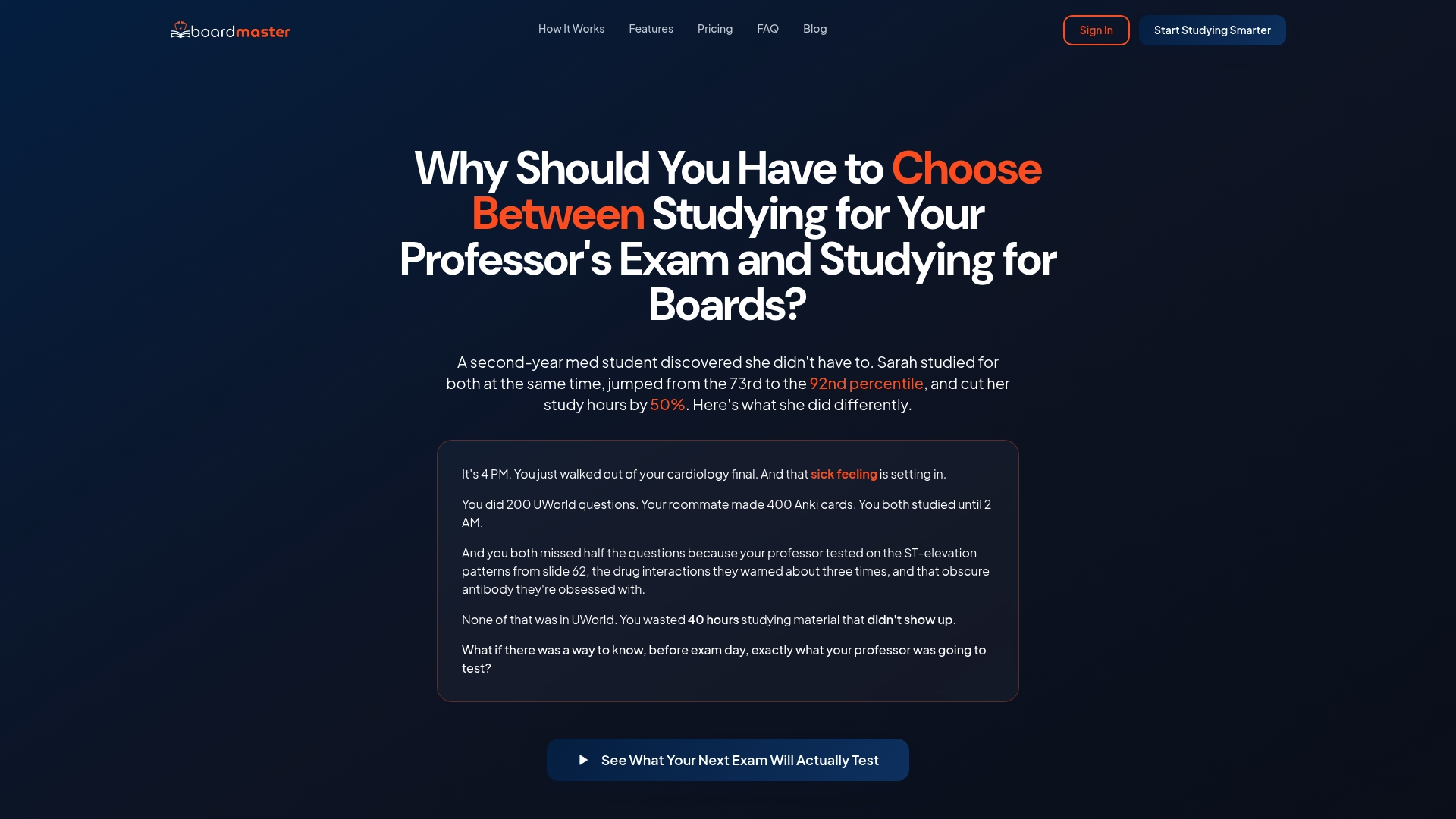
The workflow is straightforward: upload lecture notes or audio, and the AI question generator produces USMLE-style multiple-choice questions with explanations. SRS flashcards, mastery dashboards, and AI study podcasts that condense lectures into eight-minute episodes are all part of the same platform. Sarah's jump from the 73rd to the 92nd percentile while cutting study time in half is the kind of outcome the system is built for. Try the free demo at boardmaster.ai and run it against your next lecture.
Useful sources
| Source | What it supports |
|---|---|
| Neuroflip — Tracxn company profile | Market fragmentation; Neuroflip competitor count and positioning |
| Neuroflip on AppBrain | Similar apps (Voovo, Retain Cards); mobile SRS feature parity |
| Neuroflip — Google Play | Feature claims: active recall, SRS, analytics, personalized paths |
| Neuroflip — App Store | iOS availability; image-based questions and analytics features |
| Neuroflip.com | Neuroflip's own marketing claims on retention and study methodology |
| BoardMaster AI question generator demo | Evidence of lecture-to-USMLE-question pipeline |
| BoardMaster AI study podcasts | Lecture-to-podcast feature supporting BoardMaster product claims |
| MedSchoolPilot | US-specific med school readiness frameworks and progress tracking |
FAQ
What is the best Neuroflip alternative for USMLE prep?
BoardMaster is the closest match for US students because it generates USMLE-style questions directly from your lecture notes, combining class-exam alignment with board-level practice in one platform.
Does Neuroflip work for USMLE Step exams?
No. Neuroflip is built for NEET-PG and FMGE, which are Indian licensing exams. Its content and question style don't align with USMLE Step 1, Step 2 CK, or US medical school class exams.
Which alternative has the best spaced-repetition algorithm?
Anki's SRS algorithm is widely regarded as the most configurable and efficient for long-term retention. Firecracker and Brainscape also use adaptive repetition, though with less user control over scheduling parameters.
Can I upload my own lecture notes to any of these platforms?
BoardMaster is the only platform on this list that accepts lecture notes or audio and automatically generates USMLE-style questions from them. Anki and Brainscape allow manual card creation from your own content, but without AI question generation.
How long should I trial a new platform before committing?
One week on a single course topic is enough to judge retention, question quality, and usability. The 7-day test plan above gives you a structured method to compare any alternative against your current workflow.