
Becoming a general pediatrician in the United States takes a minimum of several years after high school for undergraduate education, medical school, and pediatric residency in an ACGME-accredited program; after completing residency, you become eligible for board certification through the American Board of Pediatrics (ABP) and can apply for a state medical license to practice independently.
Licensing exams sit inside that timeline, not after it. You will take the USMLE (for MD graduates) or COMLEX (for DO graduates) during medical school and early residency. Neither adds years on its own, but exam timing affects residency application competitiveness.
- Undergraduate (pre-med): 4 years (or 2–3 years in accelerated BS/MD tracks)
- Medical school (MD or DO): 4 years standard; rare 3-year programs exist
- Pediatric residency (R-1 to R-3): 3 years, ACGME-accredited
- Optional subspecialty fellowship: 1–3+ years depending on the subspecialty
Subspecialty fellowships, per National Academies research on pediatric training, typically add three years on top of residency, pushing the total to 14 years or more for a pediatric subspecialist.
Key Takeaways
Becoming a general pediatrician in the U.S. requires a minimum of 11 years from college start to independent practice, with subspecialty fellowship adding 2–3 more years and the ABP's seven-year certification window setting a hard deadline for board exam completion.
| Point | Details |
|---|---|
| Minimum total time | 11 years: 4 years undergrad + 4 years medical school + 3 years ACGME-accredited residency. |
| Residency structure | Three years (R-1 to R-3), with at least 12 satisfactory months at each level required by ABP and ACGME. |
| Fellowship adds time | Most subspecialty fellowships add 3 years; pediatric hospital medicine is approved at 2 years. |
| ABP seven-year window | Training must be completed within the previous seven years to sit for the certifying exam; missing it requires supervised retraining. |
| BoardMaster | Generates USMLE/COMLEX practice questions from your lecture notes, cutting study time during the high-pressure medical school and board prep stages. |
Table of Contents
- How long does it take to become a pediatrician, stage by stage?
- What does undergraduate pre-med actually look like?
- What happens during medical school (MD vs. DO)?
- What does pediatric residency involve?
- How does subspecialty fellowship change your total time?
- Licensure and board certification: what are the steps?
- What are the fastest realistic routes, and what extends the timeline?
- What does early practice look like after residency?
- How is fellowship training evolving?
- A realistic planning perspective
- BoardMaster helps you study smarter at every stage
- Sources
- FAQ
How long does it take to become a pediatrician, stage by stage?
| Stage | Minimum years | What you do | Required? |
|---|---|---|---|
| Undergraduate (pre-med) | 4 | Complete pre-med coursework, MCAT, clinical experience | Yes |
| Medical school (MD/DO) | 4 | Preclinical sciences, clinical rotations, USMLE/COMLEX | Yes |
| Pediatric residency | 3 | R-1 to R-3 in ACGME-accredited categorical program | Yes |
| Subspecialty fellowship | 1–3+ | Advanced clinical training in a pediatric subspecialty | Optional |
Three realistic timelines:
- Fastest: Accelerated BS/MD program (6–7 years combined) + 3-year residency = 9–10 years from high school graduation to independent practice
- Typical: 4-year undergrad + 4-year med school + 3-year residency = 11 years
- Extended: Typical path + gap year(s) + research year + 3-year fellowship = 15–16+ years
A few notes on variation. DO graduates take COMLEX instead of (or in addition to) USMLE; both pathways lead to pediatric residency eligibility, but some programs historically preferred USMLE scores, so many DO students take both. International medical graduates (IMGs) must obtain ECFMG certification before applying through ERAS, which can add a year or more depending on visa timing and observership requirements. Canadian graduates trained in RCPSC programs should note that ABP updated its requirements effective January 2025, now requiring four years of RCPSC training for recognition.
What does undergraduate pre-med actually look like?
The standard path for undergraduate education is multiple years. You do not need a specific major, but you need to complete required pre-med coursework: biology, general and organic chemistry, physics, biochemistry, math, and English. GPA matters enormously, and so does your MCAT score, clinical experience, research, and extracurricular activities.
Key pre-med variables that affect your total timeline:
- Standard 4-year path: Most students apply to medical school during their junior year, take the MCAT in spring of junior year, and begin medical school the fall after graduation.
- Gap year(s): One or two gap years are increasingly common and often strengthen applications. Each adds a year to your total timeline but can improve match competitiveness.
- Post-bacc programs: If your GPA or prerequisites are incomplete, a post-bacc adds 1–2 years before medical school.
- Accelerated BS/MD programs: These combined programs compress undergraduate and medical education into 6–7 years total. Research on accelerated tracks shows graduates report less debt and feel adequately prepared for residency compared with traditional 4-year MD graduates. More than 30 consortium programs exist across the U.S.
Pro Tip: Accelerated BS/MD programs require planning that starts in high school. Admission is highly selective, and you typically commit to a medical school before you have taken any college courses. The time savings are real, but you trade the flexibility to change your mind.
The MCAT is the single biggest scheduling decision in pre-med. Taking it too early (before you have covered biochemistry and psychology) risks a low score that delays your application cycle by a full year.
What happens during medical school (MD vs. DO)?
Medical school runs multiple years in virtually every U.S. program. The first two years cover preclinical sciences: anatomy, physiology, pharmacology, pathology, and the rest. Years three and four are clinical rotations through core specialties, including pediatrics, internal medicine, surgery, obstetrics, and psychiatry.
MD vs. DO: what actually differs:
- Degree name: MD from allopathic schools (LCME-accredited); DO from osteopathic schools (COCA-accredited)
- Additional curriculum: DO programs include osteopathic manipulative medicine (OMM) coursework
- Licensing exams: MD students take USMLE Steps 1, 2 CK, and 3; DO students take COMLEX Levels 1, 2, and 3 (many also take USMLE for broader residency access)
- Residency eligibility: Both MD and DO graduates are eligible for ACGME-accredited pediatric residency programs
Rare 3-year MD programs exist at a handful of schools, but they typically require you to choose a specialty early and may limit elective time, which can affect residency application competitiveness.
Exam timing is where students lose ground. The AAMC residency roadmap advises that applicants typically begin the residency application process in the third or early fourth year of medical school using ERAS. That means your Step 2 CK score needs to be available when ERAS opens in the fall of your fourth year.
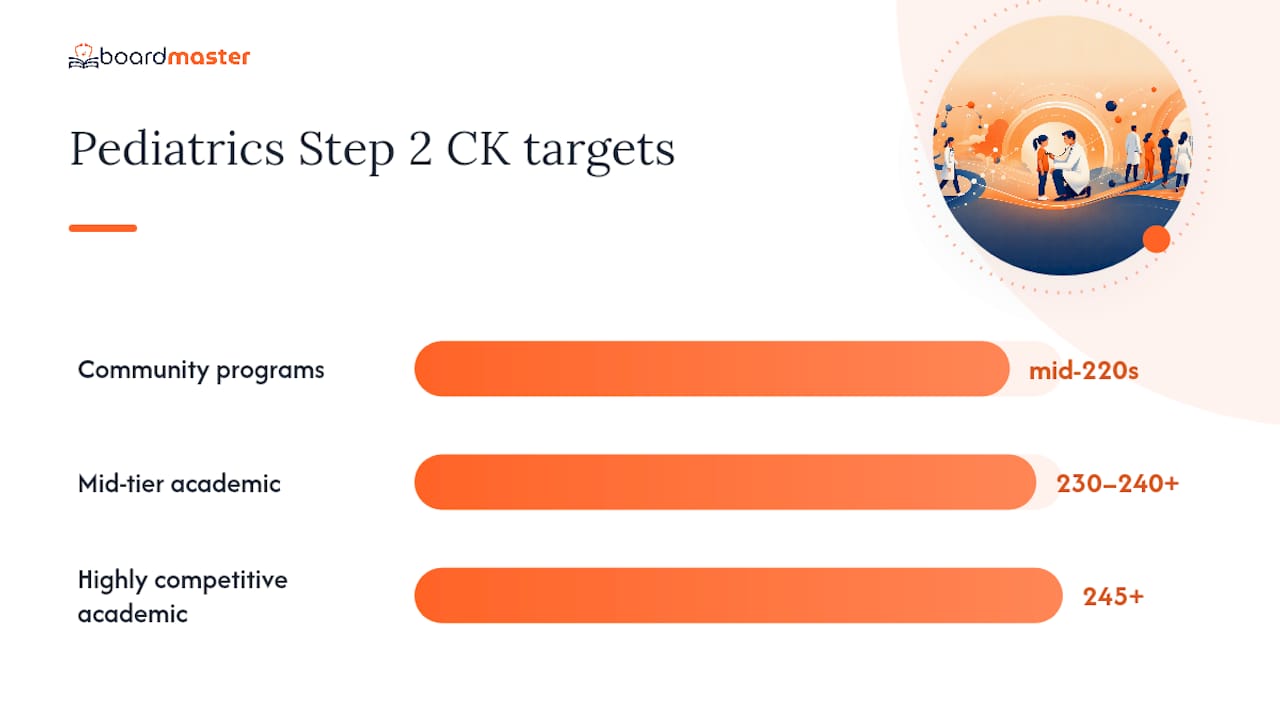
Benchmark Step 2 CK scores for pediatrics residency programs, per ResidencyAdvisor guidance: mid-220s for many community programs, 230–240+ for mid-tier academic programs, and 245+ for highly competitive academic programs. Scheduling your exam by late July or August of your application year gives scores time to post before ERAS review begins.
Pro Tip: Adaptive study methods that align your class prep with board-style questions let you prepare for Step 2 CK without doubling your study hours during clerkships.
What does pediatric residency involve?
General pediatrics residency in the U.S. runs multiple years in an ACGME-accredited categorical program. The ABP admission requirements specify that training must include at least 12 months completed satisfactorily at each level (R-1, R-2, R-3) before promotion. Leaves of absence or incomplete rotations can extend training beyond three years.
ACGME pediatrics program requirements mandate progressive responsibility across training levels, with R-1 residents functioning under close supervision and R-3 residents expected to supervise junior trainees and lead clinical teams. Curricular requirements include inpatient general pediatrics, NICU, PICU, outpatient continuity clinic, subspecialty rotations, and longitudinal experiences in quality improvement and medical education. (ACGME Pediatrics Program Requirements, 2026)
What you do across three years:
- R-1: Heavy inpatient rotations, NICU, PICU, emergency medicine; close attending supervision throughout
- R-2: Subspecialty rotations, increased autonomy, beginning to supervise interns
- R-3: Senior resident responsibilities, continuity clinic leadership, quality improvement projects, and preparing for the ABP certifying exam
After completing residency and obtaining a state medical license, you can practice as a general pediatrician independently. Board certification through ABP is not legally required to practice, but most hospital systems and academic employers expect it.
How does subspecialty fellowship change your total time?
Fellowship is optional for general pediatricians but required if you want to practice as a pediatric subspecialist. Most clinical fellowships run multiple years. Pediatric hospital medicine is an approved exception at two years, making it the shortest recognized fellowship track.
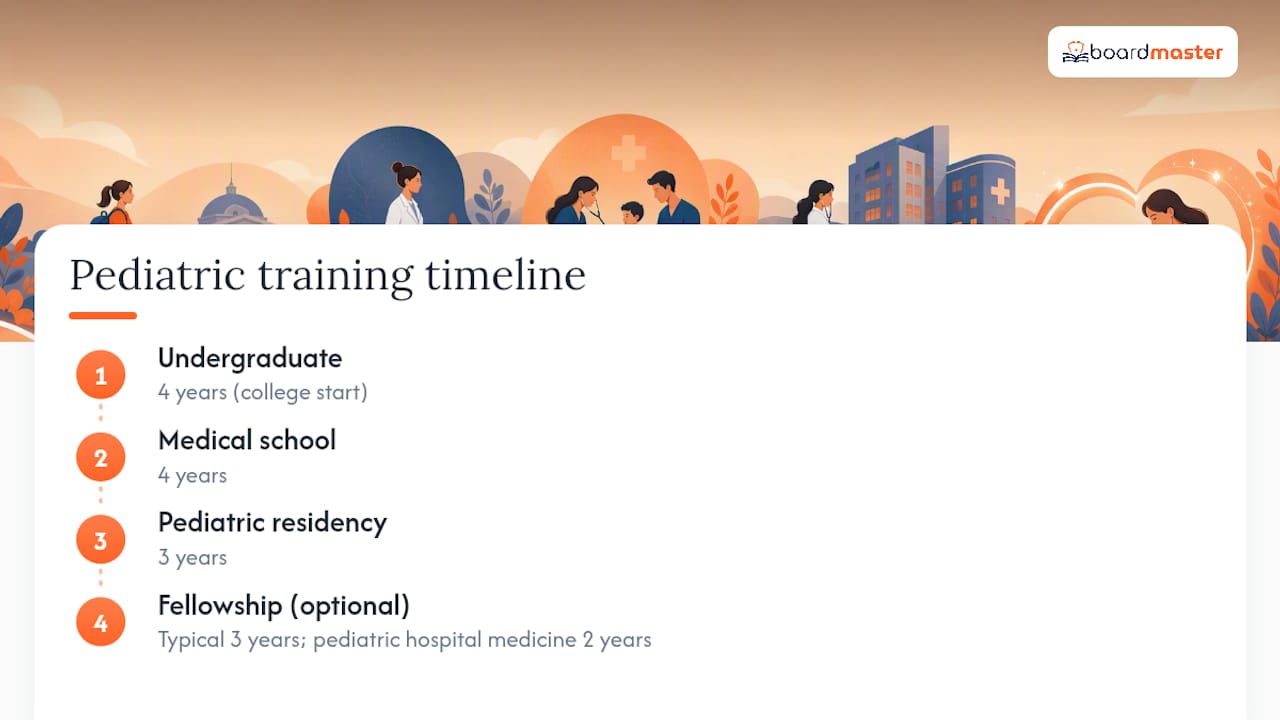
Per National Academies research, the typical subspecialist path is 4 years of medical school + 3 years of residency + 3 years of fellowship, totaling 14 years from college start. Fellowship programs include both clinical training and a scholarly activity requirement, with varying balance between the two based on program and career goals.
The ABP's Accelerated Research Pathway (ARP) offers research-focused trainees a way to integrate fellowship clinical and research goals, potentially shortening some clinical training time. ARP requires program approval and rigorous scholarly output, so it suits a narrow group of trainees aiming for academic research careers.
ABP has also signaled openness to competency-based fellowship models, where demonstrated mastery rather than fixed time determines readiness. Pediatric hospital medicine's 2-year fellowship model is the clearest current example of this flexibility in practice.
Licensure and board certification: what are the steps?
State medical licensure and ABP board certification are two separate processes, and confusing them is a common planning mistake.
State medical license: You apply through your state's medical board after graduating from medical school and beginning residency. Most states issue a training license that allows you to practice under supervision during residency. Full independent licensure follows residency completion. Requirements vary by state but generally include passing USMLE Steps 1, 2, and 3 (or COMLEX equivalents) and completing a background check.
ABP board certification: After completing residency, you become eligible to sit for the ABP general pediatrics certifying exam. The critical rule most residents overlook:
ABP requires that all required training be completed within the previous seven years for initial certification eligibility. If more than seven years pass between completing training and taking the certifying exam, you must complete a minimum of six months of supervised practice before eligibility is restored, and a new seven-year window begins. (ABP Time-Limited Eligibility for General Pediatrics)
Key steps in order:
- Pass USMLE Steps 1, 2 CK, and 3 (or COMLEX equivalents) during medical school and early residency
- Complete three years of ACGME-accredited pediatric residency with satisfactory promotion at each level
- Obtain a full state medical license
- Apply for and pass the ABP general pediatrics certifying exam within the seven-year window
- Maintain certification through ABP's ongoing Maintenance of Certification program
Subspecialty certification follows the same general structure but has its own eligibility rules and time windows set by ABP for each subspecialty.
What are the fastest realistic routes, and what extends the timeline?
Fastest realistic path: An accelerated BS/MD program (6–7 years) followed by a 3-year pediatric residency puts you at independent practice in roughly 9–10 years from high school. These programs are selective, require early commitment, and are not available everywhere, but they are a legitimate route for students who are certain about medicine early.
A 3-year MD program followed by direct categorical pediatric residency is theoretically possible but rare. Few programs offer the 3-year track, and the compressed timeline limits elective rotations that strengthen residency applications.
Common timeline extensions:
- One gap year: Adds 1 year; often improves application strength and MCAT scores
- Two gap years or post-bacc: Adds 1–2 years; common for career changers or students rebuilding GPA
- Research year during or after residency: Adds 1 year; strengthens fellowship applications in competitive subspecialties
- Not matching on first attempt: Adds at least 1 year for a preliminary year and re-application
- Subspecialty fellowship: Adds 2–3 years depending on subspecialty
IMG-specific additions: International medical graduates must obtain ECFMG certification, which requires passing USMLE Steps 1 and 2 CK and 2 CS (or its current equivalent), plus documentation review. Visa processing and observership requirements can add 1 or more years before residency begins.
Benchmark timelines in summary: fastest compressed track, roughly 9–10 years; typical U.S. path, 11 years; extended path with fellowship and research, 14–16+ years.
What does early practice look like after residency?
After completing residency and obtaining full state licensure, a general pediatrician can practice independently from day one. Most new attendings join outpatient pediatric practices, hospital-employed groups, academic medical centers, or federally qualified health centers. The Bureau of Labor Statistics notes that physicians work across a range of settings including offices, hospitals, and community health centers, with employment for physicians and surgeons projected to grow faster than average through the coming decade.
Board certification timing matters for job hunting. Academic medical centers and children's hospitals often prefer or require board-certified physicians, though many will hire a new graduate who is board-eligible and studying for the exam. Community practices tend to be more flexible. The ABP certifying exam is typically taken in the year following residency completion, so most new pediatricians are board-certified within 12–18 months of finishing training.
Fellowship changes the job market picture significantly. A neonatologist or pediatric cardiologist commands different roles and compensation than a general pediatrician, but the path to that position costs an additional three years of training and typically lower fellow salaries during that period.
How is fellowship training evolving?
The debate over fellowship length is not abstract. ABP and training program directors have been actively discussing whether fixed time-based requirements serve trainees and patients better than competency-based milestones. The approval of pediatric hospital medicine as a 2-year fellowship is the most concrete result of that debate so far.
Program directors increasingly frame residency and fellowship as periods of professional maturation and leadership development, not just clinical exposure accumulation. ACGME requirements reflect this by building progressive supervisory responsibility into the R-1 to R-3 structure, expecting residents to move from supervised learner to team leader across three years. (ACGME Pediatrics Program Requirements, 2026)
The scholarly activity requirement in fellowship has been a particular point of tension. Some programs front-load clinical training and compress research time; others do the reverse. The ARP offers a structured alternative for trainees whose career goals center on academic research, but it requires program buy-in and is not universally available.
What this means practically: if you are planning a fellowship, ask programs directly about their scholarly activity structure and whether they participate in ARP or competency-based tracks. The answer affects not just your timeline but your career trajectory.
A realistic planning perspective
The 11-year minimum is a clean number, but most people's paths are messier than that. A few planning priorities that actually move the needle:
MCAT and Step 2 CK timing are the two highest-leverage decisions in your pre-residency years. A strong MCAT score opens better medical schools, which improves your residency match options. A Step 2 CK score posted before ERAS opens in the fall of your fourth year gives programs a complete picture of your candidacy. Both exams reward dual-purpose study that covers class material and board content simultaneously.
On subspecialization: do not choose a fellowship because it sounds impressive. Choose it because the job you want requires it or because the clinical work genuinely interests you. Three extra years of training at fellow salary, followed by a subspecialty job market that may be tighter than general pediatrics, is a real trade-off. General pediatricians have strong employment prospects and more geographic flexibility.
Build contingency into your financial plan. A gap year, a failed rotation that extends residency, or a research year you did not anticipate can each add a year to your timeline and a year to your debt accumulation. The ABP's seven-year certification window is generous, but it is not infinite. If you take time away from medicine after residency, the clock is still running.
The readers who navigate this path most smoothly are the ones who treat it as a series of discrete decisions with known deadlines, not a single overwhelming commitment. Plan your MCAT date. Plan your Step 2 CK date. Know your ABP eligibility window before you finish residency.
BoardMaster helps you study smarter at every stage
The medical school years are where most of the timeline pressure concentrates. You are covering preclinical material, preparing for Step 1 and Step 2 CK, completing clerkships, and building your residency application simultaneously. Generic question banks cover the same material regardless of what your professor emphasized last Tuesday.

BoardMaster takes a different approach. Upload your lecture notes and the platform generates AI-powered USMLE and COMLEX-style practice questions built from your actual course material, so your class exam prep and board prep happen at the same time. Flashcards with spaced repetition, AI-generated study podcasts, and OSCE clinical skills simulations round out the toolkit for clerkship and residency application season. Over 5,000 physician-written board-style questions are available for structured practice when you want to move beyond your own notes. Start with a free account at Boardmaster and see how much of your study time you can reclaim.
Sources
These primary sources govern training length, board eligibility, and residency structure in the U.S. Consult the specific source for the question you have:
- Admission Requirements | The American Board of Pediatrics
- ACGME program requirements for pediatrics (2026)
- Pediatric Subspecialty Training — National Academies / NCBI (chapter)
This article is general information, not a substitute for advice from a qualified doctor. Consult a qualified healthcare professional about your own circumstances before acting on anything here.
FAQ
How long does it take to become a pediatrician in the U.S.?
The minimum is 11 years from the start of college: 4 years of undergraduate education, 4 years of medical school, and 3 years of ACGME-accredited pediatric residency. Subspecialty fellowship adds 2–3 more years for those who pursue it.
How fast can you become a pediatrician?
The fastest realistic route is an accelerated BS/MD program (6–7 years) combined with a 3-year pediatric residency, putting independent practice at roughly 9–10 years from high school graduation. These programs are selective and require early commitment.
What degree do most pediatricians have?
Most U.S. pediatricians hold an MD degree from an LCME-accredited allopathic medical school; a growing number hold a DO degree from a COCA-accredited osteopathic school. Both degrees qualify graduates for ACGME-accredited pediatric residency programs and ABP board certification.
What is the youngest age someone can become a doctor?
Completing the minimum 11-year path from college start means most pediatricians finish residency in their early-to-mid 30s. Students who enter accelerated BS/MD programs directly from high school and complete the compressed 9–10 year path could theoretically finish residency earlier, though this is uncommon.
Are pediatricians among the lower-paid physician specialties?
Pediatrics is generally considered one of the lower-compensated physician specialties compared with surgical fields, though the BLS reports that physicians and surgeons overall have high median wages. Subspecialty pediatricians (neonatology, cardiology) typically earn more than general pediatricians.