
TL;DR:
- A structured weekly schedule that includes baseline testing, time-blocking, and buffer periods optimizes USMLE preparation alongside lectures. Utilizing tools like Anki, practice exams, and question banks with data-driven adjustments helps prevent burnout and addresses individual knowledge gaps effectively. Most students succeed by treating their schedule as an adaptive feedback loop rather than rigid planning based on intuition alone.
A weekly schedule balancing lectures and USMLE preparation is a structured, adaptive plan that integrates fixed study blocks, baseline testing, and buffer time to maximize retention without burning out. Most medical students treat these two demands as competing forces. They are not. The right framework treats your lecture calendar as the skeleton of your week and builds USMLE content review around it. Tools like Anki, the Pomodoro technique, and NBME practice exams give that framework its muscle. This article shows you exactly how to build and protect that schedule, week by week.
What tools and techniques support efficient study scheduling for medical students
Time-blocking combined with task prioritization and active learning reduces academic stress and improves motivation in medical students. The mechanics matter here. A study block works best at 60 to 90 minutes with a short break before the next. The Pomodoro technique, 25 minutes of focused work followed by a 5-minute break, fits naturally inside those blocks and prevents the mental fatigue that kills retention after hour two.
The tools that belong in every medical student's weekly plan:
- Anki spaced repetition: The gold standard for long-term retention of high-volume content. Anki surfaces cards at the exact interval your brain needs to consolidate them, which means daily reviews compound over weeks rather than evaporating overnight.
- NBME practice exams: The National Board of Medical Examiners (NBME) offers timed and untimed practice forms. Use untimed early to diagnose knowledge gaps, then switch to timed mode closer to your test date to simulate real exam pacing.
- UWorld question bank: UWorld's detailed explanations train clinical reasoning, not just recall. Running blocks in tutor mode early in your dedicated period lets you learn from each question rather than just score it.
- Buffer or catch-up blocks: Building explicit uncommitted time into your weekly schedule absorbs lecture overruns and delayed reviews, preventing the cascade failure that hits when one missed day derails the rest of the week.
Pro Tip: Schedule your buffer block on Friday afternoon or Sunday morning. Treat it as sacred recovery time, not optional. Students who skip buffer blocks consistently fall behind by week three.
How to design a weekly schedule that integrates lecture attendance and USMLE review
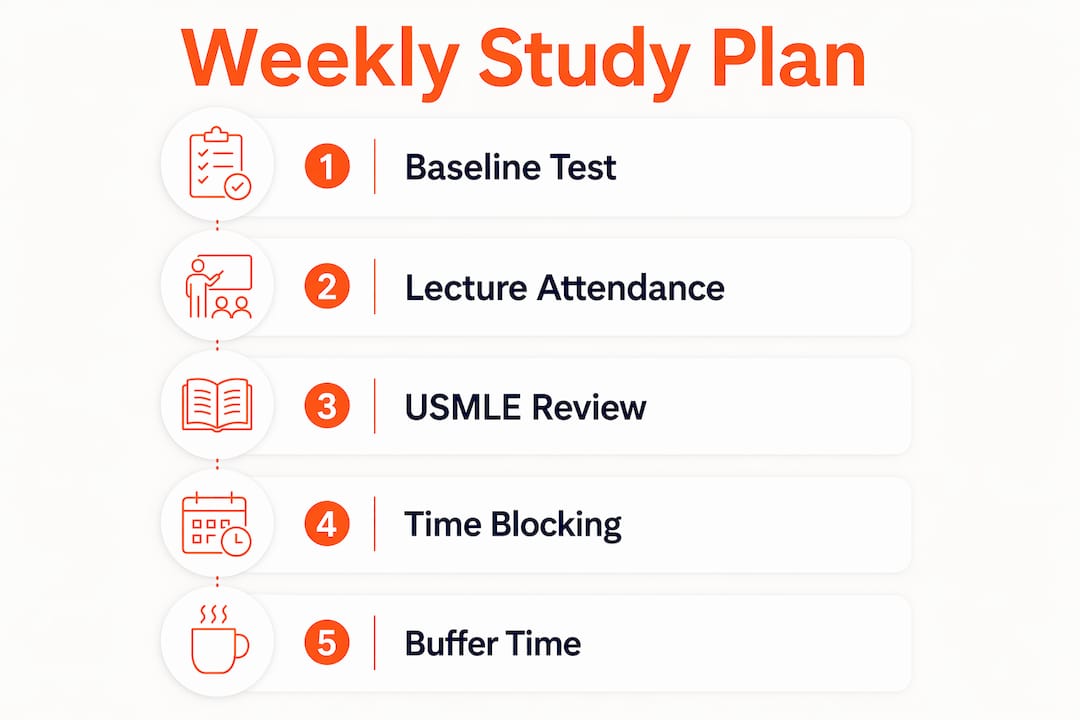
The most effective study plan for USMLE starts with data, not guesswork. Taking an initial NBME early in your dedicated period helps target weak areas and directs the weekly plan more effectively than assuming what you need to study. That single test tells you which organ systems to front-load and which you can rotate in later.
Here is a step-by-step framework for building your weekly schedule:
- Take a baseline NBME. Run it untimed. Record your score and flag every system where you missed more than 40% of questions. These become your priority subjects for the first two to three weeks.
- Map your lecture days. Identify which days carry the heaviest lecture load. On those days, cap your USMLE review at 60 minutes of Anki plus one 20-question UWorld block. Depth of processing matters more than volume on high-lecture days.
- Assign subject focus by day. Rotate organ systems across the week. Monday might be cardiology and respiratory, Wednesday renal and endocrine, Friday pathology and pharmacology review. This rotation prevents the cognitive overload of trying to master everything at once.
- Set a daily Anki time limit. Do not let Anki expand to fill your day. Cap it at 45 minutes pre-week four, then extend to one hour after that point as your deck grows.
- Schedule a weekly NBME check-in. Every two weeks, run a new NBME form. Compare scores to your baseline. Shift your subject rotation based on what the data shows, not what feels comfortable.
- Build one full catch-up block per week. This is non-negotiable. Use it to finish incomplete question blocks, review flagged Anki cards, or re-read a lecture you did not fully absorb.
The table below shows how question volume should scale across a standard dedicated period, based on a week-by-week pacing model:
| Dedicated week | Daily question target | Mode |
|---|---|---|
| Weeks 1 to 2 | 40 questions | Tutor mode |
| Weeks 3 to 4 | 40 to 80 questions | Mixed tutor and timed |
| Weeks 5 to 8 | 80 to 120 questions | Timed blocks |
| Weeks 9 to 10 | 120 or more | Full timed simulation |
Pro Tip: High-performing students prioritize high-impact tasks first and combine time-blocking with active study. Do your hardest subject block in the first two hours of your study day, before decision fatigue sets in.

Common scheduling pitfalls and how to avoid them
The most damaging mistake medical students make is skipping the baseline NBME and guessing their study focus. Without data, you spend three weeks reviewing cardiology because it feels hard, while your renal score quietly collapses. Every week without a diagnostic anchor is a week of misdirected effort.
Here are the six pitfalls that derail even disciplined students:
- Overloading Anki without time limits. Anki workload should be limited by time and card suspension for unseen systems. Suspending cards from systems you have not studied yet keeps your daily review manageable and prevents the dread that makes students abandon their deck entirely.
- Skipping catch-up buffer time. One missed day without a buffer block becomes two, then three. The spaced repetition intervals that Anki depends on break down, and you lose the compounding benefit you spent weeks building.
- Failing to adjust based on NBME progress. Your schedule is a hypothesis. If your renal score drops between NBME forms, that is data telling you to rotate renal back into your priority blocks. Ignoring it is the equivalent of ignoring a lab result.
- Multitasking during study blocks. Checking your phone during a 25-minute Pomodoro interval does not just waste five minutes. It resets the focused attention state that drives deep encoding. A distracted block is not a half-block. It is close to zero.
- Ignoring your personal productivity rhythm. Some students hit peak focus at 7 a.m. Others do not reach it until noon. Scheduling your hardest content blocks outside your natural peak window costs you retention without saving any time.
"Treat your schedule as an experiment with ongoing baseline testing and weekly adjustment. This converts hope-based plans into data-based, focused study." — Shemmassian Academic Consulting
How to adapt your schedule when school demands fluctuate
Not every student gets a clean six-week dedicated period. Dedicated study length varies from four to eight weeks, and students with shorter blocks of around three weeks need to start broader USMLE preparation before the dedicated period even begins. That means Anki and light question practice during second year, not just during dedicated.
When your lecture load spikes or your dedicated window shrinks, these adjustments protect your progress:
- Start Anki before dedicated. If your dedicated period is three weeks or fewer, begin your Anki deck during your pre-clinical curriculum. Even 20 minutes per day during second year builds a retention base that pays off enormously when dedicated arrives.
- Use early practice tests to triage. Take an NBME form four to six weeks before your dedicated period starts. This gives you a content map before the pressure peaks, so you are not diagnosing weaknesses at the same time you are trying to fix them.
- Prioritize high-yield topics on heavy lecture days. When a lecture day runs long, cut your USMLE review to one focused subject rather than skipping it entirely. Thirty minutes on your weakest system beats zero minutes of scattered review.
- Scale question blocks to available time. On a day with four hours of lecture, run 20 questions instead of 40. Consistency across weeks matters more than daily volume. Missing a block entirely breaks momentum; scaling it down does not.
- Protect your Anki streak even on hard days. First NBME practice exams taken untimed focus on knowledge diagnosis, but Anki works only if the streak holds. On your worst days, do 10 minutes of Anki reviews before bed. That is enough to preserve the spaced repetition cycle.
- Use flexible catch-up blocks strategically. When a school exam or clinical rotation disrupts your week, your buffer block absorbs the hit. Do not try to make up three missed days in one marathon session. Redistribute across the next two catch-up blocks instead.
If you are managing accommodations or overlapping exam timelines, adjusting your study plan for your specific circumstances is worth exploring early rather than mid-schedule.
Key takeaways
A weekly schedule balancing lectures and USMLE preparation works only when it combines baseline testing, structured time blocks, and built-in buffer time to adapt as demands shift.
| Point | Details |
|---|---|
| Start with a baseline NBME | Take an untimed NBME early to identify weak systems and direct your study rotation with data. |
| Use time-blocking with Pomodoro | Fixed 60 to 90 minute blocks with 25/5 Pomodoro intervals improve focus and reduce multitasking. |
| Cap Anki by time, not cards | Limit daily Anki to 45 to 60 minutes and suspend unseen systems to prevent deck overload. |
| Build one buffer block per week | A weekly catch-up block absorbs missed sessions and protects spaced repetition intervals. |
| Scale question volume progressively | Ramp from 40 tutor-mode questions in week one to 120-plus timed questions by weeks nine and ten. |
Why most med students schedule backwards
Here is what I have seen repeatedly working with medical students: most of you build your schedule around what feels productive rather than what the data says you need. You open your calendar, block out eight hours of study, and fill it with the subjects you already understand reasonably well because that feels like progress. It is not.
The students who improve fastest treat their schedule as a feedback loop. They take an NBME, find out renal physiology is their floor, and spend the next two weeks there even though it is uncomfortable. They check their Anki retention rates and suspend cards they are consistently getting right to make room for what is actually slipping. They do not try to be perfect every day. They use their buffer block without guilt when life happens, and they get back on track Monday.
I also want to push back on the idea that more hours automatically means better scores. I have seen students study 12 hours a day and plateau, while others study six focused hours and climb 15 percentile points. The difference is almost always schedule design, not willpower. If you are avoiding burnout while maintaining consistency, you are already ahead of most of your class.
Build the schedule. Test it. Adjust it. Repeat.
— Adeeb
How Boardmaster fits into your weekly study plan

Boardmaster is built for exactly the problem this article describes. You attend lectures, you have USMLE content to cover, and generic question banks do not connect the two. Boardmaster's AI question generator converts your uploaded lecture notes into USMLE-style practice questions that reflect what your professors actually emphasize. That means your lecture review and your board prep happen in the same session, not in separate silos. Students like Sarah jumped from the 73rd to the 92nd percentile while cutting their study hours in half because they stopped reviewing the wrong material. If you want a USMLE prep platform that adapts to your lecture schedule rather than ignoring it, Boardmaster is the place to start.
FAQ
How many hours should I study for USMLE while attending lectures?
Most students manage four to six focused hours of USMLE review on heavy lecture days and six to eight hours on lighter days. Quality of focus matters more than total hours logged.
When should I take my first NBME practice exam?
Take your first NBME untimed at the start of your dedicated period, or four to six weeks before it begins if your dedicated window is short. This baseline score directs your entire subject rotation.
How do I keep up with Anki during a heavy lecture week?
Set a hard time limit of 20 to 30 minutes for Anki on heavy days and suspend cards from systems you have not yet studied. Maintaining the streak at reduced volume beats skipping entirely.
What is the best way to balance daily lectures with USMLE review?
Assign lighter USMLE tasks, such as Anki and a short question block, to high-lecture days, and reserve deeper content review and full question blocks for days with fewer scheduled lectures.
How often should I adjust my weekly USMLE study schedule?
Review your schedule every two weeks after each NBME form. Shift subject focus based on score changes, not on how confident you feel about a topic.