
TL;DR:
- Rapid improvement on USMLE Step 2 CK hinges on mastering clinical question interpretation and systematic error analysis rather than passive content review. Focused practice with high-volume question banks like UWorld, combined with NBME self-assessments and targeted review, accelerates score gains by enhancing clinical reasoning skills. Consistently analyzing errors, tracking score trends, and simulating real exam conditions are essential for efficient, sustainable progress.
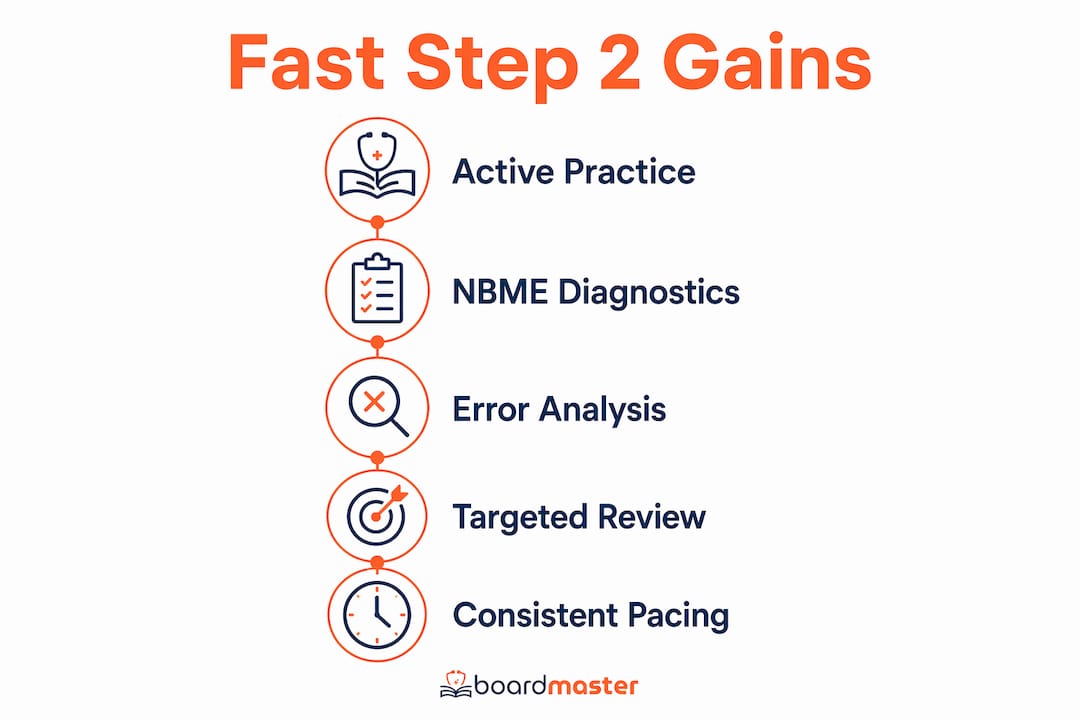
Improving your USMLE Step 2 CK score fast requires mastering clinical question interpretation and structured error review, not simply studying more content. Step 2 CK is a clinical knowledge and decision-making exam, which means passive reading of textbooks delivers far less return than active practice with vignette-based questions. The fastest gains come from combining a high-volume question bank like UWorld with NBME self-assessments used as diagnostic tools, then applying a systematic error analysis framework to every practice session. Students who follow this approach, rather than rereading First Aid or Amboss notes, consistently see the sharpest score jumps in the shortest time.
How does targeted question practice accelerate Step 2 score gains?
AMA frames Step 2 CK as a clinical diagnosis and management exam, which means every question you practice should sharpen your ability to interpret a patient scenario and select the next best step. That framing matters because it tells you exactly what to practice and what to skip.
Question interpretation (QI) is the core skill that separates high scorers from average ones. Every sentence in a clinical vignette carries information: the patient's age, the timing of symptoms, the one abnormal lab value buried in a normal panel. Training yourself to extract and weigh each data point before reading the answer choices is the single fastest way to reduce wrong answers caused by misreading rather than ignorance.
Practicing with UWorld aligns your study directly with exam demands because its questions are written at the same cognitive level as the real test. The key is not to rush through questions but to treat each explanation as a mini-lecture. Read every explanation fully, even for questions you answered correctly, because correct answers reached by faulty reasoning will fail you on test day.
- Read the last sentence of the vignette first to identify what the question is actually asking before processing the clinical details.
- Flag questions where you were unsure even if you got them right. Uncertainty is a data point.
- After each block, spend at least as much time reviewing explanations as you spent answering questions.
- Group your practice by organ system or presentation type early in your prep to build pattern libraries faster.
Pro Tip: Use the question stem breakdown technique of annotating each vignette sentence before selecting an answer. It feels slow at first but cuts second-guessing dramatically within two weeks.
What role do NBME self-assessments play in fast score improvement?
NBME self-assessments are the most reliable diagnostic tools available for Step 2 CK preparation. NBME score reports break down performance by content area, so you can see exactly which clinical domains are pulling your score down and redirect your study hours accordingly.
The right way to use NBME forms is as a structured diagnostic loop, not just a score check. MedBoardTutors highlights treating NBME review as a diagnostic loop for tailored fixes by error type, which means the review session after the test is where the real learning happens. Plan for at least six hours of post-exam review per form.
Here is the process that produces the fastest gains from each NBME form:
- Take the form under full timed conditions, no breaks beyond what the real exam allows.
- Record your raw score and note the content domain breakdown from the score report.
- Categorize every wrong answer as a knowledge gap, a reasoning error, or a careless mistake.
- For knowledge gaps, return to a targeted resource like UWorld explanations or a focused Amboss chapter.
- For reasoning errors, redo similar question types in UWorld with deliberate attention to your decision process.
- For careless mistakes, review your pacing log and identify whether time pressure or fatigue caused the slip.
Pro Tip: Never retake the same NBME form. Retaking the same form inflates your score through question memory, giving you false confidence about your readiness.
Using score trends across multiple forms gives you a far more accurate picture than any single result. Averaging recent NBME scores from the two weeks before your exam date produces the most valid readiness estimate. A single strong result after a weak week means nothing. Three consecutive forms trending upward means you are ready.
| NBME usage strategy | Why it matters |
|---|---|
| Take under timed conditions | Simulates real exam stress and pacing demands accurately. |
| Review errors by category | Distinguishes knowledge gaps from reasoning flaws for targeted fixes. |
| Track trends across forms | Multiple scores average out variance and give a reliable readiness signal. |
| Avoid repeating forms | Prevents score inflation from question memory distorting your self-assessment. |
Which study plan and question volume optimize fast gains?
A dedicated Step 2 CK study block typically runs six to eight weeks, with students completing between 2,500 and 3,500 practice questions over that period. That volume is not arbitrary. It reflects the number of clinical patterns you need to encounter to build reliable recognition speed, which is what separates a 240 from a 255.
The structure of your daily practice matters as much as the total volume. Early in your study block, prioritize understanding over speed. Spend 90 minutes answering a 40-question block, then spend 90 minutes reviewing every explanation. As your exam date approaches, shift toward timed blocks that mirror real exam pacing.
- Weeks one and two: untimed or extended-time blocks focused on explanation depth, 40 to 60 questions per day.
- Weeks three through five: timed blocks at standard pace, 80 questions per day with full review.
- Weeks six through eight: full-length timed practice, NBME forms, and targeted review of weak domains only.
- Reserve the final three days for light review and rest. Cramming in the last 72 hours raises anxiety without raising scores.
Standard pacing practice targets approximately 90 seconds per question to build the endurance and accuracy needed for exam day. If you consistently run over that threshold during practice, pacing is a score limiter you need to address directly, not ignore.
Plateaus are real and predictable. If your NBME scores stop rising after two consecutive forms, the answer is almost never to add more question banks. The answer is to spend more time on error analysis and less time generating new questions. Quality review is the lever that breaks plateaus.
How to analyze and fix common mistakes to boost your Step 2 score quickly
The failure mode framework categorizes every wrong answer into one of three buckets: knowledge gap, reasoning error, or careless mistake. Each bucket requires a completely different fix, which is why generic "study more" advice fails so many students.

A knowledge gap means you simply did not know the content. The fix is targeted content review using a focused resource, not a full re-read of a textbook chapter. If you missed a question about the management of acute pancreatitis, spend 20 minutes on that specific topic in UWorld or Amboss, then do three to five similar questions immediately to consolidate the learning.
A reasoning error means you knew the facts but applied them incorrectly. This is the most common error type for students scoring in the 230 to 245 range. The fix is more deliberate question practice with explicit attention to your decision tree. After answering a question, write out in one sentence why you chose your answer before checking the explanation. That single habit exposes flawed reasoning faster than any other technique.
A careless mistake means you misread the question, ran out of time, or selected an answer you knew was wrong. Passive reading of explanations does not fix careless mistakes. Pacing drills and a consistent pre-question routine do.
"The students who improve fastest are not the ones who study the most hours. They are the ones who spend the most time understanding exactly why they got each question wrong." This principle, drawn from AMA's guidance on Step 2 CK preparation, is the foundation of every effective score improvement plan.
For a structured approach to customizing your study plan around your specific error patterns, the process above gives you a repeatable weekly workflow.
What practical tips and pitfalls to avoid for quick score improvement
The most common trap that slows Step 2 score improvement is treating question practice as a content delivery system rather than a skill-building exercise. Students who skim explanations after getting a question wrong are not reviewing. They are performing the appearance of reviewing.
Consistent question interpretation practice eliminates second-guessing and tightens pacing, which converts existing knowledge into points you were previously leaving on the table. That distinction matters because many students already know enough content to score higher. They are losing points to process failures, not knowledge failures.
- Do not use more than two question banks simultaneously. Conflicting explanations create confusion and slow pattern recognition.
- Do not coast after a strong NBME result mid-prep. Score variance is real, and one good form does not mean you are done improving.
- Do not skip review on days when you score well. Strong performance still contains reasoning patterns worth reinforcing.
- Do use score trends, not single results, to make decisions about exam readiness or study plan changes.
Pro Tip: Compare your performance on UWorld vs. NBME question formats regularly. Discrepancies between the two often reveal whether your gains are format-specific or genuinely transferable to exam day.
AMA stresses clinical reasoning development over volume content memorization as the key driver of fast Step 2 improvement. That means your study plan should allocate more time to thinking through clinical scenarios than to reading about them.
Key takeaways
The fastest path to a higher Step 2 CK score runs through active question practice, structured NBME diagnostics, and error-type-specific fixes rather than passive content review.
| Point | Details |
|---|---|
| Prioritize active question practice | UWorld and NBME-style questions build clinical reasoning faster than passive reading. |
| Use NBME forms as diagnostics | Score reports by content domain reveal exactly where to focus your remaining study time. |
| Categorize every wrong answer | Distinguishing knowledge gaps from reasoning errors from careless mistakes drives targeted fixes. |
| Follow a structured volume plan | Six to eight weeks with 2,500 to 3,500 questions, weighted toward deep review over raw quantity. |
| Track score trends, not single results | Averaging multiple recent NBME forms gives the most reliable readiness signal before exam day. |
Why review quality is the real differentiator in Step 2 prep
After working with medical students preparing for Step 2 CK, the pattern I see most consistently is this: the students who improve the fastest are not the ones logging the most hours. They are the ones who treat every wrong answer as a clinical case worth solving.
I have watched students grind through 4,000 UWorld questions and plateau at the same NBME score for three consecutive weeks. When I look at their review logs, the problem is always the same. They are reading explanations, not interrogating them. There is a real difference between knowing that the answer was B and understanding the exact reasoning chain that makes B correct and C wrong in that specific clinical context.
The other thing I want to push back on is the idea that more resources equals better preparation. Students who use UWorld plus two other question banks plus three review books are almost always worse off than students who go deep on one resource. Depth of mastery beats breadth of exposure every time on this exam.
Realistic timed practice tests are non-negotiable. I have seen students score 15 to 20 points lower on their actual exam than on their untimed practice because they had never built the cognitive endurance to sustain clinical reasoning across a full exam day. Simulate the real conditions early and often.
Finally, be patient with gradual progress. A five-point NBME gain over two weeks is meaningful. Do not abandon a working strategy because the improvement feels slow. The students who stay disciplined through the plateau phase are the ones who break through it.
— Dr. Ahmed Abuzoor
How BoardMaster accelerates your Step 2 preparation

BoardMaster is built specifically for the problem this article describes: studying the right material in the right format. The platform's AI question generator converts your own lecture notes into USMLE-style clinical vignettes, so every question you practice is tied directly to content your professors emphasized. That means zero wasted time on low-yield material. One student, Sarah, moved from the 73rd to the 92nd percentile while cutting her study hours in half by using BoardMaster's targeted question sets. For students who want to combine class exam prep and board prep into a single workflow, BoardMaster's USMLE prep platform delivers the diagnostic feedback and question quality needed to move the needle fast.
FAQ
How long does it take to improve your Step 2 CK score?
Most students see measurable NBME score gains within two to three weeks of consistent, active question practice with deep error review. A full dedicated study block of six to eight weeks is the standard timeline for significant score improvement.
How many questions should I do per day for Step 2 CK?
Aim for 40 to 80 questions per day depending on your study phase, with equal time allocated to reviewing explanations. Strong scorers complete 2,500 to 3,500 total questions over their dedicated block while prioritizing review quality over raw volume.
Are NBME self-assessments accurate predictors of your real score?
NBME forms are the most validated predictors available, but a single form carries meaningful variance. Averaging your two or three most recent NBME scores taken under timed conditions gives a more reliable estimate of your actual exam performance.
What is the fastest way to fix reasoning errors on Step 2?
Write out your reasoning in one sentence before checking the answer on every practice question. This habit exposes flawed decision trees faster than any other technique and directly targets the most common error type for students in the 230 to 245 score range.
Should I use multiple question banks to prepare for Step 2 CK?
Using more than two question banks simultaneously creates conflicting explanations and slows pattern recognition. Go deep on one primary resource like UWorld before adding a secondary bank, and only add a second source if your NBME scores have plateaued despite thorough review.