
TL;DR:
- Filtering irrelevant USMLE material by using the official content outline helps focus study efforts on the most tested topics. Practicing with targeted questions and analyzing errors reveal personal knowledge gaps, guiding efficient review. Regular reassessment and alignment with the outline maximize study impact and improve exam performance.
Filtering irrelevant USMLE study material is the single most effective way to raise your score without adding more hours to your schedule. The USMLE content outline, published by the National Board of Medical Examiners, defines exactly what is tested. Yet most medical students ignore it and spend weeks on low-yield topics that rarely appear on exam day. The 80/20 rule applies directly here: 80% of exam questions originate from just 20% of core content. That ratio makes selective study a necessity, not a preference.
How to filter irrelevant USMLE study material using the official content outline
The USMLE content outline is the authoritative filter for every study decision you make. It organizes tested content across three dimensions: organ systems, physician tasks, and foundational science. Each dimension carries a different weight, and that weight tells you exactly how much time to allocate.

The organ systems dimension covers cardiology, renal, neurology, and other body systems. The physician tasks dimension covers clinical reasoning, diagnosis, and management. The foundational science dimension covers pathophysiology, pharmacology, and biochemistry. Most students study organ systems heavily but neglect physician tasks entirely.
That neglect is costly. Medical knowledge application represents 60–70% of Step 1 questions, meaning the exam rewards clinical reasoning far more than raw memorization. A student who can explain why a drug causes a side effect will outperform one who simply memorized the side effect.
The granular content outline lists specific diseases and conditions by name. Most students use only the broad topic list. The detailed version is the one that actually tells you whether a condition like Bartter syndrome or Gitelman syndrome is worth your time. Use it.
- Download the most current USMLE Step 1 content outline directly from the NBME website.
- Cross-reference every study resource against the outline before committing time to it.
- Flag topics in your notes that do not appear in the outline and deprioritize them immediately.
- Check the outline for updates at least once per study cycle, since content weighting shifts between exam years.
Pro Tip: Set a calendar reminder at the start of each study block to check the NBME website for content outline updates. A single weighting change can shift hours of study time.
What is the 80/20 rule for choosing USMLE study resources?
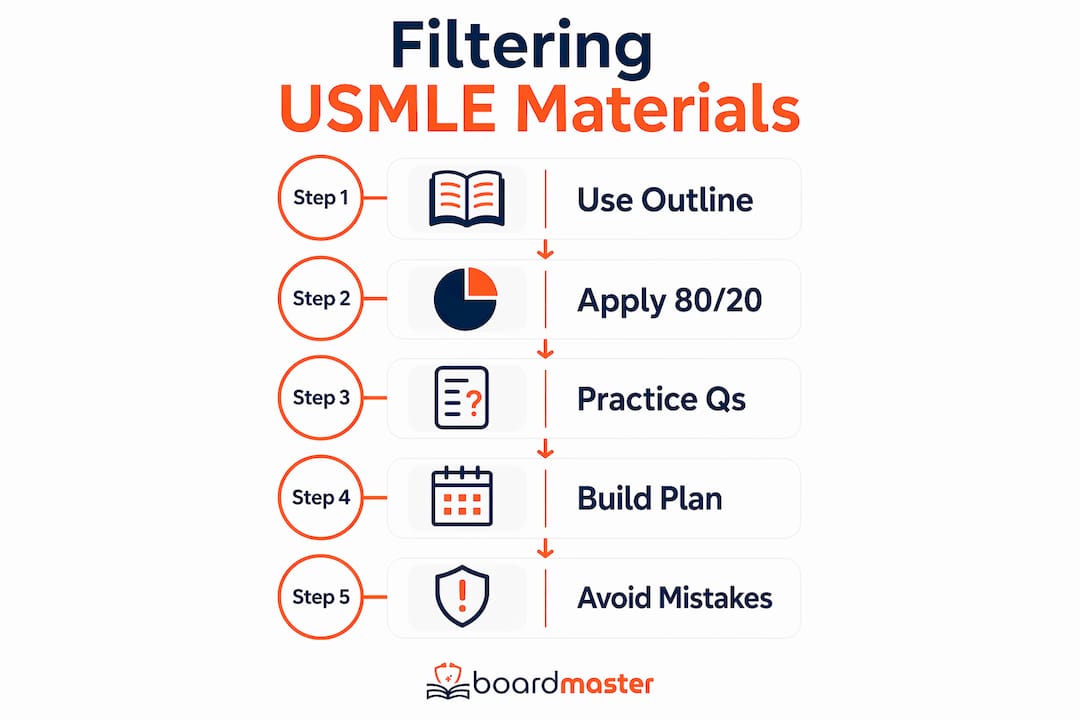
The 80/20 principle in USMLE prep means that a small core of high-yield content drives the majority of your exam score. Chasing every obscure topic in a 1,200-page reference text is the fastest way to burn out and underperform. The students who score highest are not the ones who read the most. They are the ones who read the right material repeatedly.
The most common pitfall is resource overload. A student who uses four different review books, two question banks, and a lecture series simultaneously retains less than one who masters a single well-aligned resource. Depth beats breadth on the USMLE.
Traits of high-yield study materials:
- Published within the last two years and aligned with the current NBME content outline
- Organized around mechanisms and clinical reasoning, not isolated facts
- Includes active recall features such as practice questions or self-testing prompts
- Covers commonly tested diseases with clear explanations of pathophysiology
Traits of low-yield study materials:
- Focuses on rare conditions not listed in the granular NBME outline
- Relies on passive reading without built-in testing
- Emphasizes memorization tables without explaining underlying mechanisms
- Has not been updated to reflect current exam weighting
Pro Tip: Before adding any new resource, ask one question: does this book or tool test my ability to apply a concept, or does it just present information? If the answer is the latter, skip it.
The table below compares resource features by criteria that matter for filtering USMLE content.
| Criteria | High-yield resource | Low-yield resource |
|---|---|---|
| Publication date | Within 2 years | Outdated edition |
| Content alignment | Matches NBME outline | Covers broad medical topics |
| Learning method | Active recall, practice questions | Passive reading only |
| Mechanism focus | Explains clinical reasoning | Lists facts without context |
| Specificity | Targets tested diseases | Covers rare or untested conditions |
How do practice questions help you identify relevant USMLE materials?
Practice questions are the most reliable diagnostic tool for filtering your study set. Every wrong answer tells you something specific: either you studied the wrong material, or you studied the right material the wrong way. Both signals are useful.
Taking 2–4 NBME practice exams during a 4–6 week dedicated study period gives you realistic score benchmarks without wasting time on diminishing returns. Each NBME exam reveals which content areas are costing you points. That data is more valuable than any study schedule you could build in advance.
QBank errors drive targeted flashcard creation, which is the most efficient form of active learning available. When you miss a question on beta-blocker pharmacology, you create a card that tests the mechanism, not just the drug name. That card addresses your specific gap, not a generic topic.
Passive study methods lose their effectiveness as exam day approaches. Shifting to active question drilling in the final weeks is not optional. It is the difference between recognizing information and being able to apply it under timed pressure.
Best practices for using practice questions as filtering tools:
- Complete a timed block of questions before reviewing any new topic. Your performance identifies what actually needs attention.
- After each block, categorize wrong answers by content area and physician task type.
- Build a flashcard for every concept you missed, focusing on the mechanism behind the correct answer.
- Retire flashcards for content areas where you consistently score above 80%.
- Use NBME exam scores to reallocate study time away from strong areas and toward persistent weak spots.
Pro Tip: When you get a question wrong, do not just read the explanation. Rephrase the question stem in your own words to identify exactly what concept was being tested. That habit builds pattern recognition faster than re-reading the same explanation.
How to build a study plan that cuts out low-yield content
A focused study plan starts with three prerequisites: a current NBME content outline, one core review resource per major subject, and access to a question bank. Without these three anchors, any schedule you build will drift toward low-yield material.
Time allocation should follow content weighting from the outline. If cardiology represents a larger share of tested content than dermatology, your weekly schedule should reflect that ratio. Many students allocate time by personal comfort, spending more hours on topics they enjoy and less on topics they find difficult. That approach reinforces existing strengths and ignores actual gaps.
Steps to build a filtered study plan:
- Print the NBME content outline and assign a rough percentage weight to each organ system based on published exam blueprints.
- Select one primary review resource per system and mark chapters that align with the outline. Skip chapters covering topics not listed.
- Schedule daily question blocks before passive review sessions. Questions first, reading second.
- Build in a weekly reassessment: review your QBank performance data and shift time toward your three weakest content areas.
- Schedule NBME practice exams at regular intervals to track progress and recalibrate your plan.
A common scheduling mistake is treating all study days as equal. The week before an NBME practice exam should be heavier on questions and lighter on new content. The week after should focus entirely on the concepts that exam exposed as weak. Continuous reassessment is what separates a customized USMLE study plan from a generic one.
Common mistakes when filtering USMLE study materials
The most damaging mistake is attempting to memorize facts without understanding the underlying mechanism. The USMLE tests concept application, not recall. A student who memorizes that furosemide causes hypokalemia will miss a question that asks why. A student who understands the loop of Henle mechanism will answer it correctly and apply that same logic to a novel clinical scenario.
Other common errors include:
- Using outdated resources that no longer reflect current exam weighting
- Ignoring the physician tasks dimension of the content outline entirely
- Failing to analyze wrong answers critically, treating them as random rather than diagnostic
- Overloading the schedule with passive reading in the final two weeks before the exam
- Adding new resources late in the study period instead of deepening mastery of existing ones
Pro Tip: When reviewing a wrong answer, ask yourself: "What would the question need to say for me to have answered it correctly?" That rephrasing identifies the exact concept gap you need to close, rather than just re-reading the explanation.
Splitting complex flashcards into simpler, single-concept cards prevents the "leech" problem where one difficult card repeatedly fails and drains review time. One card, one concept. That rule keeps your active review set manageable and focused on genuine gaps.
Key Takeaways
Filtering irrelevant USMLE study material requires aligning every resource and study hour with the official NBME content outline and validating that alignment through consistent practice question performance.
| Point | Details |
|---|---|
| Use the official NBME outline | The granular outline listing specific diseases is the most reliable filter for study material selection. |
| Apply the 80/20 rule | Focus on the 20% of core content that drives 80% of exam questions to reduce wasted study time. |
| Let QBank errors guide you | Wrong answers reveal personal content gaps more accurately than any preset study schedule. |
| Prioritize active learning | Shift from passive reading to timed question blocks, especially in the final weeks before the exam. |
| Reassess weekly | Adjust time allocation based on QBank performance data, not personal comfort with topics. |
What I have learned about filtering study material the hard way
By Dr. Ahmed Abuzoor
Most students treat USMLE prep as a coverage problem. They believe that if they read enough, they will be ready. That belief is wrong, and it costs them points.
The students I have seen improve the most share one habit: they treat every wrong practice question as a direct instruction. Not as a failure, but as a precise signal telling them exactly where to spend the next hour. That mindset shift, from coverage to correction, is what filtering actually looks like in practice.
The official NBME content outline is underused to a degree that still surprises me. Students will spend three days on a rare metabolic disorder they read about in a textbook while skipping a high-yield cardiovascular mechanism that appears on the outline by name. The outline is not a suggestion. It is the exam's own blueprint, and ignoring it is the equivalent of studying for the wrong test.
Filtering is also not a one-time decision. You do not filter your materials once at the start of your dedicated period and then execute. You filter continuously. Every NBME exam, every QBank block, every week of performance data is an opportunity to cut what is not working and double down on what is. The students who treat it as a dynamic process rather than a fixed plan are the ones who improve consistently. Trust the data your practice questions generate. It is more honest than your instincts about what you know.
— Dr. Ahmed Abuzoor
BoardMaster helps you study what actually matters
Medical students who filter their study materials effectively still face one persistent challenge: aligning daily lecture content with USMLE-style questions. BoardMaster solves that directly.

BoardMaster lets you upload your lecture notes and generates USMLE-style practice questions built around the concepts your professors emphasize. That means your class prep and board prep happen simultaneously, not in separate study blocks. One student, Sarah, moved from the 73rd to the 92nd percentile while cutting her study hours in half by using BoardMaster's targeted question generation. The platform's AI-powered QBank keeps your focus on high-yield content and away from material that will not appear on exam day.
FAQ
What does it mean to filter irrelevant USMLE study material?
Filtering irrelevant USMLE study material means removing resources and topics that do not align with the official NBME content outline or the high-yield content that drives the majority of exam questions. The goal is to concentrate study time on what is actually tested.
How do I know which USMLE topics are high-yield?
The NBME publishes a detailed content outline that lists specific diseases, conditions, and physician tasks by exam weight. Cross-referencing your study materials against this outline identifies which topics deserve your time and which do not.
How many practice exams should I take during dedicated study?
Taking 2–4 NBME practice exams during a 4–6 week dedicated period is the recommended range. More than four exams in that window adds time pressure without proportional gains in readiness.
Why is passive reading ineffective near the USMLE exam date?
Passive reading builds recognition but not application. The USMLE tests your ability to apply concepts to clinical scenarios, and active question practice is the only study method that trains that skill under realistic timed conditions.
How does BoardMaster help with filtering USMLE content?
BoardMaster generates practice questions directly from your uploaded lecture notes, aligning your daily coursework with high-yield USMLE topics and eliminating the gap between class preparation and board preparation.