
A personalized USMLE study plan is the single most reliable predictor of exam efficiency, outperforming any generic schedule you can download from a forum. Medical students who customize their preparation using diagnostic data, targeted resources, and adaptive scheduling consistently outperform peers who follow one-size-fits-all timelines. Tools like NBME practice exams, UWorld, First Aid, Anki, Pathoma, and Sketchy each serve a distinct role in a well-built plan. The goal is not to study more hours. The goal is to study the right material at the right time.
What you need before you customize your USMLE study plan
The foundation of any personalized study plan is a baseline diagnostic. Before you write a single schedule block, take an NBME practice exam under timed conditions. Your score tells you exactly how long your dedicated study period needs to be. Scoring below 50% requires 10 to 12 weeks of dedicated preparation. Scoring between 50 and 60 percent calls for 8 to 10 weeks. Scoring above 60 percent means 6 to 8 weeks is sufficient. That single data point prevents both under-preparation and the burnout that comes from dragging out a study period past its useful length.
Once you know your timeline, map your available hours honestly. Account for clinical rotations, family obligations, and the realistic number of productive hours per day. Most students overestimate daily capacity by two to three hours, which causes plans to collapse in week two.

Core resources every plan should include
The standard resource stack for Step 1 and Step 2 preparation includes:
- First Aid for the USMLE Step 1: the primary content reference, used as an annotation hub
- UWorld QBank: the gold standard for question practice, used in tutor mode early and timed mode later
- Pathoma: high-yield pathology video series, especially effective for organ systems
- Sketchy: memory-based video learning for microbiology and pharmacology
- Anki: spaced repetition flashcard software, ideally using pre-built decks like Anki Step 1 or Zanki as a starting point
One format change you must account for: the USMLE Step 1 format shifted on May 14, 2026 to 14 blocks of 30 minutes with 20 questions each, replacing the previous 7 blocks of 60 minutes with 40 questions. The per-question pace remains roughly 90 seconds, but your break strategy and mental stamina training must reflect the new block structure. Build timed practice sessions that mirror 30-minute blocks, not 60-minute ones.
| Resource | Primary use | When to start |
|---|---|---|
| NBME practice exams | Baseline and progress tracking | Before dedicated period begins |
| UWorld | Question practice and content reinforcement | Week 1 of dedicated period |
| First Aid | Content review and annotation | Throughout all phases |
| Anki | Spaced repetition and retention | Daily from day one |
| Pathoma / Sketchy | High-yield content learning | Foundation and mastery phases |
How to structure your study phases and daily schedule
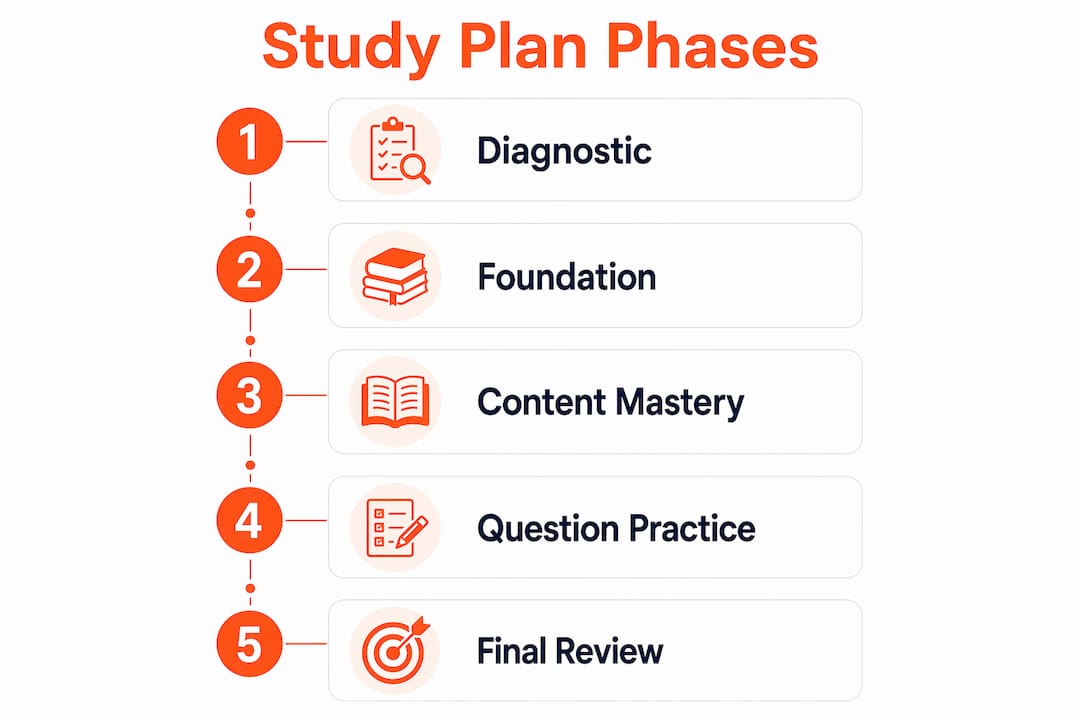
Effective USMLE preparation divides into four phases: foundation, content mastery, application, and final preparation. Each phase shifts the ratio of content review to question practice. Early phases run roughly 40% content and 60% questions, while the final phase flips to 10% content and 90% question practice and review. That shift is not arbitrary. It reflects how learning consolidates: you build schema first, then stress-test it under exam conditions.
Here is a four-phase breakdown you can adapt to your specific timeline:
- Foundation (weeks 1 to 2): Watch Pathoma and Sketchy videos for each organ system. Annotate First Aid as you go. Do 20 to 30 UWorld questions per day in tutor mode to build familiarity with question style without pressure.
- Content mastery (weeks 3 to 5): Increase UWorld to 40 questions per day. Shift from watching videos to reading First Aid directly. Begin reviewing UWorld explanations in depth, not just checking right or wrong answers.
- Application (weeks 6 to 7): Move UWorld to timed mode. Complete 40 to 60 questions per day. Spend the majority of review time on incorrect answers and flagged questions. Reduce new content to targeted weak areas only.
- Final preparation (week 8 and beyond): Complete full NBME practice exams. Review weak systems identified by score reports. Limit new Anki cards. Focus on consolidation, not new learning.
Effective study days balance video content, QBank practice, and Anki review in weighted blocks that shift across phases. A sample day in the mastery phase might look like: 90 minutes of First Aid reading, 40 UWorld questions with 60 minutes of review, and 30 minutes of Anki. That structure keeps all three learning modes active without letting any one dominate.
Pro Tip: Pace your UWorld usage so you finish the full QBank once before your final two weeks. Rushing through 2,000 questions in the last week leaves no time for meaningful review, which is where the actual learning happens.
Plans longer than 12 weeks show plateauing results and increased fatigue. If your baseline score suggests you need more than 12 weeks, the better solution is targeted remediation of specific weak systems rather than extending the overall timeline.
How to use NBME exams strategically to adjust your plan
NBME practice exams are not just progress checks. They are the primary calibration tool for your personalized study plan. Each exam tells you which systems need more time and whether your current approach is working. Using them casually, or too frequently, wastes their diagnostic value.
A strategic NBME schedule looks like this:
- Baseline NBME: Take before or at the very start of your dedicated period to set your timeline and identify weak systems
- Week 3 NBME: First in-period check to confirm your plan is producing score movement
- Week 6 NBME: Mid-period assessment to identify any systems that have not improved
- Weeks 7 to 8 NBMEs: Reserve the newest, most predictive forms for the final 10 days before your exam date
The newest NBME forms carry the highest predictive value for your actual exam score. Using them early burns your best calibration data at a point when the score is less actionable.
"Taking NBMEs under exam conditions with proper timing improves predictive value and study plan calibration better than casual usage." — NBME Form Selection & Strategy Guide 2026
After each NBME, pull the score report and map every incorrect answer to a system or topic. That map becomes your remediation list for the following week. Students who use diagnostic NBME data to allocate study time to high-yield weak topics consistently see larger score gains than students who review all systems equally. The score report is not a grade. It is a prescription.
Avoid taking more than one NBME per week during your dedicated period. Fatigue from back-to-back full-length exams degrades both performance and the quality of your post-exam review. Quality of analysis after each exam matters more than the volume of exams completed.
How do flashcards and spaced repetition improve your score?
Spaced repetition is the practice of reviewing material at increasing intervals to lock it into long-term memory before it fades. Anki automates this process by scheduling cards based on how confidently you recalled them. Regular Anki use is linked to higher USMLE Step 1 scores, with a systematic review documenting consistent associations between Anki use and improved standardized exam performance. That association holds because retrieval practice, the act of pulling information from memory rather than re-reading it, produces stronger retention than passive review.
The most effective approach to Anki for USMLE is not to build every card from scratch. Start with a pre-built deck like Anki Step 1 or Zanki, then customize it by suspending cards in systems where you already score well and adding new cards for weak topics identified by your NBME reports. This keeps your daily review load manageable while concentrating repetition where it matters most.
Pro Tip: Cap your new Anki cards at 50 to 100 per day during the content mastery phase. Adding 200 or more cards daily creates a review backlog within two weeks that takes longer to clear than the time it saves.
Common pitfalls with Anki include treating card creation as studying, spending more time making cards than reviewing them, and failing to suspend irrelevant cards. For students who find card management overwhelming, AI-generated flashcards offer a faster path to a curated, high-yield deck without the manual overhead. Spaced repetition integrated thoughtfully into a broader study system is a core habit that separates higher scorers from the rest of the field.
Key takeaways
A customized USMLE study plan built on diagnostic data, phased content-to-question ratios, and spaced repetition produces measurably better outcomes than any generic schedule.
| Point | Details |
|---|---|
| Start with a baseline NBME | Your diagnostic score determines the correct study timeline: 6 to 12 weeks based on performance. |
| Phase your content-to-question ratio | Shift from 40% content early to 90% questions in the final phase for optimal retention. |
| Reserve newest NBME forms | Use the most predictive forms in the last 10 days before your exam for accurate score forecasting. |
| Cap daily Anki cards | Limit new cards to 50 to 100 per day to prevent review backlog and burnout. |
| Adjust weekly based on data | Use NBME score reports to redirect study time toward weak systems, not equal coverage of all topics. |
Why copying someone else's schedule is the fastest way to underperform
Most students I see struggling with USMLE preparation are not studying too little. They are studying the wrong things in the wrong order because they copied a schedule built for someone with a completely different baseline, curriculum, and set of weaknesses. A schedule that worked for a classmate who scored in the 90th percentile on their baseline NBME is actively harmful for someone starting at the 40th percentile. The phases are wrong, the resource weighting is wrong, and the timeline is wrong.
The 2026 format change to 14 shorter blocks also matters more than most students realize. Training your stamina and pacing on 60-minute blocks and then sitting a 30-minute block exam is a genuine disadvantage. Your practice conditions need to match the actual exam structure, and most generic schedules written before May 2026 do not account for this.
The other thing I would push back on is the idea that more resources equals better preparation. Students who rotate through six or seven resources rarely master any of them. Pick three to four, use them deeply, and let your NBME data tell you when to add something targeted. Consistency with a smaller stack beats novelty with a larger one every time.
Stay flexible. A good personalized study plan is a living document. Review it every week against your NBME trends and adjust. The students who treat their schedule as fixed are the ones who spend weeks on strong systems while weak ones quietly drag their score down.
— Adeeb
How Boardmaster helps you build a smarter study plan
Boardmaster is built specifically for medical students who want to stop guessing and start studying with precision. The platform's AI question generator converts your own lecture notes into USMLE-style practice questions, so your study sessions target exactly what your professors emphasize rather than generic content. That alignment between class exams and board prep is where most students lose hours every week.

Boardmaster's USMLE prep tools include an adaptive QBank, AI-generated study podcasts, and scheduling features that adjust to your diagnostic performance. One student, Sarah, moved from the 73rd to the 92nd percentile while cutting her study hours in half by focusing exclusively on Boardmaster's targeted question sets. If you are ready to stop studying more and start studying smarter, Boardmaster's free tools for Step 1 and Step 2 are the place to start.
FAQ
How long should a USMLE Step 1 study plan be?
Your dedicated study period should run 6 to 12 weeks based on your baseline NBME score. Scoring below 50% calls for 10 to 12 weeks, while scoring above 60% allows for a 6 to 8 week timeline.
When should I take my first NBME practice exam?
Take a baseline NBME before or at the very start of your dedicated study period. This score determines your timeline length and identifies the weak systems that need the most attention in your plan.
How many Anki cards should I review per day for USMLE?
Limit new cards to 50 to 100 per day during active study phases. Exceeding this threshold creates a review backlog that compounds quickly and increases burnout risk without proportional retention gains.
What is the best way to use UWorld in a personalized study plan?
Start UWorld in tutor mode during the foundation phase to learn from explanations, then switch to timed mode in the application phase. Finish the full QBank at least once before your final two weeks so review time is available for incorrect answers.
How do I adjust my study plan if my NBME scores are not improving?
Pull your NBME score report and map every incorrect answer to a specific system or topic. Redirect your next week of study toward those systems using First Aid annotations, targeted UWorld filters, and Anki cards built around your weak areas.