
TL;DR:
- Anatomy questions on the USMLE Step 1 emphasize clinical reasoning through vignette-based formats, comprising about 10–15% of the exam. High-yield topics include neuroanatomy, cardiovascular anatomy, and histology, with integrated practice being more effective than memorization. Focusing on clinical scenarios, pattern recognition, and organ system context enhances exam preparation and understanding.
Anatomy questions on the USMLE Step 1 exam are single-best-answer clinical vignettes that require applied medical reasoning, not isolated recall. The exam contains 280 questions across 14 blocks, with anatomy and histology combined accounting for roughly 10–15% of total content, or about 35–42 questions. That means every anatomy question you see will ask you to connect a structure to a symptom, a nerve to a deficit, or a tissue slide to a diagnosis. Understanding how anatomy questions appear on the USMLE changes how you study and what you prioritize.
What anatomy topics carry the most weight on step 1?
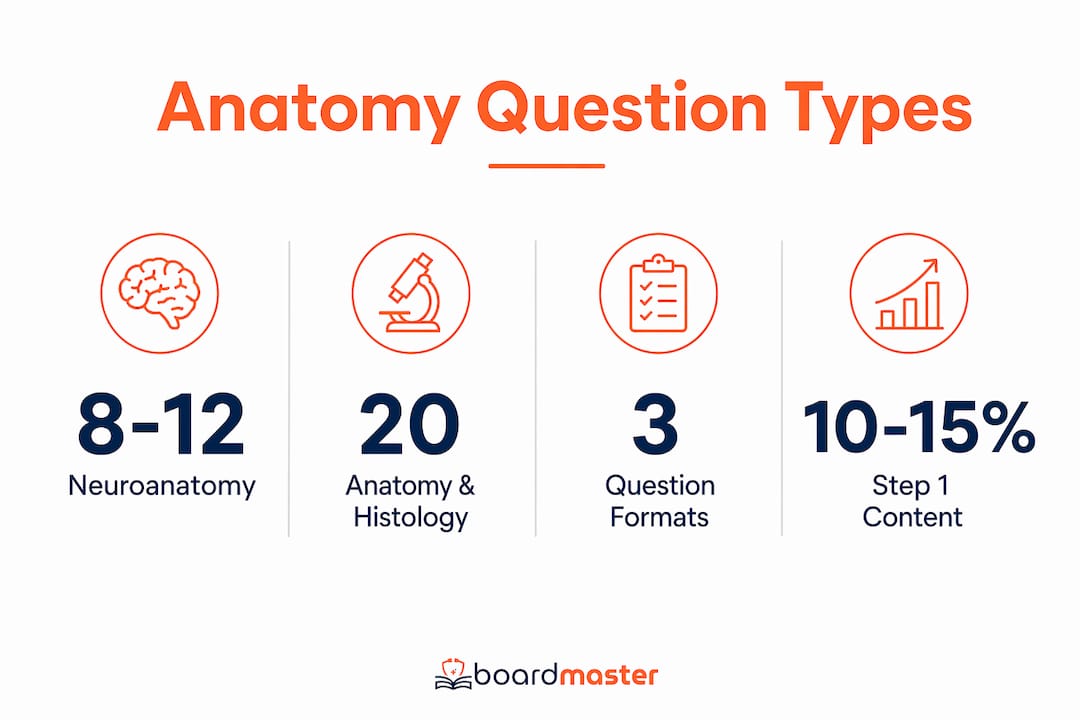
Neuroanatomy is the highest-yield anatomy subsection, contributing 8–12 questions per exam. That alone makes it worth more of your study time than any other anatomy category. Cardiovascular anatomy and histology each contribute 6–8 questions, while embryology accounts for 4–6. Musculoskeletal, gastrointestinal, and genitourinary anatomy round out the rest with smaller but still testable shares.
The distribution matters because it tells you where to spend your hours. A student who spends equal time on every anatomy system is leaving points on the table. Neuroanatomy, cardiovascular anatomy, and histology together represent the bulk of what you will see on exam day.
| Anatomy Subsection | Estimated Questions | Primary Focus |
|---|---|---|
| Neuroanatomy | 8–12 | Nerve injury patterns, brain lesions, spinal cord tracts |
| Cardiovascular Anatomy | 6–8 | Cardiac chambers, great vessels, congenital defects |
| Histology | 6–8 | Tissue and cell identification in clinical context |
| Embryology | 4–6 | Developmental defects, syndrome recognition |
| Musculoskeletal | 2–4 | Compartment anatomy, surgical landmarks |
| GI and GU Anatomy | 2–4 | Organ relationships, hernias, retroperitoneal structures |
Pro Tip: If you have limited time, lock in neuroanatomy and histology first. Together they represent up to 20 questions, which is nearly half of all anatomy content on the exam.
How are anatomy questions formatted on the USMLE?
The USMLE anatomy question format is built around the clinical vignette. You will read a 3–6 sentence patient scenario before reaching the actual question. The vignette gives you age, sex, history, physical findings, and sometimes lab or imaging results. Your job is to identify the anatomical structure, injury, or relationship that explains the clinical picture.
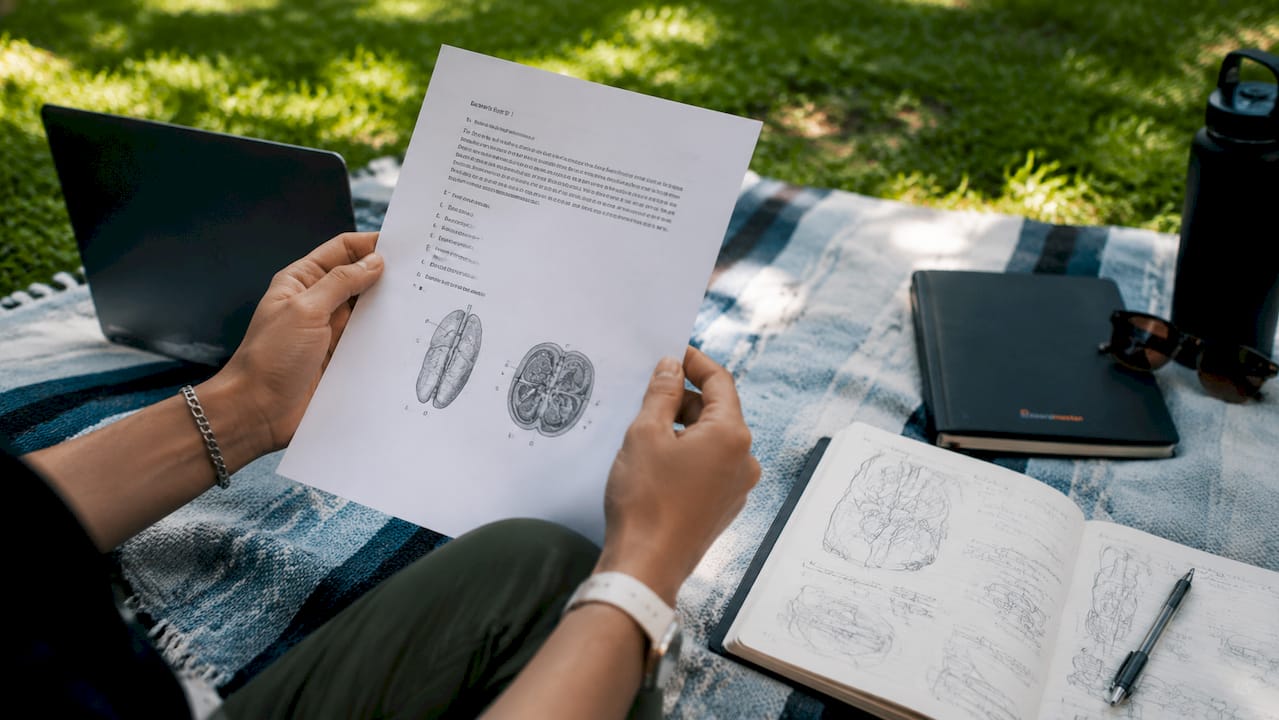
Understanding the question stem structure is the first step toward answering these correctly. The stem is not decoration. Every detail in it is a clue pointing toward the correct answer.
The most common types of anatomy exam questions on the USMLE fall into three categories:
- Nerve injury vignettes: A patient presents with wrist drop, foot drop, or scapular winging. You identify the damaged nerve based on the deficit described.
- Image-based questions: A CT scan, MRI, or histology slide is shown. You name the structure, tissue type, or pathological finding.
- Two-step integration questions: You first identify the anatomical structure, then apply that knowledge to explain a pharmacological effect or pathological outcome.
The two-step format is where most students lose points. A question might describe a stroke in the posterior limb of the internal capsule, then ask which motor deficit results and which antihypertensive would have prevented it. Anatomy combined with pharmacology and pathology increases question complexity, but it also rewards students who study with integration in mind.
| Question Type | What It Tests | Strategy |
|---|---|---|
| Nerve injury vignette | Peripheral nerve anatomy and deficit mapping | Memorize nerve-to-deficit tables; practice pattern recognition |
| Histology slide | Tissue identification in pathological context | Learn systematic identification by cell shape, arrangement, and staining |
| Imaging interpretation | Anatomical landmark recognition on CT or MRI | Practice with labeled and unlabeled images |
| Two-step integration | Anatomy plus pathology or pharmacology | Study anatomy within organ system blocks, not in isolation |
Pro Tip: When you read a vignette, underline the physical finding first. The deficit described in the exam is almost always the direct key to the anatomical structure being tested.
What mistakes do students make studying anatomy for the USMLE?
The biggest error in anatomy prep is treating it as a memorization subject. Students who spend weeks with Gray's Anatomy or Netter's Atlas often know more anatomical detail than the exam will ever ask for, yet still miss questions because they cannot connect structure to symptom. The USMLE does not reward encyclopedic knowledge. It rewards clinical reasoning.
A second common mistake is studying anatomy in isolation from other disciplines. If you learn the brachial plexus as a standalone diagram, you will struggle when a question asks you to connect a C5 injury to a specific muscle weakness and then to a surgical approach. Anatomy in pathological states is what the exam actually tests.
Here are the most common preparation mistakes and how to correct them:
- Overusing comprehensive atlases: Spending hours on full-body dissection maps is inefficient. Replace atlas time with question-based review focused on high-yield patterns.
- Skipping embryology: Students underestimate embryology until they see a question about a ventricular septal defect or a Meckel's diverticulum. Embryological syndromes are high-yield and frequently tested.
- Ignoring histology slides: Histology questions require systematic tissue identification in clinical context. Rote memorization of cell names without visual practice fails on exam day.
- Not practicing nerve injury patterns: Wrist drop, foot drop, Erb's palsy, and Klumpke's palsy are classic presentations. Each maps to a specific nerve and level. Know them cold.
The correction for all of these is the same: study anatomy the way the exam tests it. Read a clinical scenario, identify the structure, and explain the deficit. That loop, repeated with practice questions, builds the reasoning the exam demands.
How do you effectively prepare for USMLE anatomy questions?
Effective preparation for anatomy exam questions on the USMLE requires a structured, integration-focused approach. Here is a practical sequence that works:
- Start with neuroanatomy. Block out dedicated time for nerve injury patterns, spinal cord tracts, and brain lesion localization. These topics appear in 8–12 questions and connect directly to neurology, pharmacology, and pathology.
- Learn histology visually. Use image-based practice resources that show tissue slides in clinical context. Identify cell types by shape and arrangement, not just name. Recognize the pathological version of each tissue type alongside the normal.
- Study embryology by syndrome. Do not memorize embryological timelines in isolation. Learn each developmental defect by its clinical presentation. Tracheoesophageal fistula, DiGeorge syndrome, and Turner syndrome each have a recognizable pattern.
- Use question banks that integrate anatomy with clinical vignettes. Generic anatomy flashcards do not replicate the clinical integration the exam demands. Practice with vignette-style questions that force you to apply structure to symptom.
- Review anatomy within organ system blocks. When you study the cardiovascular system, include cardiac anatomy alongside pathology and pharmacology. This mirrors how the exam presents content and builds the two-step reasoning skills you need.
- Time your anatomy review strategically. Anatomy is best reviewed in the first half of your dedicated Step 1 study period. Revisit high-yield patterns in the final two weeks using spaced repetition and timed practice questions.
High-yield patterns like nerve injuries, hernias, and embryological defects are the core of what successful candidates master. Broad memorization of anatomical detail is not the path. Focused, clinically grounded practice is.
For a broader view of how to structure your entire Step 1 preparation, the complete Step 1 study guide on the BoardMaster blog covers time management, resource selection, and system-by-system strategy in detail.
Key takeaways
USMLE anatomy questions test clinical reasoning through integrated vignettes, not isolated recall, making clinical context the single most important factor in anatomy preparation.
| Point | Details |
|---|---|
| Anatomy is 10–15% of Step 1 | Expect 35–42 anatomy and histology questions across the full exam. |
| Neuroanatomy is highest-yield | Prioritize nerve injury patterns and brain lesion localization for 8–12 questions. |
| Questions are clinical vignettes | Every anatomy question connects a structure to a symptom, deficit, or diagnosis. |
| Integration beats memorization | Study anatomy alongside pathology and pharmacology to handle two-step questions. |
| Question-based practice is most effective | Replace atlas study with vignette-style practice questions focused on high-yield patterns. |
What i've learned after years of watching students prepare for step 1
Students consistently underestimate how clinical the anatomy questions actually are. I have seen students spend months with Netter's and still miss nerve injury questions because they never practiced connecting the diagram to the patient scenario. The exam does not ask you to label a picture. It asks you to explain why a patient cannot extend their wrist after a humeral shaft fracture.
The shift I recommend is simple but uncomfortable for students trained to memorize: stop studying anatomy as a standalone subject. Every structure you learn should be attached to a clinical story. The radial nerve matters because of wrist drop. The femoral canal matters because of femoral hernias. The ductus arteriosus matters because of patent ductus arteriosus and indomethacin. That is the level of integration the exam expects.
I also think students waste significant time on resources that feel productive but are not. A beautifully illustrated atlas gives you confidence without giving you points. A well-written clinical vignette question gives you both. The research backs this up: question-based learning focused on clinically relevant anatomy patterns outperforms exhaustive atlas study for Step 1 preparation.
My honest recommendation for 2026 is to treat anatomy as a reasoning subject from day one. Build your knowledge around clinical presentations, practice with integrated questions, and spend your atlas time only when a question exposes a gap you cannot fill from memory.
— Dr. Ahmed Abuzoor
Practice USMLE anatomy questions with BoardMaster

BoardMaster generates clinical vignette-style questions directly from your lecture notes, so every anatomy question you practice reflects what your professors actually emphasize. Upload your neuroanatomy or histology notes and BoardMaster produces USMLE-style vignettes that test nerve injury patterns, tissue identification, and embryological syndromes in the exact format you will see on exam day. The AI question generator also builds two-step integration questions that connect anatomy to pathology and pharmacology, training the reasoning skills Step 1 demands. Students like Sarah jumped from the 73rd to the 92nd percentile using BoardMaster's targeted approach. You can also reinforce concepts on the go with BoardMaster's study podcasts, turning lecture content into focused audio review.
FAQ
How many anatomy questions are on USMLE step 1?
Anatomy and histology combined account for approximately 10–15% of Step 1 content, which translates to roughly 35–42 questions across the full 280-question exam.
What is the most tested anatomy topic on step 1?
Neuroanatomy is the highest-yield subsection, contributing 8–12 questions per exam. Nerve injury patterns, spinal cord tracts, and brain lesion localization are the most frequently tested areas.
Are USMLE anatomy questions based on memorization?
No. Anatomy questions are clinical vignettes that require applied reasoning. The exam tests your ability to connect anatomical structures to clinical deficits, diagnoses, and management decisions.
What types of anatomy questions appear on the USMLE?
The three main types are nerve injury vignettes, image-based questions using CT scans or histology slides, and two-step integration questions that combine anatomy with pathology or pharmacology.
How should you study anatomy for USMLE step 1?
Prioritize neuroanatomy, embryology syndromes, and histology pattern recognition. Use vignette-style practice questions rather than comprehensive atlases, and always study anatomy within the context of organ system pathology.