
TL;DR:
- Many exam prep misconceptions lead medical students to rely on passive review and cramming, which produce poor long-term retention. Active recall, spaced repetition, and simulated testing are evidence-based strategies that enhance durable learning and exam performance. Embracing difficulty during study and regular practice under exam-like conditions reduces anxiety and improves results.
Common exam prep misconceptions are false beliefs about studying that cause medical students to invest time in methods that feel productive but produce poor retention. Passive review, cramming, and skipping practice tests are the most damaging of these misunderstandings about studying. Cognitive science has established that active recall and spaced repetition deliver 50–100% better long-term retention than rereading, yet most students default to the methods that feel easiest. Tools like BoardMaster and evidence-based frameworks like the Ebbinghaus spacing effect exist precisely to close that gap. Recognizing these exam preparation myths is the first step toward real exam success strategies.
1. common exam prep misconceptions start with passive study
Rereading and highlighting feel like studying because they create familiarity without retention. Cognitive scientists call this the "illusion of fluency." You recognize the material on the page, so your brain signals that you know it. That signal is wrong.
Robert Bjork's research describes this as the "current-moment learning trap." Easy study yields poor retention because the brain never has to work hard enough to encode the information durably. Medical students face this trap constantly when reviewing dense lecture slides.
Active recall breaks the illusion. When you close your notes and force yourself to retrieve a concept, you build the kind of memory that survives a shelf exam or USMLE Step 1. Students who use active recall achieve 50–100% higher retention than those relying on passive review. That difference is the gap between passing and failing.
Practical active recall methods for medical students include:
- Flashcards with Anki: Write the question on one side, the mechanism or diagnosis on the other. Never just read both sides.
- Self-quizzing after lectures: Close your notes and write down everything you remember from the session before reviewing.
- Teach-back method: Explain a concept aloud as if presenting to a classmate. Gaps in your explanation reveal gaps in your knowledge.
- BoardMaster's AI question generator: Upload your lecture notes and receive USMLE-style questions built directly from your professor's content.
Pro Tip: Combine active recall with spaced repetition by scheduling your Anki or BoardMaster review sessions at increasing intervals: one day, three days, one week, two weeks. This pairing produces the most durable retention of any study method in medical education.
2. cramming is one of the most persistent study fallacies
Cramming is defined as massing all study into one or two sessions immediately before an exam. It produces short-term recognition but causes rapid forgetting within days. For medical students, where knowledge must carry forward from block exams into boards, cramming is especially destructive.

Hermann Ebbinghaus documented the forgetting curve in the 19th century. Without review, humans forget roughly 70% of new information within 24 hours. Distributed practice, spacing review sessions across days and weeks, directly counters this curve. The spacing effect is not a theory. It is one of the most replicated findings in cognitive psychology.
Overstudying is the companion myth. More hours do not equal better outcomes when those hours are spent on passive methods or when fatigue degrades encoding. Quality of cognitive engagement matters far more than raw time. A student who studies for three focused hours using active recall outperforms one who spends eight hours rereading notes.
The negative effects of cramming compound under the pressure of medical school:
- Cortisol spikes from last-minute stress impair memory consolidation during sleep.
- Sleep deprivation before an exam reduces working memory capacity by a measurable degree.
- Knowledge gained through cramming does not transfer to clinical reasoning, which boards test heavily.
- Burnout accumulates across a semester when every exam cycle ends in a marathon session. For more on avoiding that pattern, the BoardMaster blog covers avoiding study burnout in depth.
Pro Tip: Build a distributed study calendar at the start of each block. Assign specific organ systems or topics to each week, and schedule two short review sessions per topic before the exam date. This removes the conditions that make cramming feel necessary.
3. practice exams are learning tools, not just assessments
The most widespread misunderstanding about practice tests is that they exist only to measure what you already know. Practice tests should be integral to learning, not reserved for the final week before an exam. Using them early and often programs the brain for the psychological and time pressures of real testing.
A second common error is reviewing only wrong answers. Every question, correct or incorrect, contains information about your reasoning process. Reviewing why a correct answer is correct, and why each distractor is wrong, builds the clinical reasoning pattern that USMLE questions specifically target.
Simulated timed practice reduces the gap between practice performance and actual test performance. The brain adapts to the conditions it trains under. Students who practice under exam-like conditions report lower panic and better time management on test day.
The table below contrasts the wrong and right ways to use practice exams:
| Wrong Approach | Right Approach |
|---|---|
| Save practice tests for the final week | Start practice tests in week one of each block |
| Review only incorrect answers | Review every question, including correct ones |
| Skip the timer to reduce stress | Always simulate real exam time conditions |
| Use one topic at a time only | Mix topics to mirror actual exam structure |
| Treat score as the only outcome | Treat reasoning analysis as the primary outcome |
BoardMaster's QBank of 5,000+ physician-written questions is built for this kind of integrated practice. Questions align with both course content and board-style reasoning, so every session serves double duty.
4. the learning styles myth wastes valuable study time
The learning styles theory holds that students learn best when instruction matches their preferred style, whether visual, auditory, or kinesthetic. Over 80% of people still believe learning styles improve performance. Cognitive science finds no evidence that matching study method to style preference produces better outcomes. That belief persists because it feels intuitive, not because it works.
The practical cost for medical students is real. A student who decides to only watch videos because they are "a visual learner" skips the retrieval practice that actually builds retention. A student who avoids reading because they are "an auditory learner" misses the depth that dense pathophysiology requires. Style preference is not the same as learning effectiveness.
Other common study myths that cost medical students points include:
- The tidy desk myth: Organizing your study space feels productive. It is not studying. Misinformation from parents and professors perpetuates this kind of displacement activity.
- The sugar myth: 80% of parents and 60% of students believe sugar intake negatively impacts study energy. Study quality and sleep matter far more than what you eat during a session.
- The multitasking myth: Studying with background TV or switching between tasks feels efficient. Cognitive science shows task-switching degrades encoding and increases error rates.
- The luck myth: Attributing exam outcomes to luck removes agency and discourages investment in technique improvement.
Pro Tip: When you feel the urge to reorganize your notes or switch up your study environment, treat it as a signal to start a retrieval session instead. The discomfort of not knowing something is more valuable than the comfort of a clean desk.
5. discomfort during study is a sign you are doing it right
Effective study feels difficult. The discomfort experienced during active recall is a sign of effective learning, not a sign that you are failing. Many medical students abandon spaced repetition and active recall early because the struggle feels like evidence that the method is not working. The opposite is true.
This is one of the most counterintuitive insights in cognitive science. The methods that produce the most fluency during study, rereading, reviewing highlighted notes, watching the same lecture twice, produce the most forgetting afterward. The methods that feel hardest in the moment produce the most durable retention. Persistence through that discomfort is the actual skill to develop.
Effective revision techniques share one feature: they require the brain to generate an answer rather than recognize one. Generation is harder. It is also what exams demand. Training your brain to generate under pressure, through practice tests and self-quizzing, is the closest simulation of real exam conditions you can create.
6. exam anxiety is not a study problem, it is a preparation problem
Exam anxiety is defined as performance-impairing stress caused by insufficient familiarity with exam conditions. Training under exam-like conditions familiarizes the brain with the pressure, reducing panic and improving performance. Anxiety is not a personality trait to manage. It is a preparation gap to close.
Students who treat practice tests as low-stakes exercises never build tolerance for real exam pressure. The solution is deliberate exposure. Sit down with a timer, block all distractions, and complete a full question set as if it were the real exam. Do this repeatedly across your study period. The mock exam performance improvement documented in IB and board prep research applies directly to medical school block exams and USMLE preparation.
Managing anxiety also means recognizing that some stress is functional. A moderate level of arousal improves focus and recall. The goal is not to eliminate pre-exam nerves but to prevent them from exceeding the threshold where they impair performance. Consistent, realistic practice keeps anxiety in that functional range.
Key takeaways
Debunking common exam prep misconceptions requires replacing passive habits with active recall, spaced repetition, and simulated testing, the three strategies with the strongest evidence base in medical education.
| Point | Details |
|---|---|
| Passive study creates false confidence | Rereading triggers the illusion of fluency; active recall builds durable retention. |
| Cramming destroys long-term retention | Distributed practice across weeks outperforms any last-minute marathon session. |
| Practice tests are learning tools | Use them early, time them strictly, and review every question, not just wrong answers. |
| Learning styles have no evidence base | Match your method to cognitive science, not style preference, for real results. |
| Discomfort signals effective learning | Struggle during retrieval practice is the mechanism of durable memory formation. |
What i have seen after years of watching medical students study wrong
Medical students are among the most disciplined people I have encountered. That discipline is exactly what makes these misconceptions so damaging. When a hardworking student spends 60 hours a week rereading notes and still underperforms, the instinct is to study harder. The real fix is to study differently.
The students I have seen transform their performance share one pattern: they stopped optimizing for comfort and started optimizing for difficulty. They switched from highlighting to self-quizzing. They stopped saving practice tests for the week before the exam. They accepted that feeling confused during a study session is not failure. It is the process working.
The discomfort of not knowing an answer during a retrieval session is the closest thing to a guarantee that you will know it on exam day. That reframe changes everything. Exam anxiety drops when you have trained under pressure. Scores improve when you have practiced generating answers, not just recognizing them. The research on this is not ambiguous. The only question is whether you are willing to make the shift before your next block exam.
— Dr. Ahmed Abuzoor
How BoardMaster helps you study smarter, not longer
Medical students who want to move past ineffective habits need tools built around the same principles this article covers. BoardMaster is designed specifically for that purpose.
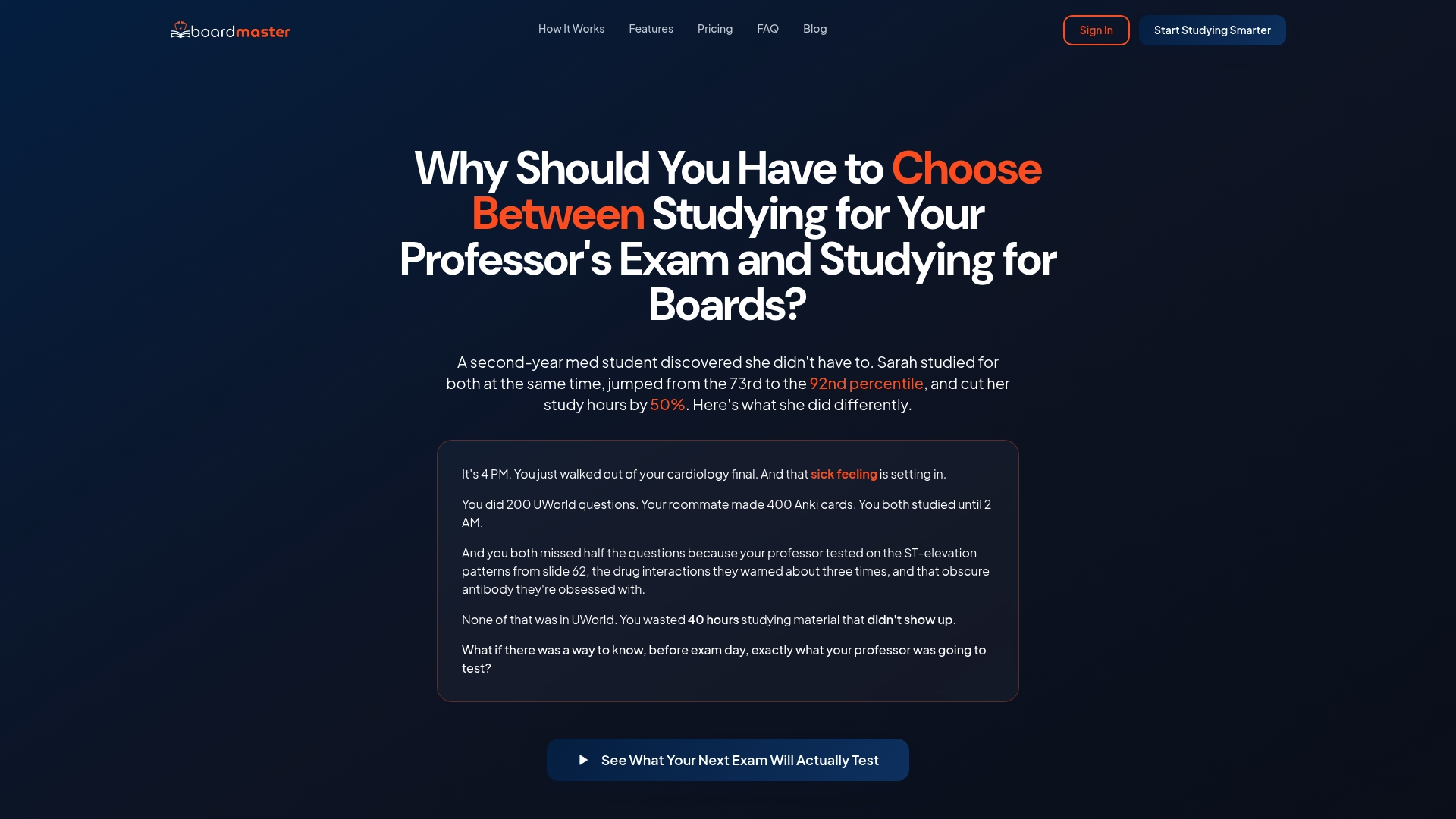
BoardMaster's AI-powered block exam prep converts your lecture notes into USMLE-style practice questions targeting exactly what your professors emphasize. That means every retrieval session is high-yield, not generic. The platform's QBank includes 5,000+ physician-written questions for spaced practice, and its AI study podcasts deliver bite-sized active recall in eight-minute episodes. Students like Sarah moved from the 73rd to the 92nd percentile while cutting study hours in half. BoardMaster aligns class exam prep with board prep so you never have to choose between the two.
FAQ
What is the biggest common exam prep misconception?
Relying on rereading and highlighting is the most damaging misconception. Active recall produces 50–100% better long-term retention than passive review methods.
Does cramming work for medical exams?
Cramming produces short-term recognition but causes rapid forgetting. Medical board exams require durable retention across months, which only distributed practice builds.
When should i start using practice tests?
Start practice tests in the first week of each study block. Early and frequent use builds clinical reasoning, time management, and tolerance for exam pressure.
Are learning styles a valid study strategy?
No. Over 80% of people believe in learning styles, but cognitive science finds no evidence that matching study method to style preference improves outcomes.
Why does studying feel harder when i use active recall?
That difficulty is called desirable difficulty. The struggle of retrieving an answer without cues is the mechanism that encodes durable memory. Discomfort during retrieval practice is a sign the method is working.