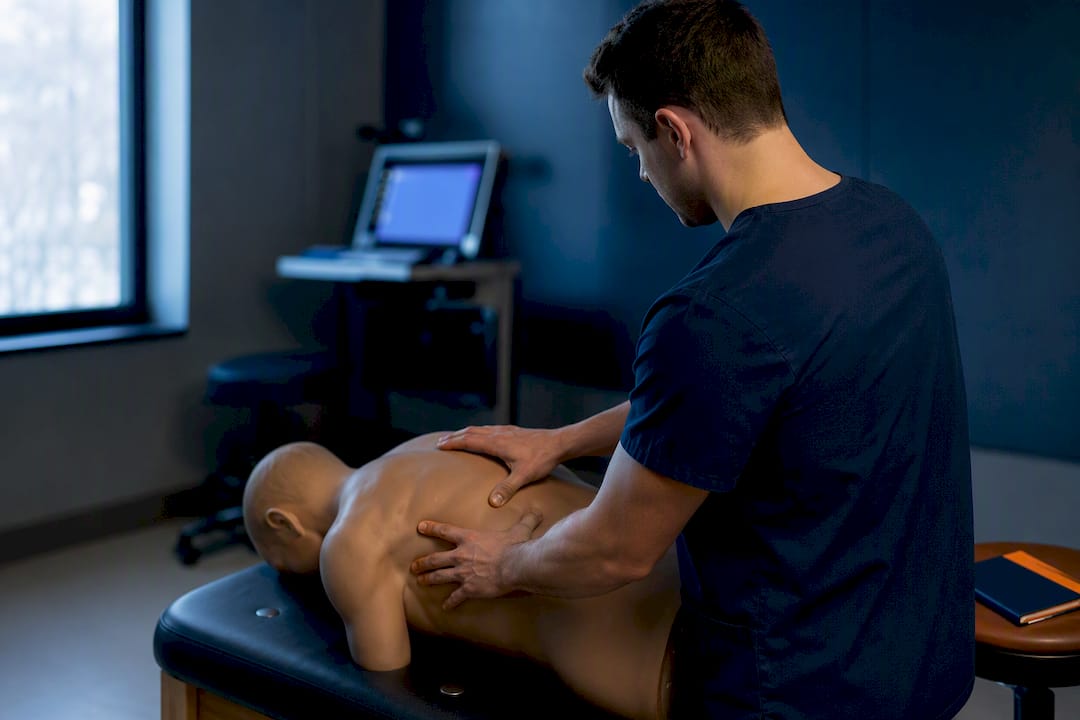
For most DO students, master COMLEX first. It's the exam that gets you licensed, and it should get your full attention before anything else enters the study plan. Add USMLE only when a specific residency program requests it or you're chasing an ultra-competitive specialty where Step scores carry real weight. Weigh the extra prep hours, the added fees, and the risk of diluting your COMLEX performance before you commit to both.
TL;DR:
- Most students should focus on mastering COMLEX first unless their target programs explicitly request USMLE scores.
- USMLE’s denser, multitiered question stems and emphasis on basic sciences can catch students off guard if they train only for COMLEX’s more direct style.
- A valid USMLE score may benefit applicants targeting competitive specialties like dermatology or orthopedic surgery, but most primary care programs accept COMLEX alone.
- Adding USMLE requires hundreds of extra study hours and fees, and should only be pursued if a specific program or specialty demands it.
- COMLEX and USMLE serve different training philosophies, with COMLEX emphasizing osteopathic medicine and manual skills, making both exams inherently distinct.
Table of Contents
- COMLEX vs USMLE: A Quick Comparison and Decision Checklist
- What Actually Differs on Test Day: Content, Format, and Pacing
- How Scoring Works, and Why Converting Scores Between Exams Is Messy
- Which Residency Programs Actually Ask for USMLE Scores?
- Planning the Logistics: Timeline, Hours, and Fees
- Studying Smarter for Both Exams Without Burning Out
- Why Two Separate Licensing Exams Exist in the First Place
- Eligibility and Registration: How Applying Differs
- Do State Licensing Boards Treat the Exams the Same Way?
- Specialty by Specialty: Where USMLE Actually Moves the Needle
- When You're On the Fence, Run the Numbers Before You Register
- Study Smarter for Both COMLEX and USMLE With BoardMaster
- Where to Verify the Details Yourself
- Sources
- FAQ
COMLEX vs USMLE: A Quick Comparison and Decision Checklist
The two exams test overlapping medical knowledge through very different lenses, and the differences matter more than most first-year students realize.
- Purpose: COMLEX is the mandatory path to osteopathic licensure; USMLE is optional for DO students but standard for MD students.
- OMM presence: COMLEX weaves osteopathic manipulative medicine significantly into its content, according to the NBOME's own blueprint; USMLE has none.
- Stem style: COMLEX vignettes tend to run shorter and more direct; USMLE stems are famously dense, layered with distractors and multistep reasoning.
- Scoring: COMLEX Level 1 and 2 use numeric scales unique to NBOME; USMLE Step 1 is pass/fail, while Step 2 CK is scored from 1 to 300.
- Timing: COMLEX runs longer blocks with a more rigid break schedule than USMLE's flexible timing structure.
Before scheduling anything, run through this checklist. Does any program on your target list explicitly request or filter by Step scores? Are you aiming at a specialty known for tight USMLE preferences? Where do your practice COMLEX scores currently sit? How many uninterrupted study hours can you actually protect over the next two to three months? And can your budget absorb another exam registration fee on top of COMLEX's?
Three paths tend to emerge. Most students land on COMLEX only, which fully satisfies licensure and residency eligibility. A smaller group takes COMLEX first, hits a strong score, then adds USMLE later once they've confirmed a program actually wants it. A rare few sit both exams close together during the same dedicated block, usually because a specific competitive specialty leaves no other option.
What Actually Differs on Test Day: Content, Format, and Pacing
Osteopathic manipulative medicine is the most obvious dividing line. COMLEX vignettes routinely ask you to identify somatic dysfunction findings, select the correct OMM technique for a contraindicated patient, or interpret a Chapman's point in the context of visceral disease. USMLE never touches any of this. If you've spent two years drilling counterstrain and muscle energy techniques, that investment only pays off on COMLEX.
Beyond OMM, the two exams diverge in how they ask questions. COMLEX stems tend to be shorter and more clinically direct, testing whether you can recognize a pattern and act on it. USMLE stems, particularly on Step 1 and Step 2 CK, stack extraneous detail, red herrings, and multi-step physiologic reasoning designed to slow you down. Students who train exclusively on one style often get caught off guard switching to the other.
Blueprint emphasis shifts too. COMLEX leans harder into musculoskeletal medicine and preventive care, reflecting osteopathic training's philosophy. USMLE's Step 1 content outline pushes deeper into biochemistry, microbiology, and molecular mechanisms, often at a level of granularity COMLEX doesn't reach.
Pacing is where a lot of students get blindsided. COMLEX's break structure and long uninterrupted question runs demand a stamina most students trained on shorter practice sets underestimate. USMLE offers more flexible break timing across its blocks, which changes how you should pace practice sessions in the weeks leading up to test day.
Pro Tip: Simulate full-length COMLEX blocks at least three times before your real exam, using the actual break schedule NBOME publishes. Stamina failures in the final hour cost more points than most content gaps.
How Scoring Works, and Why Converting Scores Between Exams Is Messy
COMLEX Level 1 is pass/fail, matching USMLE Step 1's current format. COMLEX Level 2 reports a numeric score on NBOME's proprietary scale, while USMLE Step 2 CK reports numerically from 1 to 300 with a passing threshold that NBME and FSMB periodically update.
Here's the friction point: there is no official, universally accepted formula that converts a COMLEX Level 2 score into a USMLE Step 2 CK equivalent. A peer-reviewed comparison of the two exams found meaningful correlation between scores, but the relationship isn't clean enough for programs to treat a converted number as reliable. That's exactly why some residency programs simply request USMLE scores directly rather than trying to interpret COMLEX on its own scale.
Practically, this shapes how you should apply. If a program lists both exams as acceptable, submit whichever score is stronger and skip the second exam unless you have a specific reason to sit it. If you already have a strong COMLEX Level 2 score and a program's language is ambiguous about which exam it prefers, a quick email to the program coordinator beats guessing. Only consider adding Step 2 CK after your COMLEX numbers are locked in and solid, not before.
Which Residency Programs Actually Ask for USMLE Scores?
USMLE preference isn't universal. It concentrates in specific corners of the match process, and knowing where saves you from studying for an exam nobody on your list cares about.
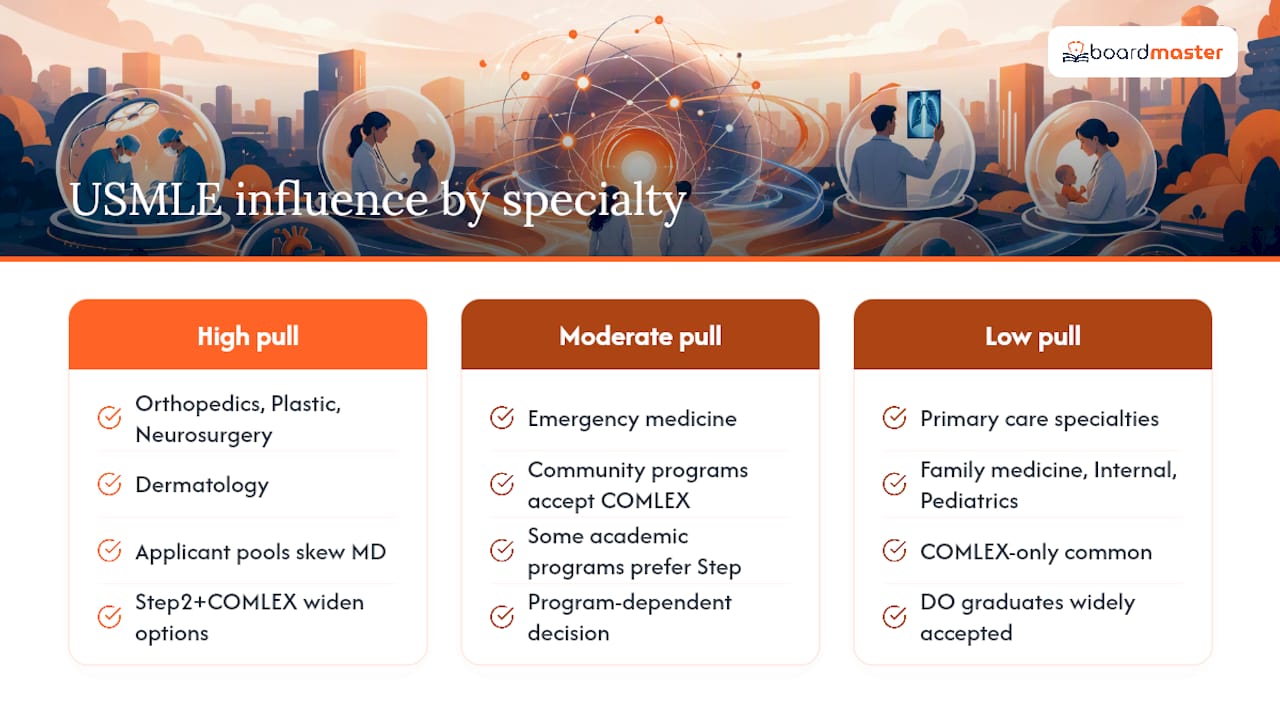
- Highly competitive specialties such as dermatology, orthopedic surgery, and plastic surgery draw disproportionately from MD-heavy applicant pools, and some programs there default to requesting Step scores out of habit.
- Academic and university-based programs, especially ones without a history of ranking DO applicants, sometimes list USMLE as a formality even when they'll accept COMLEX in practice.
- Military and federal programs occasionally standardize on USMLE for administrative consistency across branches.
- Community and DO-friendly programs, which make up the bulk of osteopathic graduate placements, typically accept COMLEX alone without hesitation.
The AMA's guidance for DO students is blunt about this: check each program's own language rather than assuming. A line that says "USMLE or COMLEX accepted" means exactly that. A line that says "USMLE preferred" is worth a direct question to the program before you invest 300 extra hours chasing a score they might not weigh heavily anyway.
The decision rule is simple to state, harder to follow under match anxiety: take USMLE only if a program on your realistic list explicitly requests or filters by Step scores, your target specialty is genuinely competitive for DOs, and your COMLEX trajectory is already strong enough that a second exam won't cannibalize your primary preparation.
Planning the Logistics: Timeline, Hours, and Fees
Adding USMLE to an already full COMLEX prep schedule is not a light lift. Students who take on both exams commonly report needing several hundred additional study hours beyond what COMLEX alone requires, on top of a separate registration fee for the USMLE exam itself.
- Confirm the need first. Don't schedule USMLE speculatively. Nail down which programs actually want it before you touch a single Step-style question bank.
- Sequence it after COMLEX, not alongside it. Most students do better sitting COMLEX first, confirming a solid score, then dedicating a focused block to USMLE-specific content and question style.
- Train for the format switch deliberately. Spend the first week of USMLE prep specifically on USMLE-style question stems, since the reasoning pattern differs enough from COMLEX to trip up even strong students.
- Protect your COMLEX stamina training. Don't let USMLE's shorter, more flexible blocks retrain you out of the longer, rigid pacing COMLEX demands.
Pro Tip: If you're adding USMLE, run integrated question sets that mix both exam styles in the same session during your final review weeks. Switching formats cold on test day costs more time than most students expect.
Studying Smarter for Both Exams Without Burning Out
Passive review, rereading notes, highlighting slides, isn't what separates students who pass comfortably from students who scrape by. Active, question-based practice tied directly to what your professors actually emphasize tends to produce better retention for both COMLEX and USMLE prep.
That's the gap BoardMaster is built to close. Upload your lecture notes, and the platform generates board-style practice questions calibrated to what your specific professors stress, rather than a generic national average. That matters for OMM content especially, where course emphasis varies widely between schools, and it matters just as much when you're layering in USMLE Step 1 content on top of an already tight schedule. One student improved her percentile ranking significantly while cutting her study hours in half using this targeted approach, a result that reflects what happens when practice questions actually match the material being tested. If you're weighing whether to add USMLE, BoardMaster's COMLEX prep tools can help you build both tracks without duplicating effort.
Why Two Separate Licensing Exams Exist in the First Place
COMLEX and USMLE didn't emerge from the same institutional root, and that history explains a lot of today's friction. NBOME, the organization behind COMLEX, was established specifically to test the osteopathic profession's distinct scope, including OMM and a philosophy of care that emphasizes the musculoskeletal system's role in overall health. USMLE, by contrast, grew out of the allopathic tradition, jointly administered by NBME and FSMB to create a single national standard for MD licensure.
For decades, the two paths ran in near-total parallel, DO students took COMLEX, MD students took USMLE, and residency programs largely sorted applicants along those same lines. That started shifting as the single accreditation system for graduate medical education, overseen by ACGME, merged osteopathic and allopathic residency pathways into one unified match process. Once DO and MD graduates began competing for the exact same residency slots under the same accreditation umbrella, some programs started asking for USMLE scores simply because that's what they'd always used to compare applicants, not because COMLEX measured anything less rigorously.
The rationale behind COMLEX's continued existence isn't nostalgia. It reflects a genuinely different curriculum, one that trains students in manual medicine skills USMLE was never designed to assess. Understanding that history helps explain why "just take USMLE instead" oversimplifies a decision rooted in two exams built for two different training philosophies that now compete for the same match slots.
Eligibility and Registration: How Applying Differs
Eligibility for COMLEX is tied directly to enrollment in an osteopathic medical school accredited to prepare students for the exam series; DO students register through NBOME's own portal, and the process is built around your school's academic calendar, with Level 1 typically taken after the second year of coursework.
USMLE eligibility works differently. Historically restricted mainly to MD students, USMLE.org registration is open to DO students as well, but you'll need certification from your school's registrar confirming you meet the eligibility criteria before NBME will schedule you. That certification step is easy to overlook and can add weeks to your timeline if you assume registration works the same way COMLEX does.
The application windows and score reporting timelines also don't run on identical schedules, and fees are charged separately for each exam. If you're planning to sit both, map out your school's certification process for USMLE early. Some registrars process these requests quickly; others need a formal request submitted a semester in advance. Waiting until you're mid-dedicated-study to sort out eligibility paperwork is one of the more avoidable mistakes DO students make when deciding to add USMLE. Check your own institution's process rather than assuming it mirrors a classmate's experience at a different school.
Do State Licensing Boards Treat the Exams the Same Way?
Every state medical board in the country accepts COMLEX as sufficient for osteopathic licensure, which is precisely why NBOME describes the exam as the mandatory series for DO graduates. There's no state where a DO physician needs USMLE to get licensed. That part of the decision is settled and doesn't vary by geography.
Where things get more nuanced is at the level of specific hospital credentialing committees and some state-level administrative processes, which occasionally default to language written decades ago when USMLE was the only exam boards had ever seen. This shows up rarely and unevenly, and it's worth confirming directly with a state board or hospital credentialing office if you're planning to practice in a jurisdiction you're unfamiliar with, rather than assuming uniform treatment nationwide.
The larger point for licensure purposes stands regardless: COMLEX alone opens every state's licensing door. Any USMLE decision you make should be driven by residency competitiveness, not by any concern that COMLEX won't count somewhere.
Specialty by Specialty: Where USMLE Actually Moves the Needle
General residency implications only tell part of the story. Some specialties show a much stronger pull toward USMLE than others, and knowing which ones can save you from sitting an exam that won't change your match outcome.
Surgical subspecialties, particularly orthopedic surgery, plastic surgery, and neurosurgery, tend to draw the most consistent USMLE preference among competitive fields, partly because applicant pools there skew heavily MD and program directors default to familiar scoring benchmarks. Dermatology shows similar patterns. In these fields, a strong USMLE Step 2 CK score alongside a strong COMLEX Level 2 score can genuinely widen your options.
Primary care specialties, family medicine, internal medicine, and pediatrics chief among them, show the opposite pattern. These fields have absorbed DO graduates at high rates for years, and COMLEX alone is standard practice at the overwhelming majority of programs. Emergency medicine sits somewhere in between: increasingly comfortable with COMLEX-only applicants at community programs, while a handful of academic emergency programs still lean on Step scores.
The takeaway isn't "competitive specialties require USMLE." It's narrower than that: only specific programs within those specialties do, and the AMA's own guidance urges checking each program rather than generalizing from specialty reputation alone.
When You're On the Fence, Run the Numbers Before You Register
If your COMLEX practice scores are strong and your target list doesn't mention USMLE, don't sit it. Adding a second board exam only makes sense when a program explicitly asks for it or when you're chasing a specialty where the applicant pool genuinely rewards it. Run the checklist above before you spend a dollar on registration. If the answer is still unclear after checking program language directly, that uncertainty itself is a sign you probably don't need it yet.
— Dr. Ahmed Abuzoor
Study Smarter for Both COMLEX and USMLE With BoardMaster
Whether you land on COMLEX-only or decide a specific program justifies adding USMLE, the real bottleneck is always the same: study time wasted on material your professors never emphasized. BoardMaster turns your uploaded lecture notes into board-style practice questions calibrated to what's actually being tested in your course, so class exams and board prep stop competing for separate hours.

The platform generates OMM-focused items for COMLEX alongside USMLE-style stems when you need both, plus flashcards with spaced repetition and a study assistant for explanations you'd otherwise chase down in three different textbooks. If you're weighing whether USMLE is worth the added hours, start by making your existing COMLEX prep more efficient first. Visit BoardMaster to try the platform on your own lecture material and see how much study time you can reclaim before deciding whether a second exam even makes sense.
Where to Verify the Details Yourself
Don't take any exam's rules on faith, confirm directly with the source. NBOME's COMLEX-USA overview and master blueprint cover licensure requirements and content weighting. USMLE.org's Step 1 content outline and the USMLE guidebook lay out scoring and format. The AMA's guidance for DO students addresses when programs actually request USMLE. For score correlation data, the peer-reviewed comparison in PMC is the most rigorous source available. ACGME's website covers unified accreditation standards governing today's single residency match.
Sources
- USMLE guidebook (LSU Health New Orleans) 2025-2026
- Taking both USMLE and COMLEX? What DO medical students must know | AMA
- COMLEX-USA master blueprint | NBOME
- PMC article on medical licensing exam comparisons
FAQ
Is COMLEX Harder Than USMLE?
Neither exam is objectively harder; they test differently. COMLEX adds OMM content and favors more direct clinical stems, while USMLE leans on denser vignettes and deeper basic-science reasoning, so difficulty depends on which content and question style suits your training.
What Percentage of Test-Takers Fail COMLEX?
Pass rates fluctuate by year and level, and NBOME publishes official pass-rate data directly rather than through secondary sources, so check its current statistics before relying on a specific figure quoted elsewhere.
Do DO Residency Programs Care About COMLEX Scores?
Yes. COMLEX is the standard credential most DO-friendly and primary care programs expect, and it fully satisfies licensure and residency eligibility on its own without any USMLE score attached.
Is COMLEX or Step 1 Harder to Study For?
Both require heavy study time, but COMLEX demands extra preparation in OMM and manual medicine that USMLE Step 1 doesn't touch at all, while Step 1 pushes further into biochemistry and molecular detail, so the added difficulty depends on where your strengths already lie.